Columbia University, Department of Neurology, New York, New York, USA.
Nextcea, 500 West Cummings Park, Suite 4550, Woburn, Massachusetts, USA.
Mov Disord. 2020 Jan;35(1):134-141. doi: 10.1002/mds.27818. Epub 2019 Sep 10.
LRRK2 mutations are a common cause of dominantly inherited PD. Previous studies showed decreases in urine levels of didocohexaenoyl (22:6) bis(monoacylglycerol)phosphate in LRRK2-knockout mice and in non-human primates treated with LRRK2 kinase inhibitors. We hypothesized that urine levels of bis(monoacylglycerol)phosphate isoforms will be higher in individuals with a PD-causing gain-of-kinase function mutation, LRRK2 G2019S. The objective of this study was to investigate alterations in urinary phospholipids as biomarkers of LRRK2 mutations and Parkinson's disease status/phenotypes.
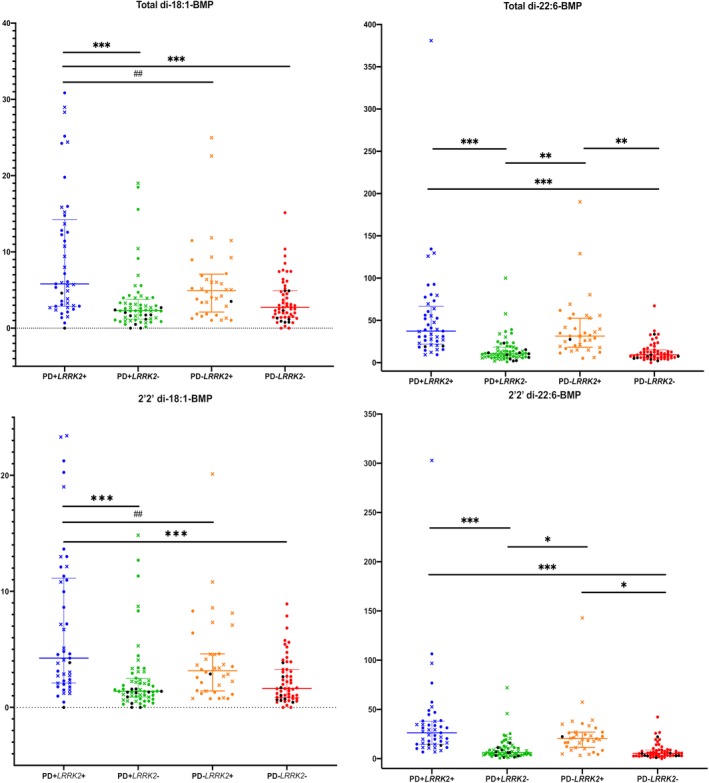
Ultra-performance liquid chromatography-tandem mass spectrometry (UPLC-MS/MS) was used to assess 54 bioactive phospholipids in urine from the LRRK2 Cohort Consortium (n = 80). To confirm and extend the findings, urine from an independent LRRK2 cohort from Columbia University Irving Medical Center (n = 116) was used. Both cohorts were composed of LRRK2 G2019S carriers and non-carriers with and without PD.
In each cohort, 4 bis(monoacylglycerol)phosphate isoforms (di-18:1-bis[monoacylglycerol]phosphate, didocohexaenoyl [22:6] bis[monoacylglycerol] phosphate, 2,2'-di-22:6-bis[monoacylglycerol]phosphate, and 2,2'-di-18:1-bis[monoacylglycerol]phosphate) were significantly higher (2.5- to 4.3-fold) in G2019S carriers compared with non-carriers. Interestingly, 2,2'-di-18:1-bis(monoacylglycerol)phosphate levels were marginally higher in LRRK2 carriers with PD than in those without PD (P = 0.045). Moreover, increased 2,2' and total di-22:6-bis(monoacylglycerol)phosphate were associated with worse cognitive status assessed by the Montreal Cognitive Assessment (P = 0.0033 and 0.0144, respectively).
The observed association of bis(monoacylglycerol)phosphate isoforms with LRRK2 G2019S mutation, PD status among G2019S carriers, and correlation with cognitive decline suggest the potential use of urinary bis(monoacylglycerol)phosphate isoforms as biomarkers for clinical trials of LRRK2-targeted therapies. © 2019 The Authors. Movement Disorders published by Wiley Periodicals, Inc. on behalf of International Parkinson and Movement Disorder Society.
LRRK2 突变是一种常见的显性遗传性 PD 致病原因。先前的研究表明,LRRK2 基因敲除小鼠和用 LRRK2 激酶抑制剂处理的非人类灵长类动物尿液中二十二碳六烯酰基(22:6)双(单酰基甘油)磷酸酯的水平降低。我们假设,具有 PD 致病获得性功能突变(LRRK2 G2019S)的个体尿液中双(单酰基甘油)磷酸酯同型物的水平会更高。本研究旨在探讨尿磷脂作为 LRRK2 突变和帕金森病状态/表型的生物标志物的变化。
使用超高效液相色谱-串联质谱(UPLC-MS/MS)分析来自 LRRK2 队列联盟(n=80)的尿液中的 54 种生物活性磷脂。为了确认和扩展研究结果,使用来自哥伦比亚大学欧文医学中心的独立 LRRK2 队列的尿液(n=116)进行了研究。两个队列均由 LRRK2 G2019S 携带者和非携带者组成,包括有无 PD。
在每个队列中,4 种双(单酰基甘油)磷酸酯同型物(二-18:1-双[单酰基甘油]磷酸酯、二十二碳六烯酰基[22:6]双[单酰基甘油]磷酸酯、2,2'-二-22:6-双[单酰基甘油]磷酸酯和 2,2'-二-18:1-双[单酰基甘油]磷酸酯)在 G2019S 携带者中的水平显著升高(2.5-4.3 倍)与非携带者相比。有趣的是,与无 PD 的 LRRK2 携带者相比,LRRK2 携带者中 PD 患者的 2,2'-二-18:1-双(单酰基甘油)磷酸酯水平略有升高(P=0.045)。此外,2,2'-和总二-22:6-双(单酰基甘油)磷酸酯的增加与蒙特利尔认知评估(MoCA)评估的认知状态较差相关(P=0.0033 和 0.0144)。
观察到双(单酰基甘油)磷酸酯同型物与 LRRK2 G2019S 突变、G2019S 携带者中的 PD 状态以及与认知能力下降的相关性提示,尿双(单酰基甘油)磷酸酯同型物可能作为 LRRK2 靶向治疗临床试验的生物标志物。© 2019 作者。运动障碍由 Wiley 期刊出版公司代表国际帕金森病和运动障碍协会出版。