Wang Junjuan, Xue Jiao, Gong Pan, Wu Minhang, Yang Wenshuang, Jiang Shiju, Wu Ye, Jiang Yuwu, Zhang Yuehua, Yuzyuk Tatiana, Li Hong, Yang Zhixian
Department of Epidemiology & Bio-Statistics, Zhejiang University School of Public Health, Zhejiang, China.
Zhejiang Biosan Biochemical Technologies Co., Ltd., Zhejiang, China.
Front Pediatr. 2019 Aug 26;7:337. doi: 10.3389/fped.2019.00337. eCollection 2019.
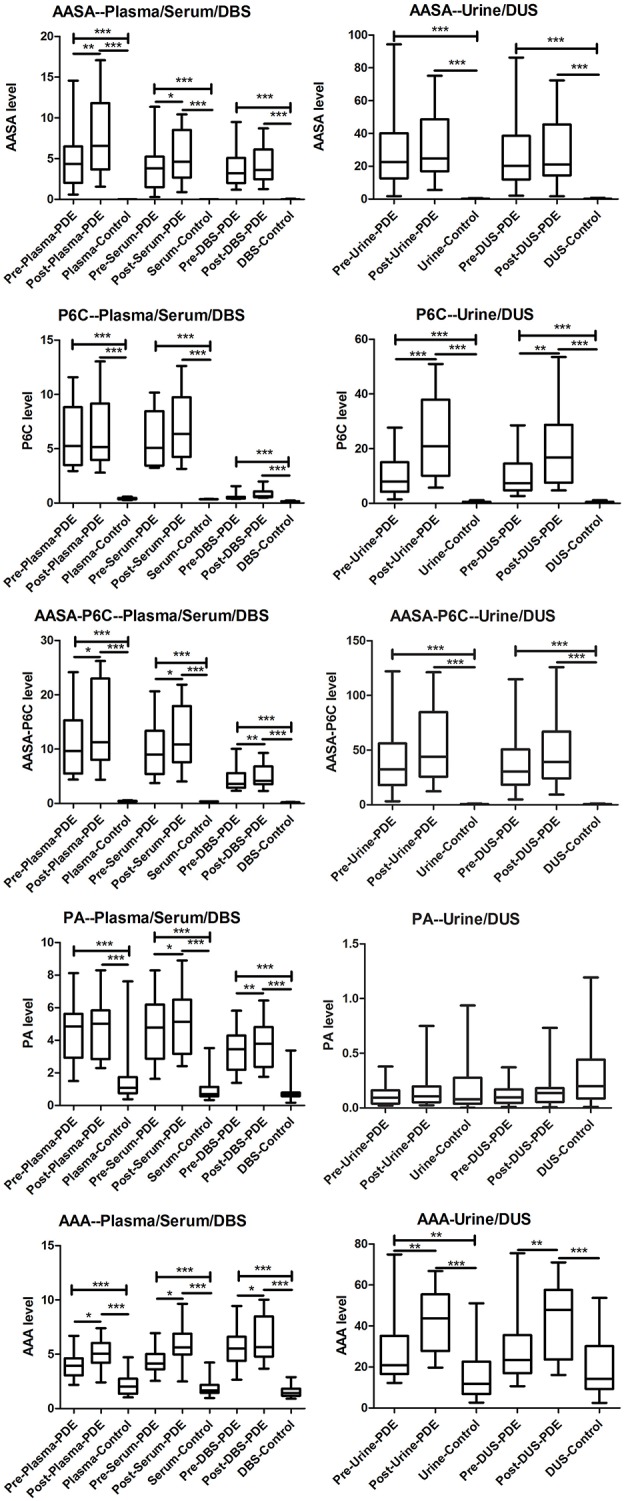
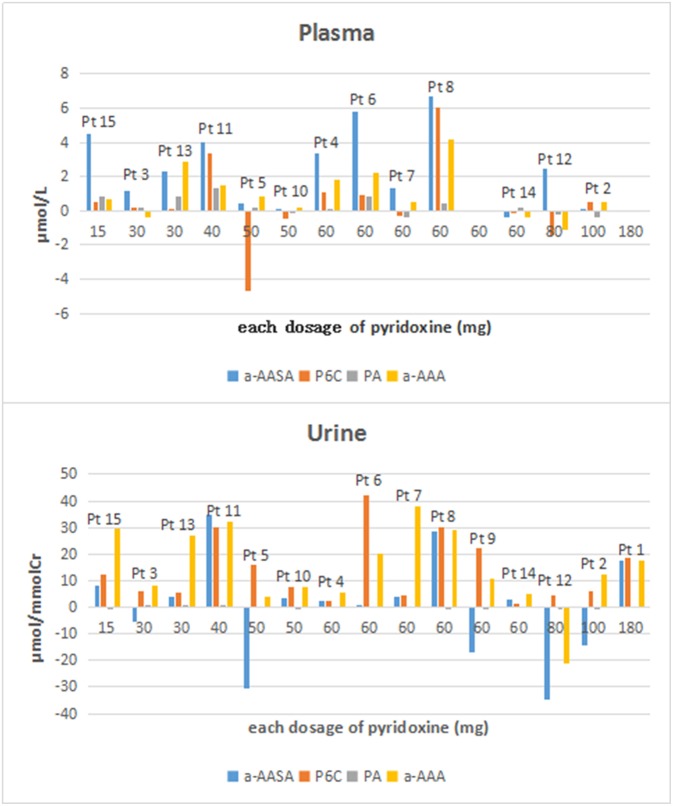
To evaluate the effects of a single oral dose of pyridoxine on lysine metabolites including α-aminoadipic semialdehyde (a-AASA), piperideine-6-carboxylate (P6C), the sum of AASA and P6C (AASA-P6C), pipecolic acid (PA), and α-aminoadipic acid (α-AAA) in PDE patients. The lysine metabolites of 15 patients with molecularly confirmed PDE were detected before and 4 h after taking a single oral dose of pyridoxine, respectively, using liquid chromatography-mass spectrometry (LC-MS/MS) method. Five types of samples were freshly prepared, including plasma, serum, dried blood spots (DBS), urine, and dried urine spots (DUS). All the patients had been treated with long-term oral pyridoxine for several months to years, with doses of 30-360 mg/d. The concentrations of a-AASA, P6C, AASA-P6C, PA, and a-AAA before and after taking a single oral dose of pyridoxine for the same analyte detected in the same type of sample varied among patients. The mean concentrations increased in almost all the metabolites after taking an oral dose of pyridoxine, with or without statistical significance. Whereas, the metabolites concentrations might increase or decrease among different patients, or in different samples of the same patient, without a regular tendency. There was no statistical correlation between the concentrations before and after taking pyridoxine in the same type of sample for most metabolites. No obvious relationship between the metabolite levels or concentration differences and the age, pyridoxine dose (a single oral dose and long-term maintenance dose), duration of treatment, or neurodevelopmental phenotype was found at present study. The large individual differences among patients, probably affected by various genotypes, leading to quite different effects of pyridoxine on the change degree of metabolites concentrations. Our study suggested that long-term pyridoxine treatment could control seizures rather than getting toxic lysine metabolites such as a-AASA and P6C back to normal. In the future, more therapies should be focused to alleviate the metabolites accumulation and further improve the prognosis of PDE.
评估单次口服吡哆醇对磷酸吡哆醛缺乏症(PDE)患者赖氨酸代谢产物的影响,这些代谢产物包括α-氨基己二酸半醛(a-AASA)、哌啶酸-6-羧酸(P6C)、AASA与P6C之和(AASA-P6C)、哌可酸(PA)以及α-氨基己二酸(α-AAA)。分别在15例经分子确诊为PDE的患者单次口服吡哆醇前及服药后4小时,采用液相色谱-质谱联用(LC-MS/MS)法检测其赖氨酸代谢产物。新鲜制备了五种类型的样本,包括血浆、血清、干血斑(DBS)、尿液和干尿斑(DUS)。所有患者均长期口服吡哆醇数月至数年,剂量为30 - 360mg/d。在同一类型样本中检测到的同一分析物在单次口服吡哆醇前后,不同患者的a-AASA、P6C、AASA-P6C、PA和a-AAA浓度各不相同。几乎所有代谢产物在口服吡哆醇后平均浓度都有所升高,无论是否具有统计学意义。然而,不同患者之间或同一患者的不同样本中,代谢产物浓度可能升高或降低,无规律趋势。对于大多数代谢产物,同一类型样本中服用吡哆醇前后的浓度之间无统计学相关性。在本研究中,未发现代谢产物水平或浓度差异与年龄、吡哆醇剂量(单次口服剂量和长期维持剂量)、治疗持续时间或神经发育表型之间存在明显关系。患者之间存在较大个体差异,可能受多种基因型影响,导致吡哆醇对代谢产物浓度变化程度的影响差异很大。我们的研究表明,长期吡哆醇治疗可控制癫痫发作,而非使毒性赖氨酸代谢产物如a-AASA和P6C恢复正常。未来,应更注重采取更多疗法来减轻代谢产物蓄积并进一步改善PDE的预后。