Carlsen Katrine, Hald Mette, Dubinsky Marla C, Keefer Laurie, Wewer Vibeke
Department of Pediatrics, Hvidovre University Hospital, Hvidovre, Denmark.
Division of Pediatric Gastroenterology and Hepatology, Susan and Leonard Feinstein IBD Center, Icahn School of Medicine at Mount Sinai Hospital, New York, NY, United States.
JMIR Pediatr Parent. 2019 Apr 24;2(1):e12258. doi: 10.2196/12258.
Transfer from pediatric to adult care is a crucial period for adolescents with inflammatory bowel disease (IBD).
Our aim was to develop a personalized transition-transfer concept including relevant tools in an established eHealth (electronic health) program.
Required transition skills and validated patient-reported outcome measures (PROMs) were identified via bibliographic search and clinical experience and were implemented into an existing eHealth program.
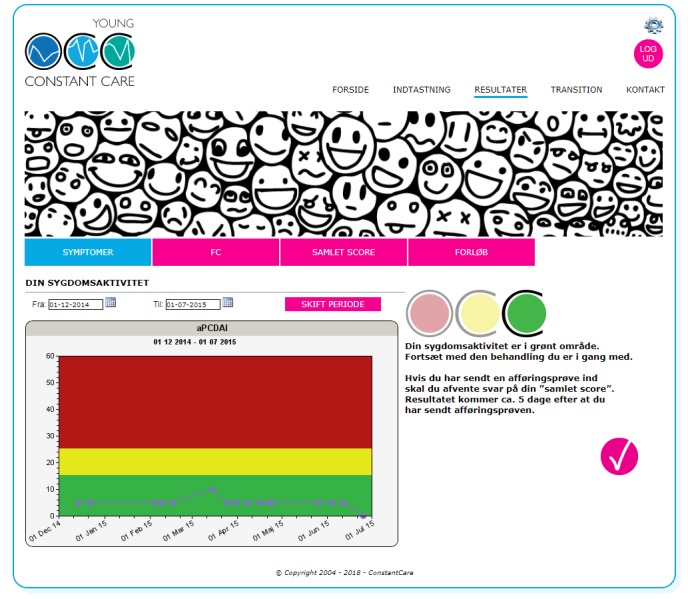
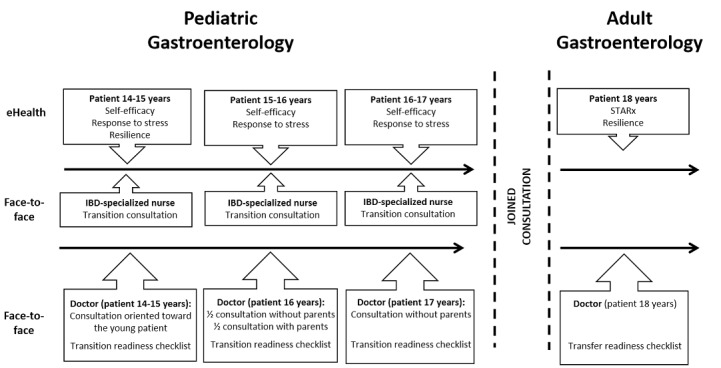
The following skills were identified: disease knowledge, social life, disease management, and making well-informed, health-related decisions. The PROMs included the following: self-efficacy (the IBD Self-Efficacy Scale-Adolescents), resilience (the 10-item Connor-Davidson Resilience Scale), response to stress (the Child Self-Report Responses to Stress-IBD), and self-management and health care transition skills (the Self-Management and Transition to Adulthood with Treatment questionnaire). Starting at age 14, the patient will be offered a 1-hour annual transition consultation with an IBD-specialized nurse. The consultation will be based on the results of the PROMs and will focus on the patient's difficulties. Patients will complete the PROMs on the eHealth program at home, allowing nurses and patients to prepare for the meeting. Symptom scores and medication will be filled out on the eHealth program to support disease self-management. The consultation will be a topic-centered dialogue with practical exercises. During routine outpatient visits with the provider, parents will be left out of half of the consultation when the patient is 16 years old; at 17 years old, the parents will not be present. At the transfer consultation, the pediatric provider, the adult gastroenterologist, the pediatric nurse, the patient, and the parents will be present to ensure a proper transfer.
We have conducted a personalized eHealth transition concept consisting of basic elements that measure, train, and monitor the patients' transition readiness. The concept can be implemented and adjusted to local conditions.
从儿科护理过渡到成人护理对患有炎症性肠病(IBD)的青少年来说是一个关键时期。
我们的目标是在一个既定的电子健康(eHealth)项目中开发一个个性化的过渡转移概念,包括相关工具。
通过文献检索和临床经验确定所需的过渡技能和经过验证的患者报告结局指标(PROMs),并将其纳入现有的电子健康项目。
确定了以下技能:疾病知识、社交生活、疾病管理以及做出明智的、与健康相关的决策。PROMs包括以下内容:自我效能感(IBD青少年自我效能量表)、心理韧性(10项Connor-Davidson心理韧性量表)、对压力的反应(儿童自我报告的IBD压力反应)以及自我管理和医疗保健过渡技能(自我管理与治疗成人过渡问卷)。从14岁开始,患者将每年接受一次由IBD专科护士提供的为期1小时的过渡咨询。咨询将基于PROMs的结果,并将聚焦于患者的困难。患者将在家中通过电子健康项目完成PROMs,以便护士和患者为会面做准备。症状评分和用药情况将在电子健康项目上填写,以支持疾病自我管理。咨询将是以主题为中心的对话并伴有实践练习。在与医疗服务提供者的常规门诊就诊期间,当患者16岁时,家长将在一半的咨询中离场;17岁时,家长将不再出席。在转诊咨询时,儿科医疗服务提供者、成人胃肠病学家、儿科护士、患者和家长都将到场,以确保顺利转诊。
我们开展了一个个性化的电子健康过渡概念,其包含测量、培训和监测患者过渡准备情况的基本要素。该概念可以实施并根据当地情况进行调整。