Department of Obstetrics, Gynecology and Reproductive Sciences, University of California, San Diego, 9500 Gilman Drive, La Jolla, CA, 92093-0674, USA.
Department of Obstetrics, Gynecology and Reproductive Sciences, University of California, San Diego, 9500 Gilman Drive, La Jolla, CA, 92093-0674, USA.
Mol Cell Endocrinol. 2019 Dec 1;498:110579. doi: 10.1016/j.mce.2019.110579. Epub 2019 Sep 12.
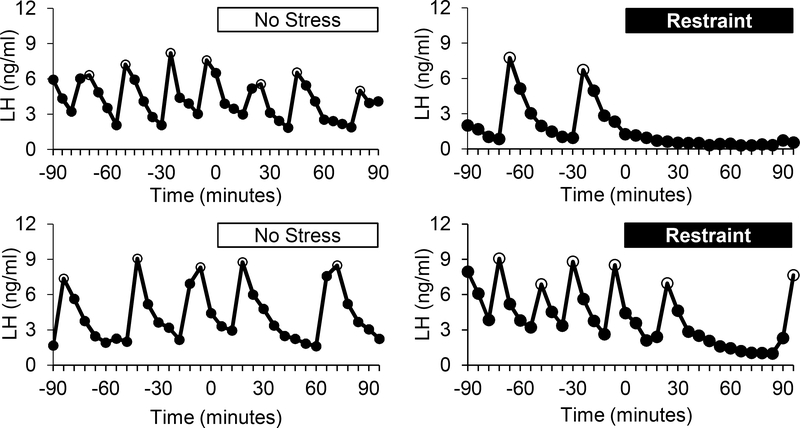
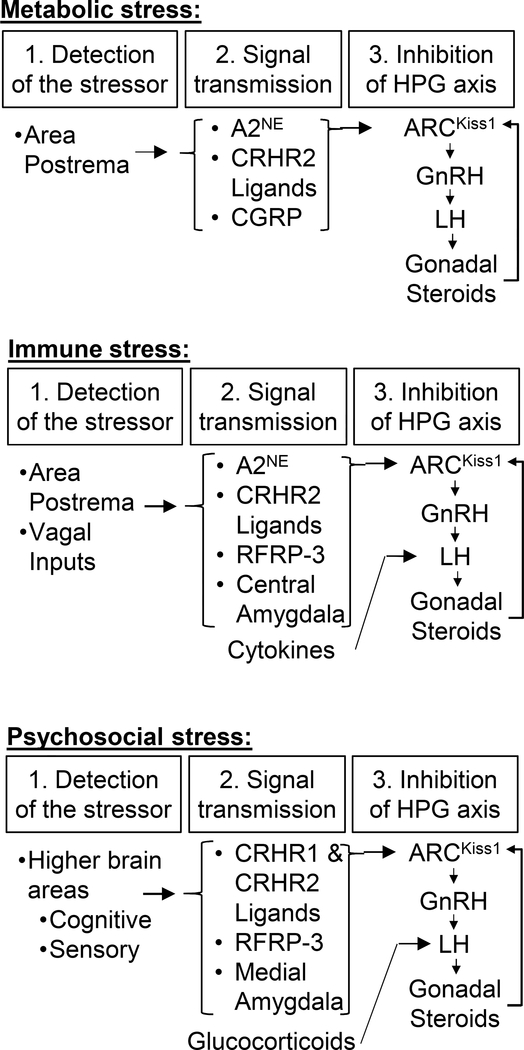
Stress is well-known to inhibit a variety of reproductive processes, including the suppression of episodic Gonadotropin releasing hormone (GnRH) secretion, typically measured via downstream luteinizing hormone (LH) secretion. Since pulsatile secretion of GnRH and LH are necessary for proper reproductive function in both males and females, and stress is common for both human and animals, understanding the fundamental mechanisms by which stress impairs LH pulses is of critical importance. Activation of the hypothalamic-pituitary-adrenal axis, and its corresponding endocrine factors, is a key feature of the stress response, so dissecting the role of stress hormones, including corticotrophin releasing hormone (CRH) and corticosterone, in the inhibition of LH secretion has been one key research focus. However, some evidence suggests that these stress hormones alone are not sufficient for the full inhibition of LH caused by stress, implicating the additional involvement of other hormonal or neural signaling pathways in this process (including inputs from the brainstem, amygdala, parabrachial nucleus, and dorsomedial nucleus). Moreover, different stress types, such as metabolic stress (hypoglycemia), immune stress, and psychosocial stress, appear to suppress LH secretion via partially unique neural and endocrine pathways. The mechanisms underlying the suppression of LH pulses in these models offer interesting comparisons and contrasts, including the specific roles of amygdaloid nuclei and CRH receptor types. This review focuses on the most recent and emerging insights into endocrine and neural mechanisms responsible for the suppression of pulsatile LH secretion in mammals, and offers insights in important gaps in knowledge.
压力众所周知会抑制各种生殖过程,包括抑制间歇性促性腺激素释放激素(GnRH)的分泌,通常通过下游黄体生成素(LH)的分泌来衡量。由于 GnRH 和 LH 的脉冲分泌对于男性和女性的正常生殖功能都是必要的,而且压力在人类和动物中都很常见,因此了解压力损害 LH 脉冲的基本机制至关重要。下丘脑-垂体-肾上腺轴的激活及其相应的内分泌因素是应激反应的一个关键特征,因此,剖析应激激素(包括促肾上腺皮质释放激素(CRH)和皮质酮)在抑制 LH 分泌中的作用一直是一个关键的研究重点。然而,一些证据表明,这些应激激素本身不足以完全抑制应激引起的 LH 抑制,这表明在这个过程中还涉及其他激素或神经信号通路(包括来自脑干、杏仁核、臂旁核和背内侧核的输入)。此外,不同类型的应激,如代谢应激(低血糖)、免疫应激和心理社会应激,似乎通过部分独特的神经和内分泌途径抑制 LH 分泌。这些模型中 LH 脉冲抑制的机制提供了有趣的比较和对比,包括杏仁核核和 CRH 受体类型的特定作用。这篇综述重点介绍了最近和新兴的关于哺乳动物中负责抑制脉冲 LH 分泌的内分泌和神经机制的见解,并提供了知识空白的重要见解。