Yang Kailun, Kas Recep, Smith Wilson A
Materials for Energy Conversion and Storage (MECS), Department of Chemical Engineering , Delft University of Technology , 2629 HZ Delft , The Netherlands.
J Am Chem Soc. 2019 Oct 9;141(40):15891-15900. doi: 10.1021/jacs.9b07000. Epub 2019 Sep 30.
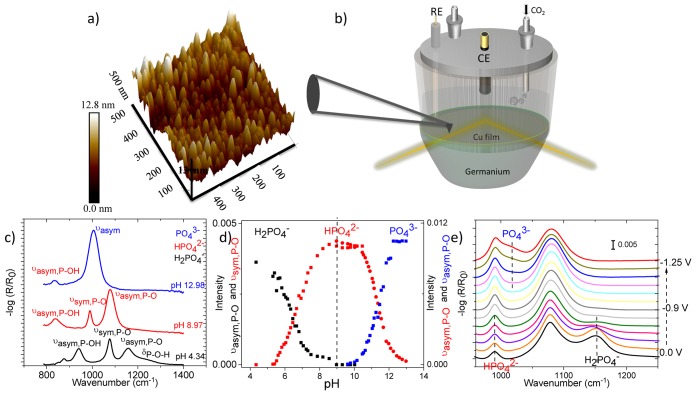
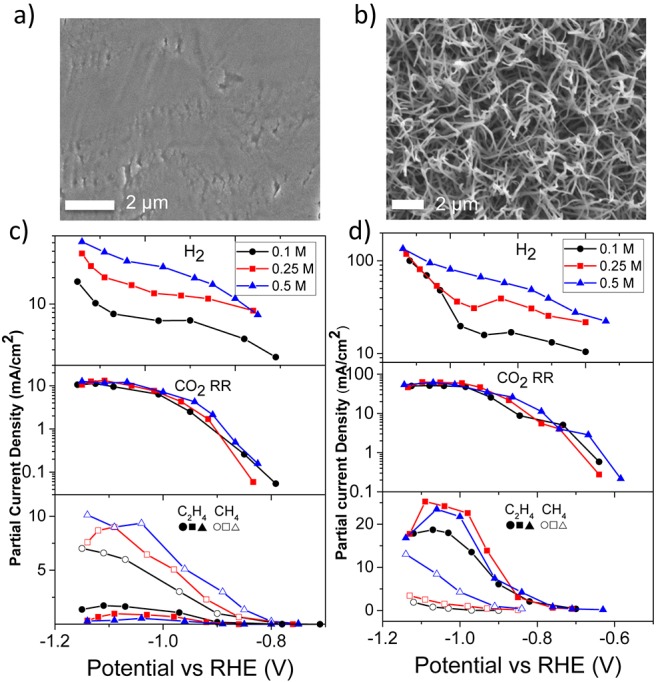
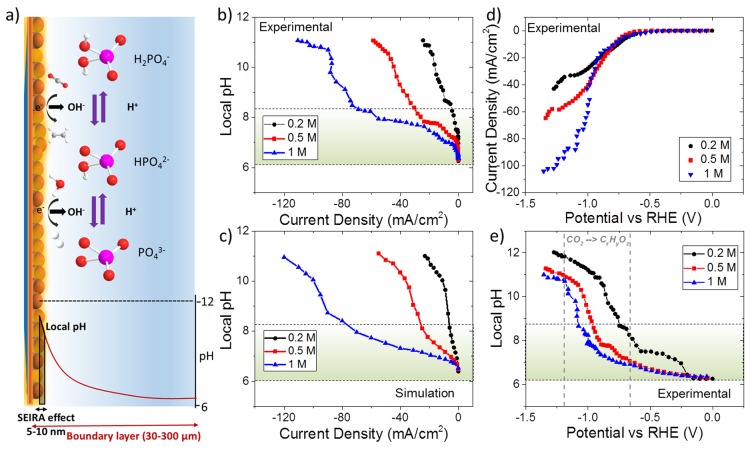
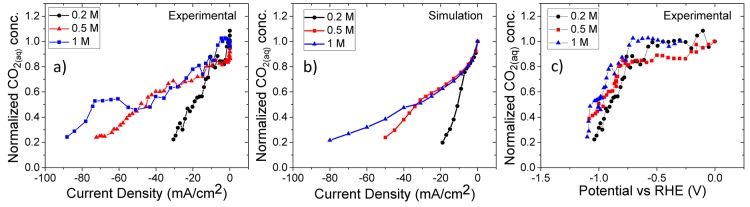
Over the past decade, electrochemical carbon dioxide reduction has become a thriving area of research with the aim of converting electricity to renewable chemicals and fuels. Recent advances through catalyst development have significantly improved selectivity and activity. However, drawing potential dependent structure-activity relationships has been complicated, not only due to the ill-defined and intricate morphological and mesoscopic structure of electrocatalysts, but also by immense concentration gradients existing between the electrode surface and bulk solution. In this work, by using in situ surface enhanced infrared absorption spectroscopy (SEIRAS) and computational modeling, we explicitly show that commonly used strong phosphate buffers cannot sustain the interfacial pH during CO electroreduction on copper electrodes at relatively low current densities, <10 mA/cm. The pH near the electrode surface was observed to be as much as 5 pH units higher compared to bulk solution in 0.2 M phosphate buffer at potentials relevant to the formation of hydrocarbons (-1 V vs RHE), even on smooth polycrystalline copper electrodes. Drastically increasing the buffer capacity did not stand out as a viable solution for the problem as the concurrent production of hydrogen increased dramatically, which resulted in a breakdown of the buffer in a narrow potential range. These unforeseen results imply that most of the studies, if not all, on electrochemical CO reduction to hydrocarbons in CO saturated aqueous solutions were evaluated under mass transport limitations on copper electrodes. We underscore that the large concentration gradients on electrodes with high local current density (e.g., nanostructured) have important implications on the selectivity, activity, and kinetic analysis, and any attempt to draw structure-activity relationships must rule out mass transport effects.
在过去十年中,电化学二氧化碳还原已成为一个蓬勃发展的研究领域,旨在将电能转化为可再生化学品和燃料。通过催化剂开发取得的最新进展显著提高了选择性和活性。然而,绘制电位依赖的结构-活性关系一直很复杂,这不仅是由于电催化剂的形态和介观结构不明确且复杂,还因为电极表面和本体溶液之间存在巨大的浓度梯度。在这项工作中,通过使用原位表面增强红外吸收光谱(SEIRAS)和计算建模,我们明确表明,在相对较低的电流密度(<10 mA/cm²)下,常用的强磷酸盐缓冲液在铜电极上进行CO电还原时无法维持界面pH值。在与烃类形成相关的电位(相对于可逆氢电极,-1 V)下,即使在光滑的多晶铜电极上,在0.2 M磷酸盐缓冲液中,观察到电极表面附近的pH值比本体溶液高多达5个pH单位。大幅提高缓冲容量并不是解决该问题的可行方案,因为同时产生的氢气急剧增加,导致缓冲液在狭窄的电位范围内分解。这些意外结果表明,大多数(如果不是全部)在CO饱和水溶液中电化学CO还原为烃类的研究是在铜电极上的传质限制条件下进行评估的。我们强调,具有高局部电流密度(例如,纳米结构)的电极上的大浓度梯度对选择性、活性和动力学分析具有重要影响,并且任何绘制结构-活性关系的尝试都必须排除传质效应。