Guo Tao, Liu Pengpeng, Yang Jian, Wu Ping, Chen Baiyang, Liu Zhisu, Li Zhen
Department of Hepatobiliary and Pancreatic Surgery, Department of General Surgery, Zhongnan Hospital of Wuhan University, Wuhan 430071, P.R. China.
School of Nursing, Huanggang Polytechnic College, Huanggang, 438002, P.R. China.
J Cancer. 2019 Aug 19;10(19):4671-4678. doi: 10.7150/jca.32828. eCollection 2019.
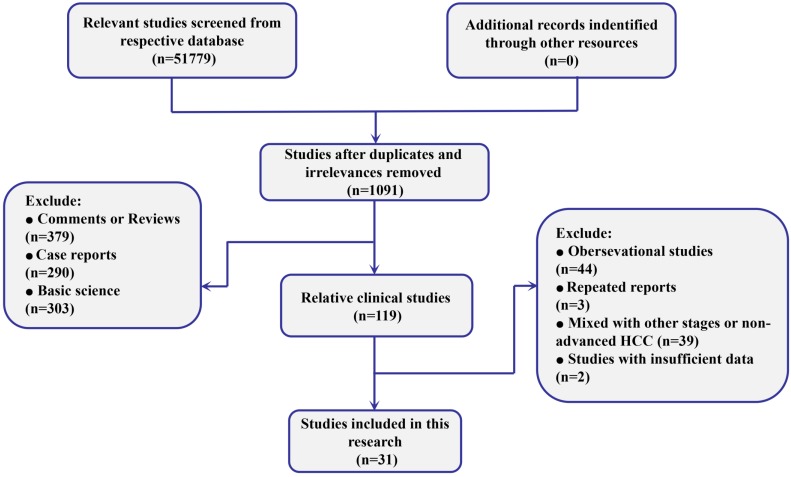
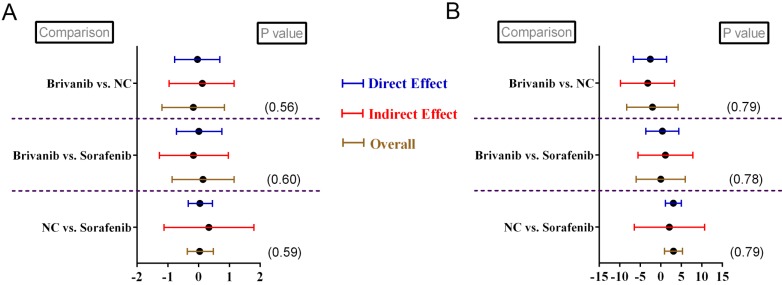
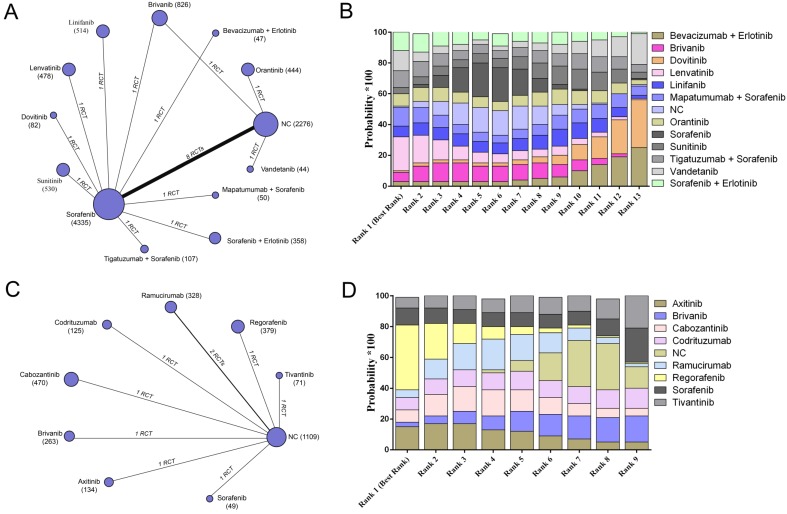
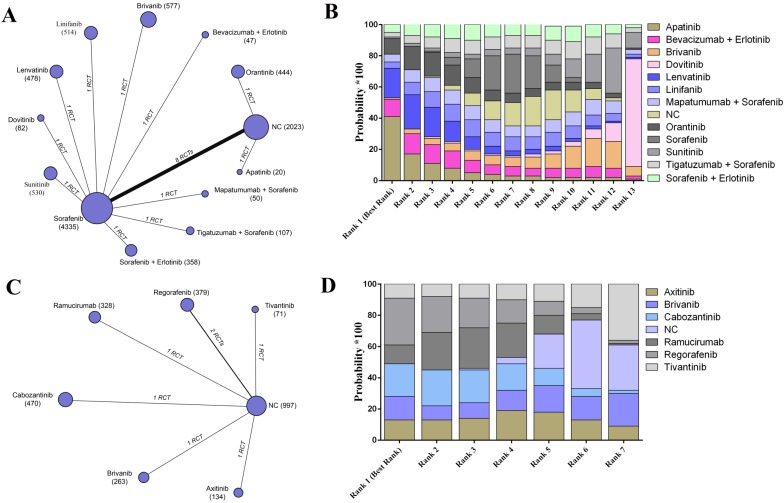
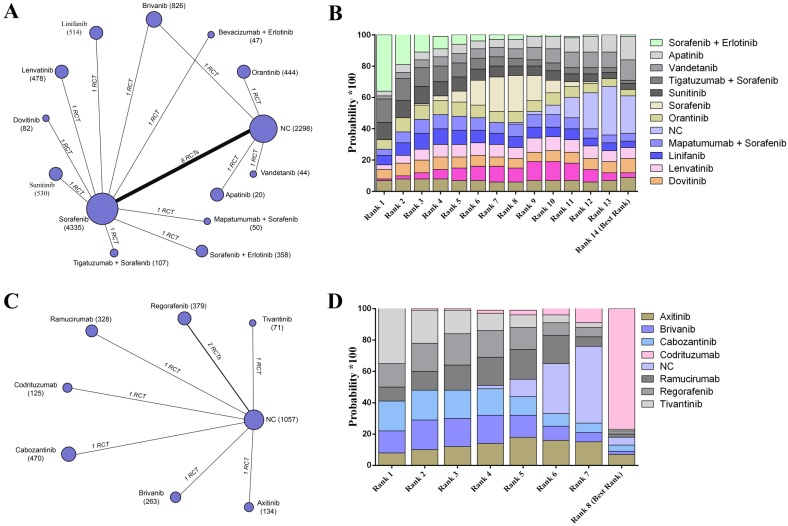
To evaluate different targeted anticancer agents for patients with advanced or unresectable hepatocellular carcinoma (HCC) based on network meta-analysis. Literature retrieval was conducted in globally recognized databases, namely, MEDLINE, PMC, EMBASE and Cochrane Central to find relevant randomized controlled trials (RCTs). Relative parametric data, including overall survival (OS), progression-free survival (PFS) and adverse event (AE), were quantitatively pooled and estimated based on the Bayesian theorem. The values of the surface under the cumulative ranking (SUCRA) probabilities regarding each parameter were calculated and ranked. Node-splitting analysis was performed to test the inconsistency of the main results, and publication bias was assessed by examining funnel-plot symmetry. After a detailed review, 31 RCTs containing 20 different agents or combinations were finally included for network meta-analysis. For patients without previously systematic treatments, lenvatinib had the best clinical effects on OS (SUCRA, 0.22), and apatinib was superior regarding PFS (SUCRA, 0.41) and AE (SUCRA, 0.15). For patients who received previously targeted agents therapies, regorafenib exhibited the superior clinical effects on OS (SUCRA, 0.42) and PFS (SUCRA, 0.30), while codrituzumab showed the greatest safety benefit on AE (SUCRA, 0.75). Moreover, node-splitting analysis and funnel-plot symmetries illustrated no inconsistency or obvious publication bias in the current study. According to current evidence, lenvatinib and apatinib had superior clinical effects for patients without previously systematic treatments, and regorafenib seemed to be more suitable for patients with previously targeted agent therapies. However, our conclusions still need more statistical validations, and more high-quality trials are expected.
基于网络荟萃分析评估不同的靶向抗癌药物用于晚期或不可切除肝细胞癌(HCC)患者的疗效。在全球公认的数据库,即MEDLINE、PMC、EMBASE和Cochrane Central中进行文献检索,以查找相关的随机对照试验(RCT)。基于贝叶斯定理对包括总生存期(OS)、无进展生存期(PFS)和不良事件(AE)在内的相对参数数据进行定量汇总和估计。计算并排列每个参数的累积排名曲线下面积(SUCRA)概率值。进行节点拆分分析以检验主要结果的不一致性,并通过检查漏斗图对称性评估发表偏倚。经过详细审查,最终纳入31项包含20种不同药物或联合用药的RCT进行网络荟萃分析。对于未接受过先前系统治疗的患者,乐伐替尼对OS的临床效果最佳(SUCRA,0.22),而阿帕替尼在PFS(SUCRA,0.41)和AE(SUCRA,0.15)方面更具优势。对于先前接受过靶向药物治疗的患者,瑞戈非尼在OS(SUCRA,0.42)和PFS(SUCRA,0.30)方面表现出更优的临床效果,而考地珠单抗在AE方面显示出最大的安全性优势(SUCRA,0.75)。此外,节点拆分分析和漏斗图对称性表明本研究中不存在不一致性或明显的发表偏倚。根据目前的证据,乐伐替尼和阿帕替尼对未接受过先前系统治疗的患者具有更优的临床效果,而瑞戈非尼似乎更适合先前接受过靶向药物治疗的患者。然而,我们的结论仍需要更多的统计学验证,期待更多高质量的试验。