Lowe Marcus, Maidstone Robert, Poulton Kay, Worthington Judith, Durrington Hannah J, Ray David W, van Dellen David, Asderakis Argiris, Blaikley John, Augustine Titus
Transplantation Laboratory, Manchester University NHS Foundation Trust, Manchester, UK.
Faculty of Biology, Medicine and Health, University of Manchester, Manchester, UK.
BMJ Open. 2019 Sep 17;9(9):e028786. doi: 10.1136/bmjopen-2018-028786.
To identify whether renal transplant activity varies in a reproducible manner across the year.
Retrospective cohort study using NHS Blood and Transplant data.
All renal transplant centres in the UK.
A total of 24 270 patients who underwent renal transplantation between 2005 and 2014.
Monthly transplant activity was analysed to see if transplant activity showed variation during the year.
The number of organs rejected due to healthcare capacity was analysed to see if this affected transplantation rates.
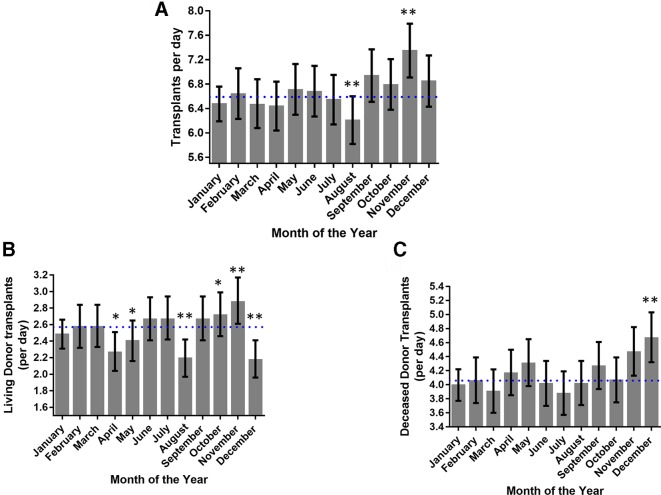
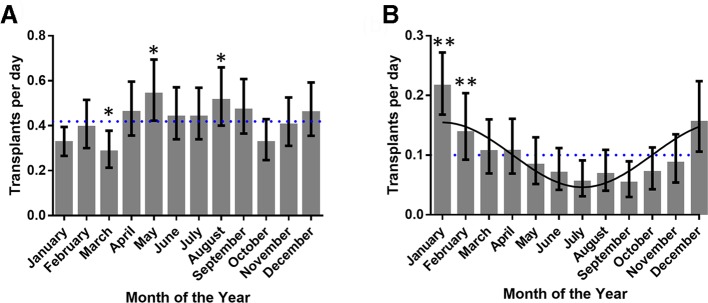
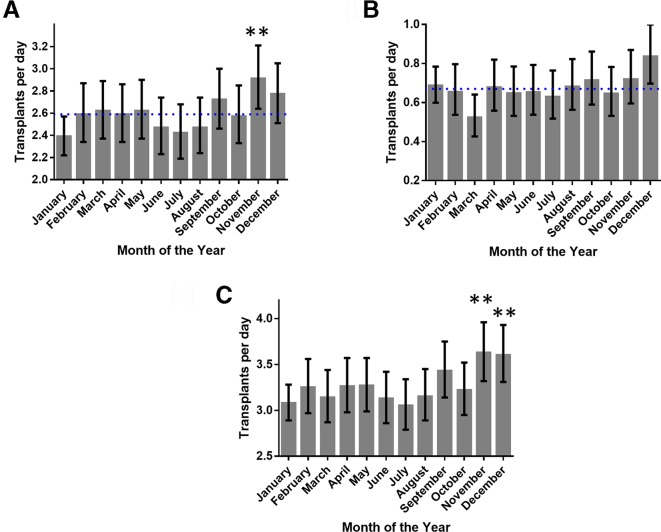
Analysis of national transplant data revealed a reproducible yearly variance in transplant activity. This activity increased in late autumn and early winter (p=0.05) and could be attributed to increased rates of living (October and November) and deceased organ donation (November and December). An increase in deceased donation was attributed to a rise in donors following cerebrovascular accidents and hypoxic brain injury. Other causes of death (infections and road traffic accidents) were more seasonal in nature peaking in the winter or summer, respectively. Only 1.4% of transplants to intended recipients were redirected due to a lack of healthcare capacity, suggesting that capacity pressures in the National Health Service did not significantly affect transplant activity.
UK renal transplant activity peaks in late autumn/winter in contrast to other countries. Currently, healthcare capacity, though under strain, does not affect transplant activity; however, this may change if transplantation activity increases in line with national strategies as the spike in transplant activity coincides with peak activity in the national healthcare system.
确定肾脏移植活动在一年中是否以可重复的方式变化。
使用英国国民医疗服务体系血液与移植数据进行的回顾性队列研究。
英国所有肾脏移植中心。
2005年至2014年间共24270例接受肾脏移植的患者。
分析每月的移植活动,以观察移植活动在一年中是否有变化。
分析因医疗能力不足而被拒绝的器官数量,以观察这是否影响移植率。
对全国移植数据的分析显示,移植活动存在可重复的年度差异。这种活动在秋末和初冬增加(p=0.05),这可归因于活体捐赠率(10月和11月)和尸体器官捐赠率(11月和12月)的增加。尸体捐赠的增加归因于脑血管意外和缺氧性脑损伤后捐赠者数量的增加。其他死因(感染和道路交通事故)在性质上更具季节性,分别在冬季或夏季达到高峰。由于医疗能力不足,只有1.4%的移植手术被重新安排给其他预期受者,这表明国民医疗服务体系的能力压力并未显著影响移植活动。
与其他国家不同,英国肾脏移植活动在秋末/冬季达到高峰。目前,医疗能力虽然紧张,但并不影响移植活动;然而,如果移植活动按照国家战略增加,这种情况可能会改变,因为移植活动的激增与国家医疗系统的高峰活动相吻合。