Division of Cardiology, Department of Pediatrics, Heart Institute, Children's Hospital Colorado, University of Colorado Denver, Anschutz Medical Campus, Aurora, CO, USA.
Department of Radiology, Children's Hospital Colorado, University of Colorado Denver, Anschutz Medical Campus, Aurora, CO, USA.
Eur J Cardiothorac Surg. 2020 Mar 1;57(3):588-595. doi: 10.1093/ejcts/ezz246.
Aortopathy in tetralogy of Fallot (TOF) is characterized by increased aortic stiffness, dilation and reduced left ventricular (LV) function. Repair in infancy normalizes aortic dimensions in early childhood. Our prior work demonstrated that early TOF repair does not normalize aortic compliance and that abnormal ascending aortic flow patterns are prevalent. The objectives of this study were to: (i) determine whether proximal aortic flow-mediated viscous energy loss (EL') is elevated in patients with early TOF repair compared with healthy controls, and (ii) determine whether the degree of EL' is associated with LV function.
Forty-one patients post TOF repair with normalized aortic size and 15 healthy controls underwent 4-dimenisonal-flow magnetic resonance imaging flow analysis and EL' assessment. Correlations between EL', aortic size, and LV function were assessed.
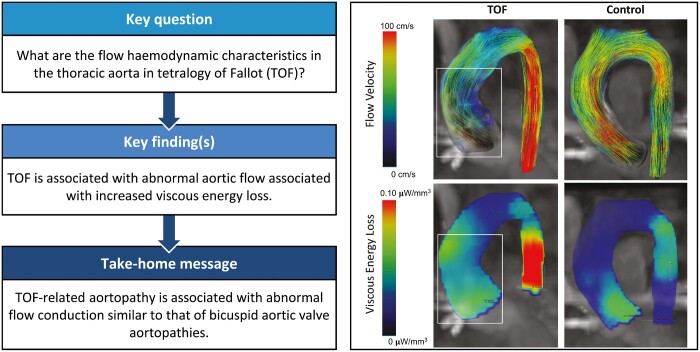
The TOF group had increased peak systolic thoracic aorta EL' (3.8 vs 1.5 mW, P = 0.004) and increased averaged EL' throughout the cardiac cycle (1.2 vs 0.5 mW, P = 0.003). Peak and mean systolic EL' in the ascending aorta was increased 2-fold in the TOF group compared with control (peak: 2.0 vs 0.9 mW, P = 0.007). Peak EL' measured along the entire thoracic aortic length correlated with LV ejection fraction (R = -0.45, P = 0.009), indexed LV end-systolic volume (R = -0.40, P = 0.010), and right ventricular end-systolic volume (R = -0.37, P = 0.034).
Patients with repaired TOF exhibit abnormal aortic flow associated with increased EL' in the thoracic aorta. The magnitude of EL' is associated with LV function and volumes. Increased aortic EL' in TOF is likely due to inherently abnormal LV outflow geometry and or right ventricular interaction. Reduced aortic flow efficiency in TOF increases cardiac work and may be an important factor in long-term cardiac performance.
法洛四联症(TOF)的主动脉病变表现为主动脉僵硬度增加、扩张和左心室(LV)功能降低。婴儿期的修复可使主动脉早期在幼儿期恢复正常。我们之前的工作表明,早期 TOF 修复并不能使主动脉顺应性正常化,并且异常的升主动脉血流模式很常见。本研究的目的是:(i)确定与健康对照组相比,早期 TOF 修复患者的近端主动脉血流介导的粘性能量损失(EL')是否升高,以及(ii)确定 EL'的程度是否与 LV 功能相关。
41 例 TOF 修复术后主动脉大小正常的患者和 15 例健康对照者接受了 4 维血流磁共振成像流量分析和 EL'评估。评估了 EL'与主动脉大小和 LV 功能之间的相关性。
TOF 组的胸主动脉收缩期峰值 EL'(3.8 比 1.5 mW,P=0.004)和整个心动周期的平均 EL'(1.2 比 0.5 mW,P=0.003)均升高。TOF 组的升主动脉峰值和平均 EL'比对照组高 2 倍(峰值:2.0 比 0.9 mW,P=0.007)。沿整个胸主动脉长度测量的峰值 EL'与 LV 射血分数(R=-0.45,P=0.009)、LV 收缩末期容积指数(R=-0.40,P=0.010)和右心室收缩末期容积(R=-0.37,P=0.034)相关。
修复后的 TOF 患者表现出异常的主动脉血流,与胸主动脉中增加的 EL'相关。EL'的大小与 LV 功能和容量有关。TOF 中主动脉 EL'的增加可能是由于 LV 流出道几何形状异常和/或右心室相互作用所致。TOF 中主动脉血流效率降低会增加心脏工作量,可能是长期心脏功能的重要因素。