BMJ Open. 2019 Sep 18;9(9):e029054. doi: 10.1136/bmjopen-2019-029054.
Following the treatment of patients with soft tissue sarcomas (STS) that are not metastatic at presentation, the high risk for local and systemic disease recurrence necessitates post-treatment surveillance. Systemic recurrence is most often detected in the lungs. The most appropriate surveillance frequency and modality remain unknown and, as such, clinical practice is highly varied. We plan to assess the feasibility of conducting a multi-centre randomised controlled trial (RCT) that will evaluate the effect on overall 5-year survival of two different surveillance frequencies and imaging modalities in patients with STS who undergo surgical excision with curative intent.
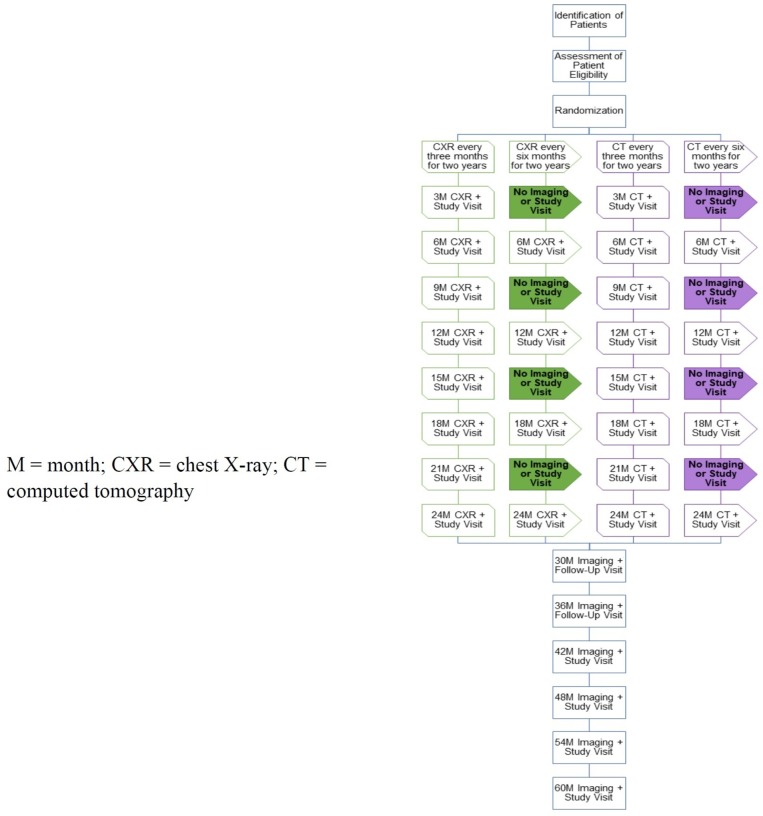
The Surveillance After Extremity Tumor Surgery trial will be a multi-centre 2×2 factorial RCT. Patients with non-metastatic primary Grade II or III STS treated with excision will be allocated to one of four treatment arms1: chest radiograph (CXR) every 3 months for 2 years2; CXR every 6 months for 2 years3; chest CT every 3 months for 2 years or4 chest CT every 6 months for 2 years. The primary outcome of the pilot study is the feasibility of a definitive RCT based on a combination of feasibility endpoints. Secondary outcomes for the pilot study include the primary outcome of the definitive trial (overall survival), patient-reported outcomes on anxiety, satisfaction and quality of life, local recurrence-free survival, metastasis-free survival, treatment-related complications and net healthcare costs related to surveillance.
This trial received provisional ethics approval from the McMaster/Hamilton Health Sciences Research Ethics Board on 7 August 2019 (Project number 7562). Final ethics approval will be obtained prior to commencing patient recruitment. Once feasibility has been established and the definitive protocol is finalised, the study will transition to the definitive study.
NCT03944798; Pre-results.
在对初诊时无转移的软组织肉瘤(STS)患者进行治疗后,局部和全身疾病复发的高风险使得治疗后监测成为必要。全身复发最常发生在肺部。最合适的监测频率和方式仍不明确,因此临床实践差异很大。我们计划评估开展一项多中心随机对照试验(RCT)的可行性,该试验将评估两种不同监测频率和成像方式对接受根治性手术切除的STS患者5年总生存率的影响。
肢体肿瘤手术后监测试验将是一项多中心2×2析因随机对照试验。接受切除治疗的非转移性原发性II级或III级STS患者将被分配到四个治疗组之一:1. 每3个月进行2年胸部X线摄影(CXR);2. 每6个月进行2年胸部X线摄影;3. 每3个月进行2年胸部CT;4. 每6个月进行2年胸部CT。初步研究的主要结局是基于可行性终点组合的确定性随机对照试验的可行性。初步研究的次要结局包括确定性试验的主要结局(总生存率)、患者报告的焦虑、满意度和生活质量结局、无局部复发生存率、无转移生存率、治疗相关并发症以及与监测相关的医疗费用净额。
本试验于2019年8月7日获得麦克马斯特/汉密尔顿健康科学研究伦理委员会的临时伦理批准(项目编号7562)。在开始招募患者之前将获得最终伦理批准。一旦确定了可行性并最终确定了确定性方案,该研究将过渡到确定性研究。
NCT03944798;预结果。