Radiochemistry and Nuclear Imaging Group, CIC biomaGUNE, 20014, San Sebastián, Guipúzcoa, Spain.
Achucarro Basque Center for Neuroscience, 48940, Leioa, Spain.
Sci Rep. 2019 Sep 20;9(1):13672. doi: 10.1038/s41598-019-50071-w.
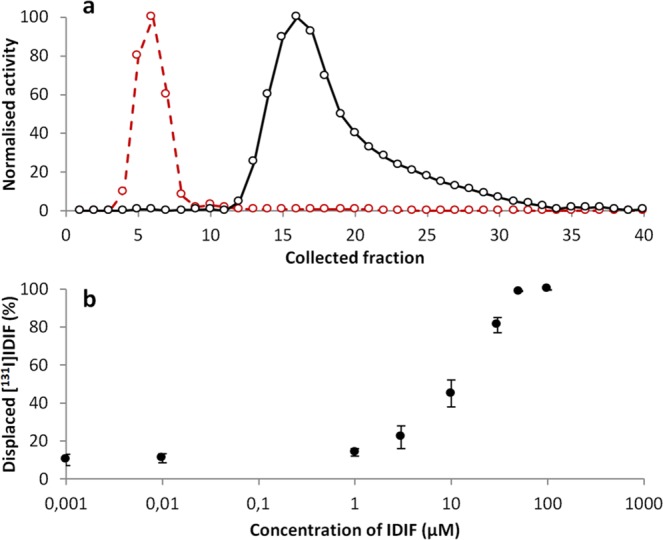
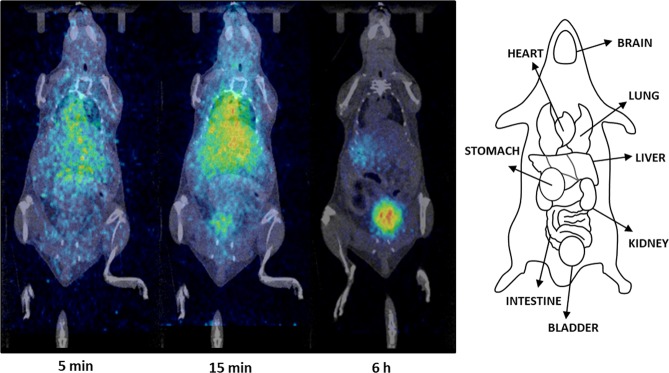
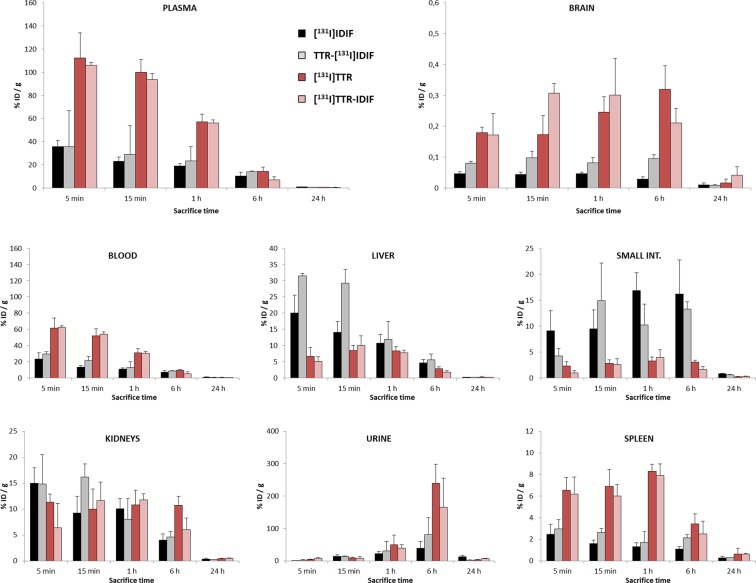
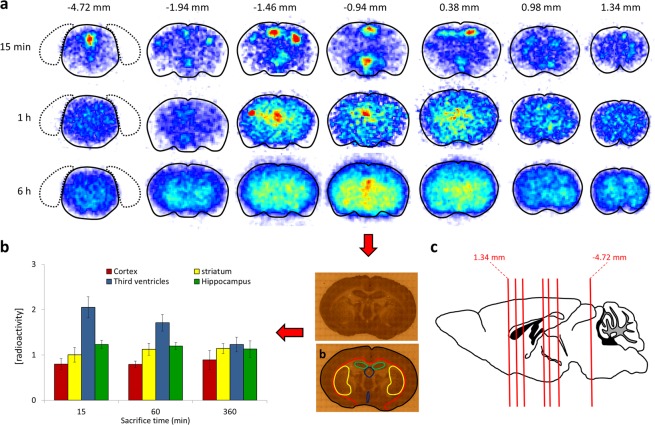
It is well settled that the amyloidogenic properties of the plasma protein transporter transthyretin (TTR) can be modulated by compounds that stabilize its native tetrameric conformation. TTR is also present in cerebrospinal fluid where it can bind to Aβ-peptides and prevent Aβ aggregation. We have previously shown that treatment of Alzheimer's Disease (AD) model mice with iododiflunisal (IDIF), a TTR tetramer stabilizing compound, prevents AD pathologies. This evidence positioned IDIF as a new lead drug for AD. In dissecting the mechanism of action of IDIF, we disclose here different labeling strategies for the preparation of I-labeled IDIF and I- and I-labeled TTR, which have been further used for the preparation of IDIF-TTR complexes labeled either on the compound or the protein. The biodistribution of all labeled species after intravenous administration has been investigated in mice using ex vivo and in vivo techniques. Our results confirm the capacity of TTR to cross the blood brain barrier (BBB) and suggest that the formation of TTR-IDIF complexes enhances BBB permeability of both IDIF and TTR. The increased TTR and IDIF brain concentrations may result in higher Aβ-peptide sequestration capacity with the subsequent inhibition of AD symptoms as we have previously observed in mice.
众所周知,血浆蛋白转运蛋白转甲状腺素(TTR)的淀粉样变性特性可以通过稳定其天然四聚体构象的化合物来调节。TTR 也存在于脑脊液中,它可以与 Aβ-肽结合,防止 Aβ 聚集。我们之前已经表明,用 TTR 四聚体稳定化合物碘代二氟尼柳(IDIF)治疗阿尔茨海默病(AD)模型小鼠可以预防 AD 病理。这一证据将 IDIF 定位为 AD 的一种新的先导药物。在剖析 IDIF 的作用机制时,我们在这里披露了用于制备 I 标记的 IDIF 和 I 和 I 标记的 TTR 的不同标记策略,这些策略进一步用于制备在化合物或蛋白质上标记的 IDIF-TTR 复合物。使用离体和体内技术研究了所有标记物在静脉注射后在小鼠中的体内分布。我们的结果证实了 TTR 穿过血脑屏障(BBB)的能力,并表明 TTR-IDIF 复合物的形成增强了 IDIF 和 TTR 的 BBB 通透性。由于我们之前在小鼠中观察到的,TTR 和 IDIF 脑浓度的增加可能导致 Aβ-肽的结合能力更高,从而抑制 AD 症状。