Department of Rheumatology, Noordwest Ziekenhuisgroep, Postbus 501, 1800 AM, Alkmaar, The Netherlands.
Department of Rheumatology, Amsterdam UMC, Vrije Universiteit Amsterdam, Amsterdam Rheumatology and Immunology Center, De Boelelaan 1117, 1081 HV, Amsterdam, The Netherlands.
Drugs Aging. 2019 Dec;36(12):1061-1072. doi: 10.1007/s40266-019-00714-4.
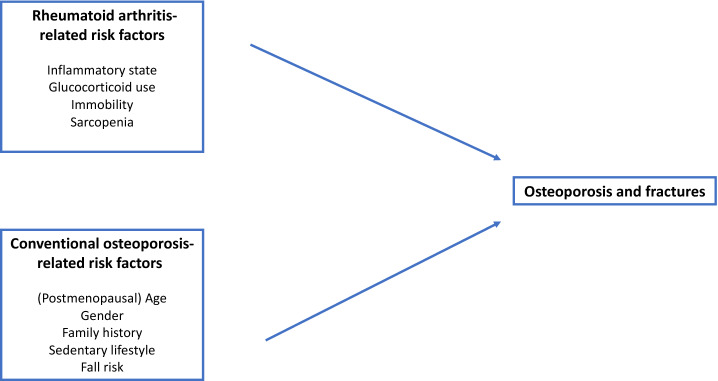
Rheumatoid arthritis (RA) is a chronic disabling disease that is associated with increased localized and generalized osteoporosis (OP). Previous studies estimated that approximately one-third of the RA population experience bone loss. Moreover, RA patients suffer from a doubled fracture incidence depending on several clinical factors, such as disease severity, age, glucocorticoid (GC) use, and immobility. As OP fractures are related to impaired quality of life and increased mortality rates, OP has an enormous impact on global health status. Therefore, there is an urgent need for a holistic approach in daily clinical practice. In other words, both OP- and RA-related factors should be taken into account in treatment guidelines for OP in RA. First, to determine the actual fracture risk, dual-energy X-ray absorptiometry (DXA), including vertebral fracture assessment (VFA) and calculation of the 10-year fracture risk with FRAX, should be performed. In case of high fracture risk, calcium and vitamin D should be supplemented alongside anti-osteoporotic treatment. Importantly, RA treatment should be optimal, aiming at low disease activity or remission. Moreover, GC treatment should be at the lowest possible dose. In this way, good fracture risk management will lead to fracture risk reduction in RA patients. This review provides a practical guide for clinicians regarding pharmacological treatment options in RA patients with OP, taking into account both osteoporotic-related factors and factors related to RA.
类风湿关节炎(RA)是一种慢性致残性疾病,常伴有局部和全身骨质疏松症(OP)加重。既往研究估计,约三分之一的 RA 患者存在骨丢失。此外,RA 患者的骨折发生率增加一倍,这取决于多种临床因素,如疾病严重程度、年龄、糖皮质激素(GC)的使用和活动受限。由于 OP 骨折与生活质量受损和死亡率增加有关,OP 对全球健康状况有巨大影响。因此,在日常临床实践中需要采用整体治疗方法。换句话说,RA 相关因素和 OP 相关因素都应考虑到 RA 患者的 OP 治疗指南中。首先,为了确定实际的骨折风险,应进行双能 X 线吸收法(DXA),包括椎体骨折评估(VFA)和使用 FRAX 计算 10 年骨折风险。如果骨折风险高,应补充钙和维生素 D 以及抗骨质疏松治疗。重要的是,RA 治疗应达到最佳状态,目标是低疾病活动度或缓解。此外,GC 治疗应尽可能使用最低剂量。通过这种方式,良好的骨折风险管理将降低 RA 患者的骨折风险。本综述为临床医生提供了关于 RA 合并 OP 患者的药物治疗选择的实用指南,同时考虑了与 OP 相关的因素和与 RA 相关的因素。