Department of Pharmacy, Kyushu University Hospital, 3-1-1 Maidashi, Higashi-ku, Fukuoka 812-8582, Japan.
Department of Clinical Pharmacology and Biopharmaceutics, Graduate School of Pharmaceutical Sciences, Kyushu University, 3-1-1 Maidashi, Higashi-ku, Fukuoka 812-8582, Japan.
Int J Mol Sci. 2019 Sep 22;20(19):4699. doi: 10.3390/ijms20194699.
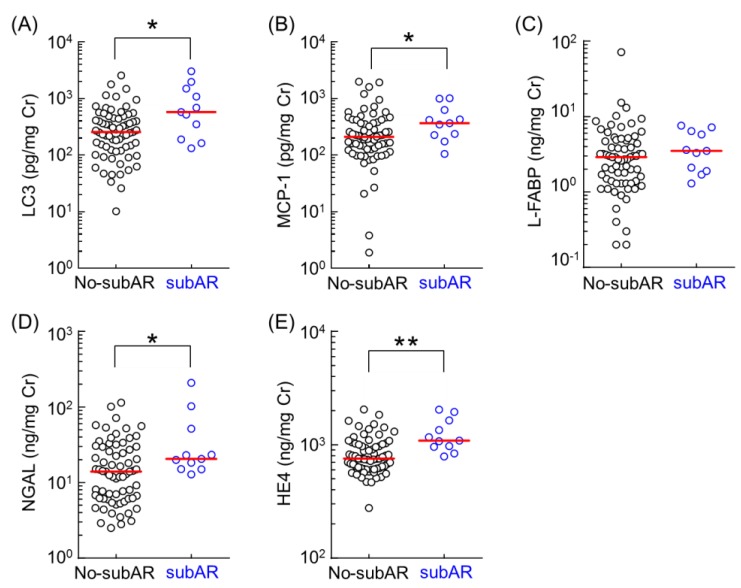
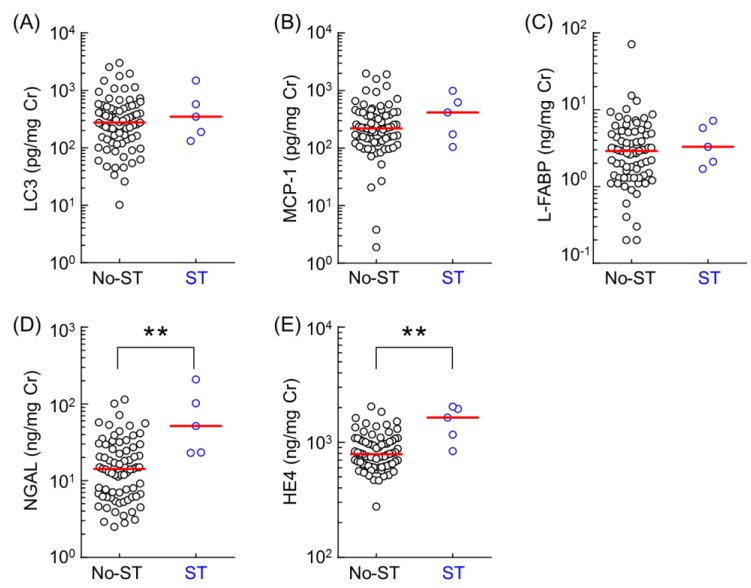
Kidney transplantation is the treatment of choice for patients with advanced chronic kidney disease (CKD) and end stage renal disease (ESRD). However, acute rejection (AR) is a common complication in kidney transplantation and is associated with reduced graft survival. Current diagnosis of AR relies mainly on clinical monitoring including serum creatinine, proteinuria, and confirmation by histopathologic assessment in the biopsy specimen of graft kidney. Although an early protocol biopsy is indispensable for depicting the severity of pathologic lesions in subclinical acute rejection (subAR), it is not acceptable in some cases and cannot be performed because of its invasive nature. Therefore, we examined the detection of noninvasive biomarkers that are closely related to the pathology of subAR in protocol biopsies three months after kidney transplantation. In this study, the urinary level of microtubule-associated protein 1 light chain 3 (LC3), monocyte chemotactic protein-1 (MCP-1), liver-type fatty acid-binding protein (L-FABP), neutrophil gelatinase-associated lipocalin (NGAL), and human epididymis secretory protein 4 (HE4) were measured three months after kidney transplantation. Urine samples of 80 patients undergoing kidney transplantation between August 2014 to September 2016, were prospectively collected after three months. SubAR was observed in 11 patients (13.8%) in protocol biopsy. The urinary levels of LC3, MCP-1, NGAL, and HE4 were significantly higher in patients with subAR than in those without, while those of L-FABP did not differ between the two groups. Multivariate regression models, receiver-operating characteristics (ROC), and areas under ROC curves (AUC) were used to identify predicted values of subAR. Urinary HE4 levels were able to better identify subAR (AUC = 0.808) than the other four urinary biomarkers. In conclusion, urinary HE4 is increased in kidney transplant recipients of subAR three months after kidney transplantation, suggesting that HE4 has the potential to be used as a novel clinical biomarker for predicting subAR.
肾移植是治疗晚期慢性肾脏病(CKD)和终末期肾病(ESRD)患者的首选方法。然而,急性排斥反应(AR)是肾移植中的常见并发症,与移植物存活率降低有关。目前 AR 的诊断主要依赖于临床监测,包括血清肌酐、蛋白尿,并通过移植肾活检标本的组织病理学评估来确认。虽然早期的方案活检对于描绘亚临床急性排斥(subAR)的病理病变严重程度是不可或缺的,但在某些情况下是不可接受的,也不能进行,因为它具有侵入性。因此,我们检查了在肾移植后三个月的方案活检中检测与 subAR 病理密切相关的非侵入性生物标志物的能力。在这项研究中,测量了微管相关蛋白 1 轻链 3(LC3)、单核细胞趋化蛋白-1(MCP-1)、肝型脂肪酸结合蛋白(L-FABP)、中性粒细胞明胶酶相关脂质运载蛋白(NGAL)和人附睾分泌蛋白 4(HE4)在肾移植后三个月的尿水平。前瞻性收集了 2014 年 8 月至 2016 年 9 月期间接受肾移植的 80 例患者在三个月后的尿样。在方案活检中观察到 11 例(13.8%)患者存在 subAR。与无 subAR 的患者相比,LC3、MCP-1、NGAL 和 HE4 的尿水平在 subAR 患者中显著升高,而 L-FABP 在两组之间没有差异。使用多变量回归模型、接收者操作特性(ROC)和 ROC 曲线下面积(AUC)来识别 subAR 的预测值。尿 HE4 水平比其他四种尿生物标志物更能识别 subAR(AUC=0.808)。总之,肾移植后三个月 subAR 患者的尿 HE4 水平升高,提示 HE4 有可能成为预测 subAR 的新型临床生物标志物。