Centre de Recherche en Transplantation et Immunologie UMR1064, INSERM, Université de Nantes, Nantes, France.
Institut de Transplantation Urologie Néphrologie (ITUN), CHU Nantes, Nantes, France.
Front Immunol. 2019 Sep 10;10:2071. doi: 10.3389/fimmu.2019.02071. eCollection 2019.
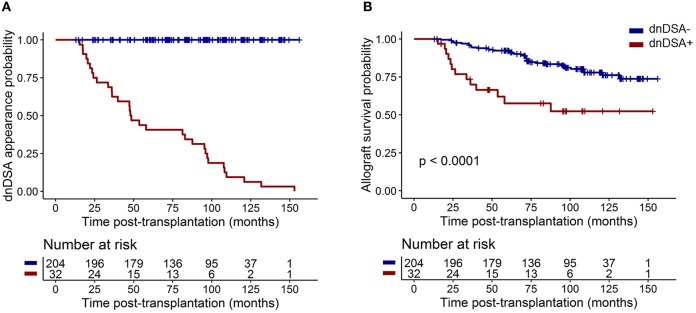
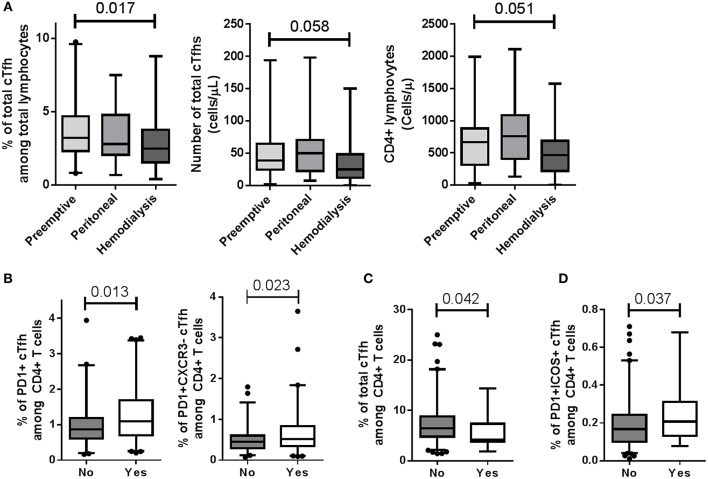
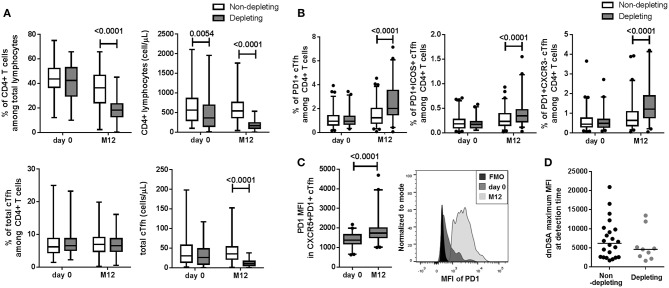
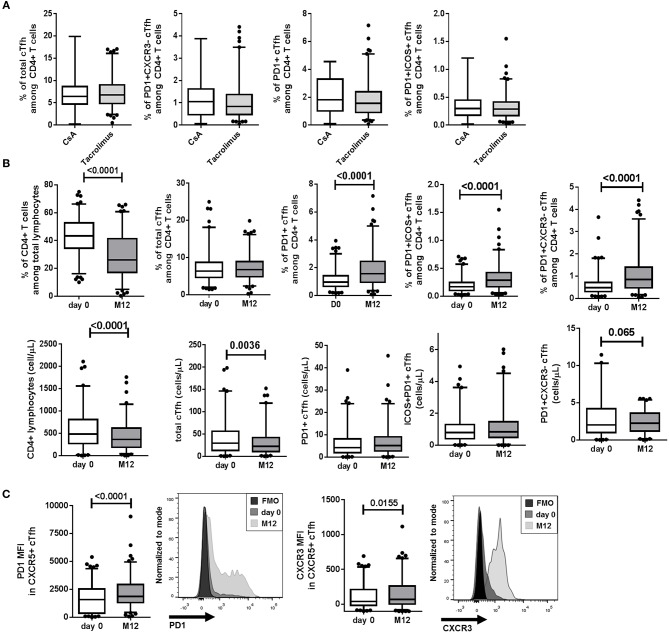
Donor-specific anti-HLA antibodies (DSAs) are a major risk factor associated with renal allograft outcomes. As a trigger of B cell antibody production, T follicular helper cells (Tfhs) promote DSA appearance. Herein, we evaluated whether circulating Tfhs (cTfhs) are associated with the genesis of antibody-mediated rejection. We measured cTfh levels on the day of transplantation and 1 year after transplantation in blood from a prospective cohort of 237 renal transplantation patients without DSA during the first year post-transplantation. Total cTfhs were characterized as CD4CD45RACXCR5, and the three following subsets of activated cTfh were analyzed: CXCR5PD1, CXCR5PD1ICOS, an CXCR5PD1CXCR3. Immunizing events (previous blood transfusion and/or pregnancy) and the presence of class II anti-HLA antibodies were associated with increased frequencies of activated CXCR5PD1, CXCR5PD1ICOS, and CXCR5PD1CXCR3 cTfh subsets. In addition, ATG-depleting induction and calcineurin inhibitor treatments were associated with a relative increase of activated cTfh subsets frequencies at 1 year post-transplantation. In multivariate survival analysis, we reported that a decrease in activated CXCR5PD1ICOS at 1 year after transplantation in the blood of DSA-free patients was significantly associated with the risk of developing DSA after the first year ( = 0.018, HR = 0.39), independently of HLA mismatches ( = 0.003, HR = 3.79). These results highlight the importance of monitoring activated Tfhs in patients early after transplantation and show that current treatments cannot provide early, efficient prevention of Tfh activation and migration. These findings indicate the need to develop innovative treatments to specifically target Tfhs to prevent DSA appearance in renal transplantation.
供者特异性抗 HLA 抗体(DSA)是与肾移植结果相关的主要危险因素。滤泡辅助 T 细胞(Tfh)作为 B 细胞抗体产生的触发因素,促进 DSA 的出现。在此,我们评估了循环滤泡辅助 T 细胞(cTfh)是否与抗体介导的排斥反应的发生有关。我们在 237 例无 DSA 的肾移植患者的前瞻性队列中,于移植当天和移植后 1 年测量了他们的血液中 cTfh 水平。cTfh 被定义为 CD4+CD45RO+CXCR5+,并分析了三种激活的 cTfh 亚群:CXCR5+PD1+、CXCR5+PD1+ICOS+和 CXCR5+PD1+CXCR3+。免疫事件(既往输血和/或妊娠)和 II 类 HLA 抗体的存在与激活的 CXCR5+PD1+、CXCR5+PD1+ICOS+和 CXCR5+PD1+CXCR3+cTfh 亚群频率的增加有关。此外,ATG 耗竭诱导和钙调神经磷酸酶抑制剂治疗与移植后 1 年激活的 cTfh 亚群频率的相对增加有关。在多变量生存分析中,我们报告了在无 DSA 患者的血液中,移植后 1 年激活的 CXCR5+PD1+ICOS+cTfh 的减少与第 1 年后发生 DSA 的风险显著相关(=0.018,HR=0.39),与 HLA 错配无关(=0.003,HR=3.79)。这些结果强调了在移植后早期监测激活的 Tfh 的重要性,并表明目前的治疗方法不能提供对 Tfh 激活和迁移的早期、有效的预防。这些发现表明需要开发创新的治疗方法来特异性靶向 Tfh,以防止肾移植中 DSA 的出现。