Mao Naqing, Huang Lijin, Shuai Qin
Faculty of Materials Science and Chemistry, Engineering Research Center of Nano-Geomaterials of Ministry of Education, China University of Geosciences (Wuhan), 388 Lumo Road, Hongshan District, Wuhan 430074, P. R. China.
ACS Omega. 2019 Sep 6;4(12):15051-15060. doi: 10.1021/acsomega.9b01838. eCollection 2019 Sep 17.
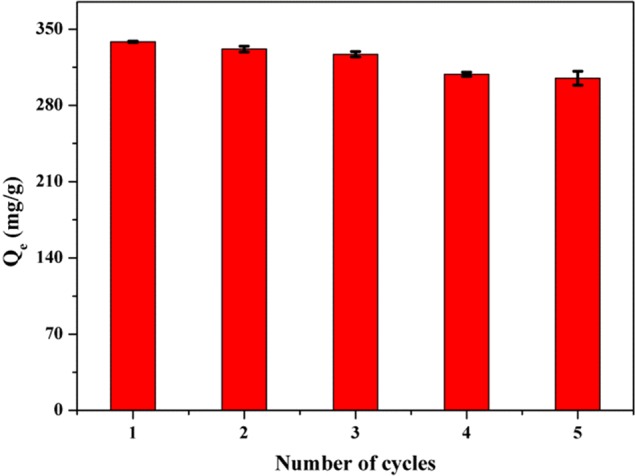
In this work, a series of porous carbon materials (PCs) were obtained at different carbonization temperatures (800, 900, 1000, and 1100 °C) by a simple and fast solvent-free method. Moreover, the feasibility of PCs as reliable and efficient adsorbents to capture diclofenac sodium (DCF) from the water was evaluated. Notably, porous carbon (PC) prepared at 1000 °C (PC-1000) was found to be the best candidate for the adsorption of DCF. Remarkably, adsorption equilibrium was achieved within 3 h, which followed a pseudo-second-order kinetic model with a high correlation coefficient ( > 0.994). Furthermore, experimental data obtained from adsorption isotherm indicated that the capture of DCF onto PC-1000 followed the Langmuir adsorption model ( > 0.997), wherein its maximum adsorption capacity was calculated to be 392 mg/g. In addition, based on the results obtained from the zeta potential of PC-1000 under different pH and the adsorbed quantity of DCF along with functional groups created on the surface of PC-1000, electrostatic and H-bonding interactions were proposed as the possible adsorption mechanisms. Due to its high stability and excellent reusability, PC-1000 has been testified as a promising candidate for removing DCF from contaminated water.
在本工作中,通过一种简单快速的无溶剂方法,在不同碳化温度(800、900、1000和1100℃)下获得了一系列多孔碳材料(PCs)。此外,还评估了PCs作为可靠且高效的吸附剂从水中捕获双氯芬酸钠(DCF)的可行性。值得注意的是,发现在1000℃制备的多孔碳(PC-1000)是吸附DCF的最佳候选材料。显著的是,在3小时内达到了吸附平衡,其遵循具有高相关系数(>0.994)的准二级动力学模型。此外,从吸附等温线获得的实验数据表明,DCF在PC-1000上的捕获遵循朗缪尔吸附模型(>0.997),其中其最大吸附容量经计算为392mg/g。此外,基于在不同pH下PC-1000的zeta电位以及DCF的吸附量和PC-1000表面产生的官能团所获得的结果,提出静电和氢键相互作用作为可能的吸附机制。由于其高稳定性和优异的可重复使用性,PC-1000已被证明是从受污染水中去除DCF的有前景的候选材料。