Chang Suchan, Ryu Yeonhee, Fan Yu, Bang Se Kyun, Kim Nam Jun, Lee Jin Gyeom, Kim Jin Mook, Lee Bong Hyo, Yang Chae Ha, Kim Hee Young
College of Korean Medicine, Daegu Haany University, Daegu, South Korea.
Korean Medicine Fundamental Research Division, Korea Institute of Oriental Medicine, Daejeon, South Korea.
Front Neurosci. 2019 Aug 29;13:928. doi: 10.3389/fnins.2019.00928. eCollection 2019.
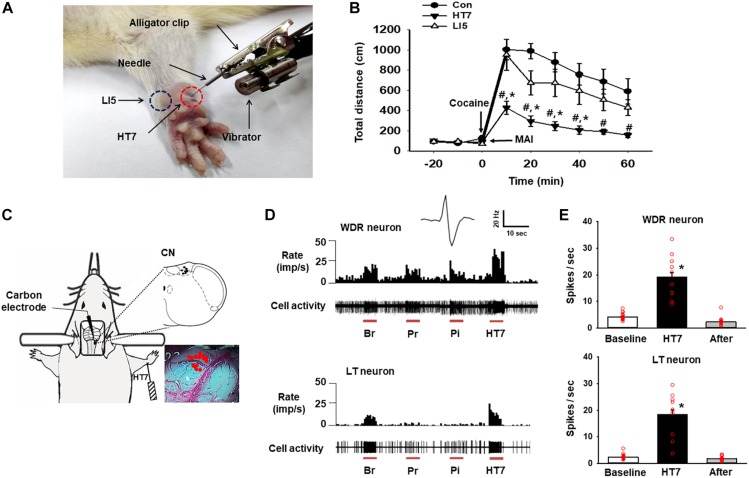
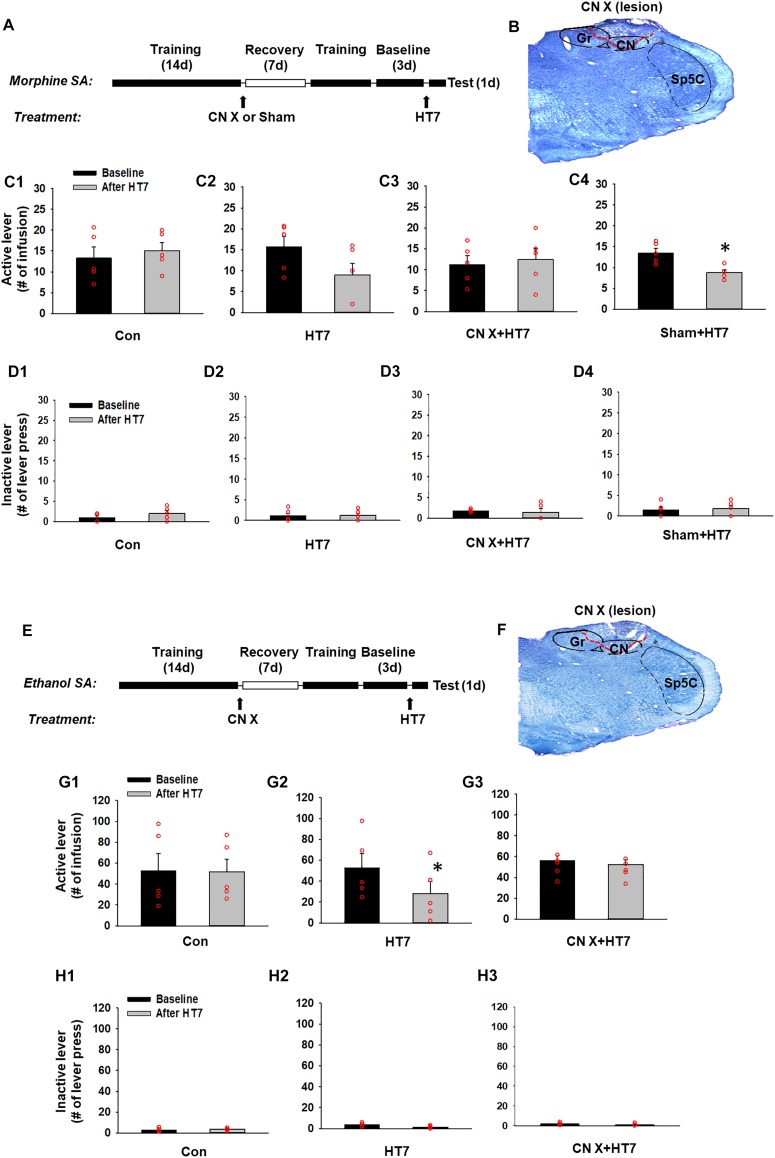
Our previous studies have shown that acupuncture suppresses addictive behaviors induced by drugs of abuse, including cocaine, morphine and ethanol, by modulating GABA neurons in the ventral tegmental area (VTA) and dopamine (DA) release in the nucleus accumbens (NAc). The mechanisms by which the peripheral signals generated by acupoint stimulation are transmitted to brain reward systems are largely unexplored. The present study aims to investigate the role of spinal dorsal column (DC) somatosensory pathways in the acupuncture inhibition of drug addictive behaviors. Thus, we tested whether acupuncture at (HT7) points reduces drug-seeking behaviors in rats self-administering morphine or ethanol and whether such effects are inhibited by the disruption of the cuneate nucleus (CN). The stimulation of HT7 suppressed morphine and ethanol self-administration, which were completely abolished by surgical lesioning of the CN. In extracellular recordings, single-unit activity of the CN was evoked during acupuncture stimulation. The results suggest that acupuncture suppresses morphine- and ethanol-seeking behaviors through the modulation of the CN, second-order neurons of the DC somatosensory pathway.
我们之前的研究表明,针刺通过调节腹侧被盖区(VTA)的γ-氨基丁酸(GABA)能神经元以及伏隔核(NAc)中的多巴胺(DA)释放,抑制包括可卡因、吗啡和乙醇在内的滥用药物所诱发的成瘾行为。穴位刺激产生的外周信号传递至脑奖赏系统的机制在很大程度上尚未得到探索。本研究旨在探讨脊髓背柱(DC)体感通路在针刺抑制药物成瘾行为中的作用。因此,我们测试了针刺神门穴(HT7)是否能减少吗啡或乙醇自我给药大鼠的觅药行为,以及这种作用是否会因楔束核(CN)的破坏而受到抑制。针刺HT7抑制了吗啡和乙醇的自我给药,而CN的手术损伤完全消除了这种作用。在细胞外记录中,针刺刺激时可诱发CN的单单位活动。结果表明,针刺通过调节DC体感通路的二级神经元CN,抑制了对吗啡和乙醇的觅药行为。