Centre for Dengue Research, Faculty of Medical Sciences, University of Sri Jayewardenepura, Nugegoda, Sri Lanka.
Infectious Diseases Hospital, Angoda, Sri Lanka.
Immun Inflamm Dis. 2019 Dec;7(4):276-285. doi: 10.1002/iid3.271. Epub 2019 Sep 30.
Although the role of dengue virus (DENV)-specific T cells in the pathogenesis of acute dengue infection is emerging, the functionality of virus-specific T cells associated with milder clinical disease has not been well studied. We sought to investigate how the functionality of DENV-NS3 and DENV-NS5 protein-specific T cells differ in patients with dengue fever (DF) and dengue hemorrhagic fever (DHF).
Using intracellular cytokine assays, we assessed the production of interferon γ (IFNγ), tumor necrosis factor-α (TNF-α), macrophage inflammatory protein-1β (MIP-1β), and CD107a expression in adult patients with acute DF (n = 21) and DHF (n = 22).
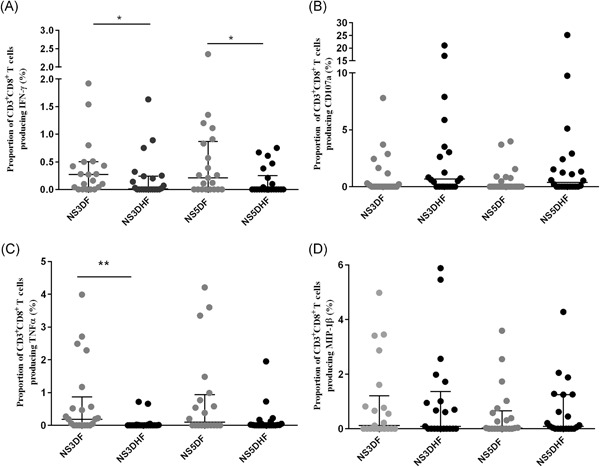
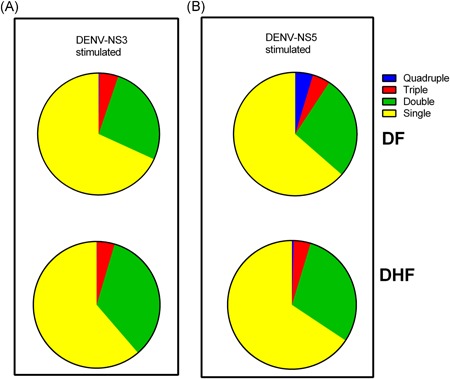
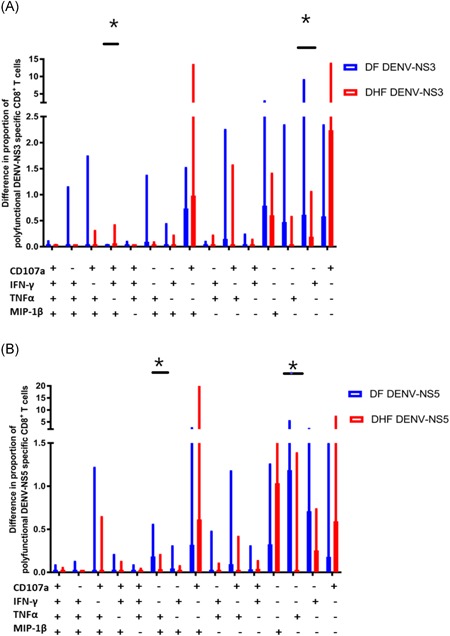
Quadruple cytokine-producing, polyfunctional DENV-NS3- and DENV-NS5-specific T cells were more frequent in those with DF when compared to those with DHF. While DENV-NS3- and DENV-NS5-specific T cells in patients with DF expressed IFNγ > TNF-α > MIP-β > CD107a, T cells of those with DHF predominantly expressed CD107a > MIP-1β > IFNγ > TNF-α. Overall production of IFNγ or TNF-α by DENV-NS3- and DENV-NS5-specific T cells was significantly higher in patients with DF. The majority of NS3-specific T cells in patients with DF (78.6%) and DHF (68.9%) were single-cytokine producers; 76.6% of DENV-NS5-specific T cells in those with DF and 77.1% of those with DHF, produced only a single cytokine. However, no significant association was found with polyfunctional T-cell responses and the degree of viraemia.
Our results suggest that the functional phenotype of DENV-specific T cells are likely to associate with clinical disease severity.
尽管登革热病毒(DENV)特异性 T 细胞在急性登革热感染发病机制中的作用正在显现,但与较轻临床疾病相关的病毒特异性 T 细胞的功能尚未得到很好的研究。我们试图研究登革热(DF)和登革出血热(DHF)患者中 DENV-NS3 和 DENV-NS5 蛋白特异性 T 细胞的功能有何不同。
通过细胞内细胞因子测定,我们评估了 21 例急性 DF 患者和 22 例 DHF 患者中 DENV-NS3 和 DENV-NS5 蛋白特异性 T 细胞产生干扰素 γ(IFNγ)、肿瘤坏死因子-α(TNF-α)、巨噬细胞炎症蛋白-1β(MIP-1β)和 CD107a 的情况。
与 DHF 患者相比,DF 患者中具有四倍细胞因子产生的、多功能的 DENV-NS3 和 DENV-NS5 特异性 T 细胞更为常见。DF 患者的 DENV-NS3 和 DENV-NS5 特异性 T 细胞表达 IFNγ>TNF-α>MIP-β>CD107a,而 DHF 患者的 T 细胞主要表达 CD107a>MIP-1β>IFNγ>TNF-α。DF 患者的 DENV-NS3 和 DENV-NS5 特异性 T 细胞产生 IFNγ或 TNF-α的总量明显更高。DF 患者(78.6%)和 DHF 患者(68.9%)中大多数 NS3 特异性 T 细胞为单细胞因子产生者;DF 患者中 76.6%的 DENV-NS5 特异性 T 细胞和 DHF 患者中 77.1%的 DENV-NS5 特异性 T 细胞仅产生一种细胞因子。然而,多细胞因子反应与病毒血症程度之间未发现显著相关性。
我们的结果表明,DENV 特异性 T 细胞的功能表型可能与临床疾病严重程度相关。