Department of Radiation Oncology, Klinikum rechts der Isar, Technische Universität München (TUM), Ismaninger Straße 22, 81675 Munich, Germany.
Institute of Radiation Medicine (IRM), Department of Radiation Sciences (DRS), Helmholtz Zentrum München, Ingolstädter Landstraße 1, 85764 Neuherberg, Germany.
Cells. 2019 Sep 28;8(10):1166. doi: 10.3390/cells8101166.
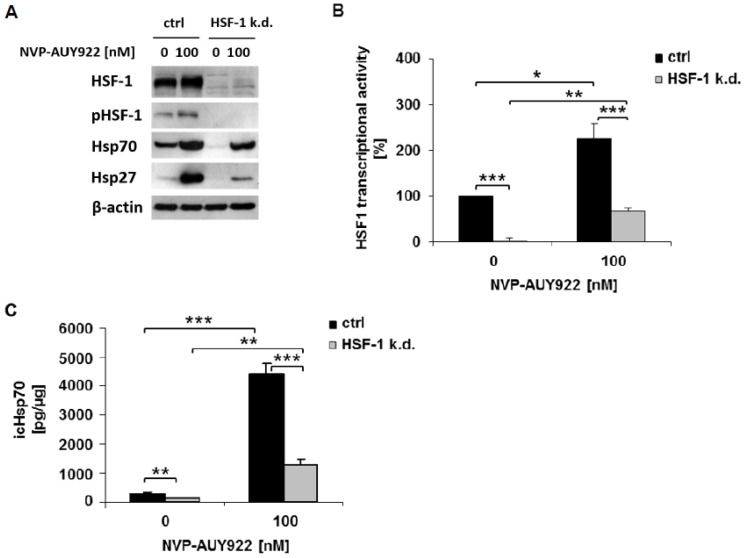
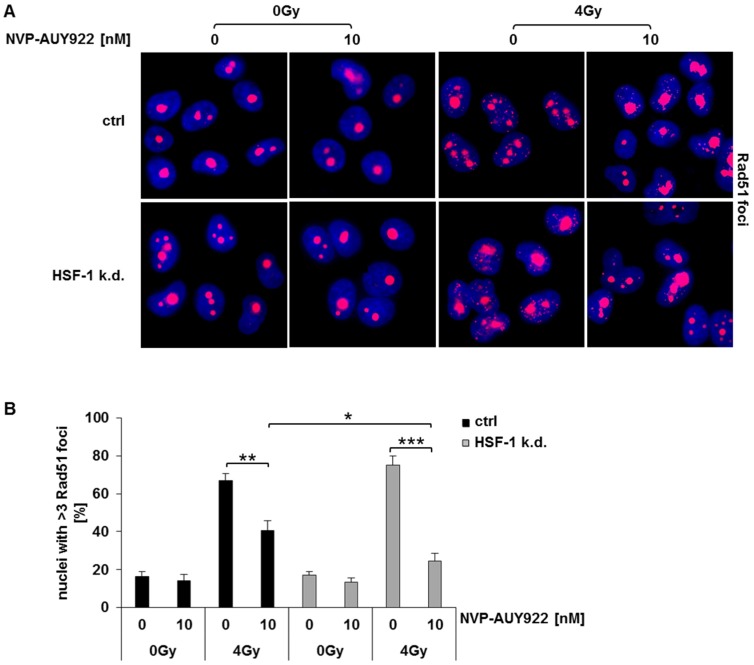
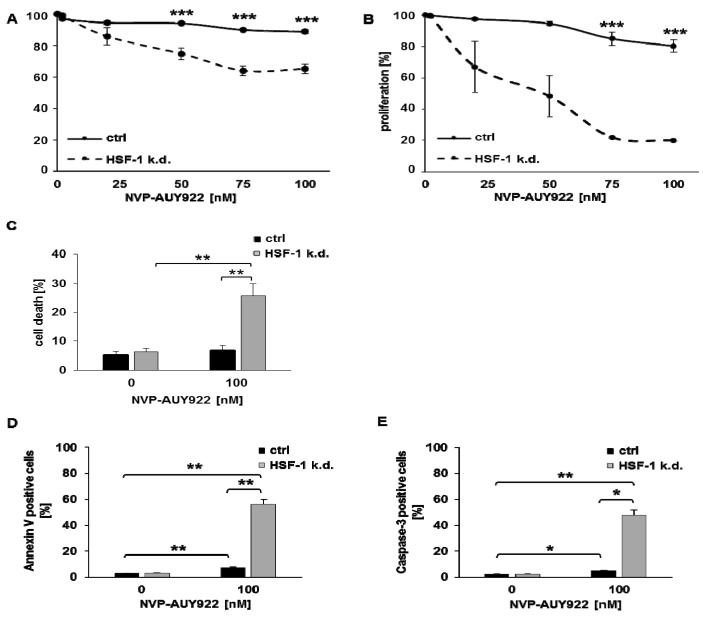
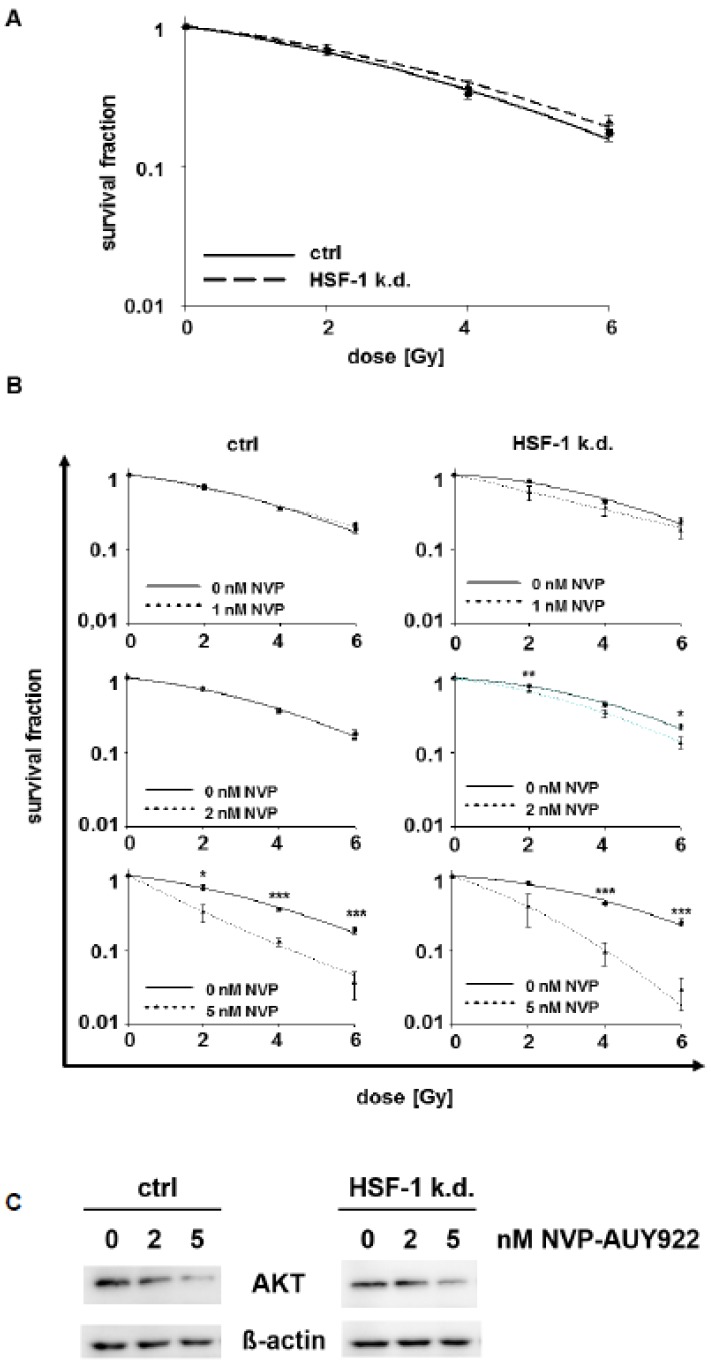
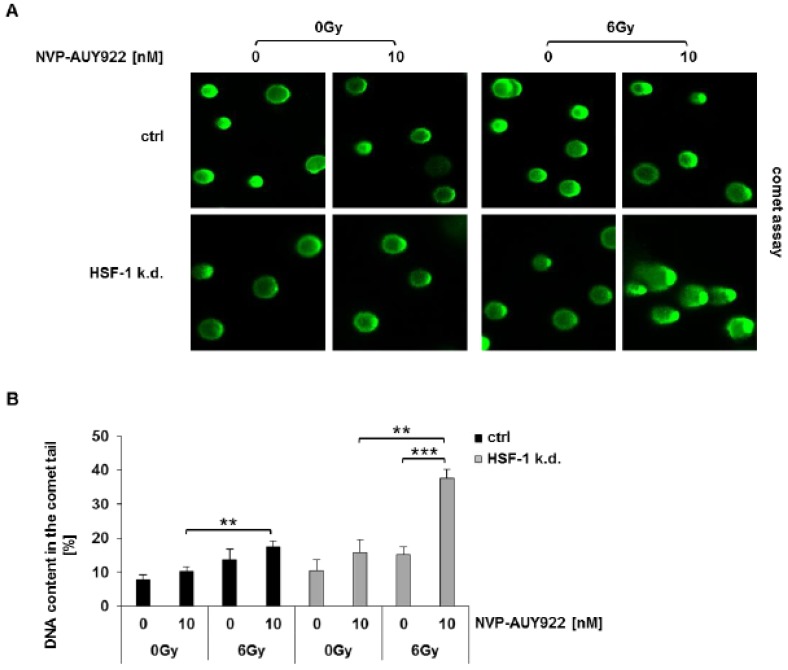
The inhibition of heat shock protein 90 (Hsp90) a molecular chaperone for multiple oncogenic client proteins is considered as a promising approach to overcome radioresistance. Since most Hsp90 inhibitors activate HSF-1 that induces the transcription of cytoprotective and tumor-promoting stress proteins such as Hsp70 and Hsp27, a combined approach consisting of HSF-1 knockdown (k.d.) and Hsp90 inhibition was investigated. A specific HSF-1 k.d. was achieved in H1339 lung cancer cells using RNAi-Ready pSIRENRetroQ vectors with puromycin resistance. The Hsp90 inhibitor NVP-AUY922 was evaluated at low concentrations-ranging from 1-10 nM-in control and HSF-1 k.d. cells. Protein expression (i.e., Hsp27/Hsp70, HSF-1, pHSF-1, Akt, ß-actin) and transcriptional activity was assessed by western blot analysis and luciferase assays and radiosensitivity was measured by proliferation, apoptosis (Annexin V, active caspase 3), clonogenic cell survival, alkaline comet, γH2AX, 53BP1, and Rad51 foci assays. The k.d. of HSF-1 resulted in a significant reduction of basal and NVP-AUY922-induced Hsp70/Hsp27 expression levels. A combined approach consisting of HSF-1 k.d. and low concentrations of the Hsp90 inhibitor NVP-AUY922 reduces the Hsp90 client protein Akt and potentiates radiosensitization, which involves an impaired homologous recombination mediated by Rad51. Our findings are key for clinical applications of Hsp90 inhibitors with respect to adverse hepatotoxic effects.
热休克蛋白 90(Hsp90)抑制剂是一种针对多种致癌客户蛋白的分子伴侣,被认为是克服放射抵抗的一种有前途的方法。由于大多数 Hsp90 抑制剂会激活 HSF-1,从而诱导细胞保护和促进肿瘤的应激蛋白(如 Hsp70 和 Hsp27)的转录,因此研究了一种由 HSF-1 敲低(k.d.)和 Hsp90 抑制组成的联合方法。使用带有嘌呤霉素抗性的 RNAi-Ready pSIRENRetroQ 载体,在 H1339 肺癌细胞中实现了特定的 HSF-1 k.d.。在对照和 HSF-1 k.d.细胞中,评估了 Hsp90 抑制剂 NVP-AUY922 的低浓度-范围为 1-10 nM。通过 Western blot 分析和荧光素酶测定评估蛋白表达(即 Hsp27/Hsp70、HSF-1、pHSF-1、Akt、ß-肌动蛋白)和转录活性,并通过增殖、凋亡(Annexin V、活性 caspase 3)、克隆形成细胞存活、碱性彗星、γH2AX、53BP1 和 Rad51 焦点测定来测量放射敏感性。HSF-1 的 k.d.导致基础和 NVP-AUY922 诱导的 Hsp70/Hsp27 表达水平显著降低。由 HSF-1 k.d.和低浓度 Hsp90 抑制剂 NVP-AUY922 组成的联合方法降低了 Hsp90 客户蛋白 Akt,并增强了放射增敏作用,这涉及到由 Rad51 介导的同源重组受损。我们的发现对于 Hsp90 抑制剂的临床应用具有重要意义,因为它们可能会产生肝毒性等不良反应。