Key Laboratory of Carcinogenesis and Translational Research (Ministry of Education), Department of Thoracic Medical Oncology-I, Peking University Cancer Hospital & Institute, Beijing, China.
Key Laboratory of Carcinogenesis and Translational Research (Ministry of Education), Department of Pharmacy, Peking University Cancer Hospital & Institute, Beijing, China.
Thorac Cancer. 2019 Nov;10(11):2088-2095. doi: 10.1111/1759-7714.13184. Epub 2019 Sep 30.
Taxane-based chemotherapy is widely used in lung cancer. ABCB1 have a role in the prediction of treatment response and toxicity of chemotherapy in solid tumors. In this retrospective study, we investigated ABCB1 polymorphism on response and toxicity in taxane-based chemotherapy in lung cancer patients.
A total of 122 lung cancer patients who received taxane-based chemotherapy were included in this study. Fluorescence in situ hybridization (FISH) was used for ABCB1 polymorphism detection. Turbidimetric inhibition immunoassay was used for pharmacokinetic analysis. Statistical analysis was performed using SPSS 20.0.
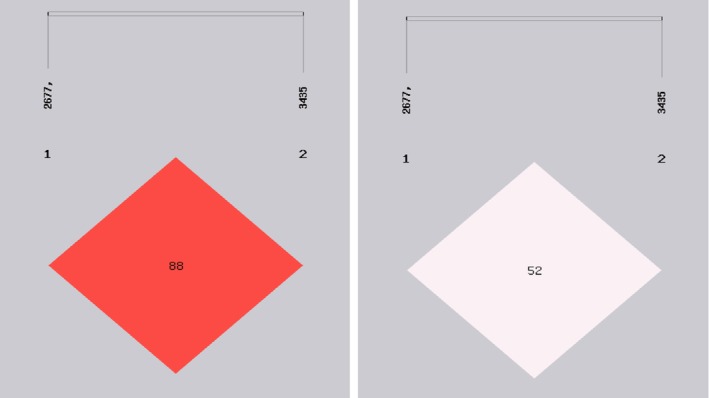
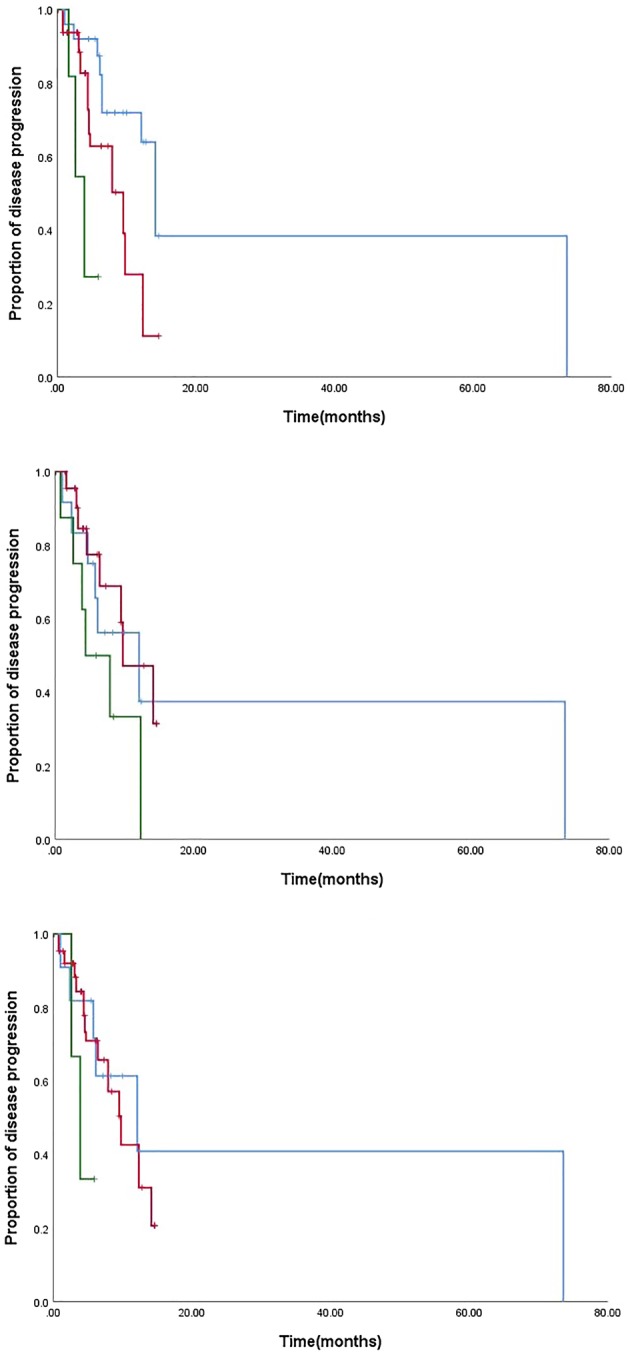
The frequency of the ABCB1 2677 site TT/TG/GG genotype was 32.8%, 43.4% and 23.8%, respectively and the frequency of the 3435 sites the TT/TC/CC genotype was 13.9%, 44.3% and 41.8%, respectively. The occurrence of neurotoxicity was higher in patients who had ABCB1 3435 site mutation (TT 88.2%, TC 22.2%, CC 21.6% P = 0.004). There was no significant difference between ABCB1 genotypes with regard to other chemotherapy-induced toxicity. For non-small cell lung cancer (NSCLC) patients, those harboring ABCB1 2677 and 3435 site wild-type patients had longer median progression-free survival (PFS) in the paclitaxel subgroup (3435 site: TT 3.87 vs. TC 9.50 vs. CC 14.13 months; P < 0.001; 2677 site: TT 4.37 vs. TG 9.73 vs. GG 12.1 months; P = 0.013). The area under the concentration-time curve (AUC) of 20 patients treated with docetaxel increased for ABCB1 mutation subgroups.
ABCB1 mutation is associated with higher neurotoxicity of taxane-based chemotherapy. It also predicts shorter PFS for NSCLC in paclitaxel-based treatment.
紫杉烷类化疗广泛应用于肺癌。ABCB1 在预测实体肿瘤化疗的治疗反应和毒性方面发挥作用。在这项回顾性研究中,我们研究了 ABCB1 多态性对肺癌患者紫杉烷类化疗的反应和毒性的影响。
本研究共纳入 122 例接受紫杉烷类化疗的肺癌患者。荧光原位杂交(FISH)用于 ABCB1 多态性检测。比浊抑制免疫测定法用于药代动力学分析。统计分析采用 SPSS 20.0 进行。
ABCB1 2677 位点 TT/TG/GG 基因型的频率分别为 32.8%、43.4%和 23.8%,3435 位点 TT/TC/CC 基因型的频率分别为 13.9%、44.3%和 41.8%。ABCB1 3435 位点突变患者神经毒性发生率较高(TT88.2%,TC22.2%,CC21.6%P=0.004)。ABCB1 基因型与其他化疗诱导的毒性无显著差异。对于非小细胞肺癌(NSCLC)患者,紫杉醇亚组中 ABBC1 2677 和 3435 位点野生型患者的中位无进展生存期(PFS)更长(3435 位点:TT3.87 与 TC9.50 与 CC14.13 个月;P<0.001;2677 位点:TT4.37 与 TG9.73 与 GG12.1 个月;P=0.013)。20 例接受多西他赛治疗的患者的 AUC 增加。
ABCB1 突变与紫杉烷类化疗的神经毒性增加相关。它还预测 NSCLC 患者在紫杉醇治疗中的 PFS 更短。