School of Biochemistry and Immunology, Trinity College Dublin, University of Dublin, Dublin, Ireland.
School of Medicine, Trinity Biomedical Biosciences Institute, Trinity College Dublin, Dublin, Ireland.
Front Immunol. 2019 Sep 11;10:2137. doi: 10.3389/fimmu.2019.02137. eCollection 2019.
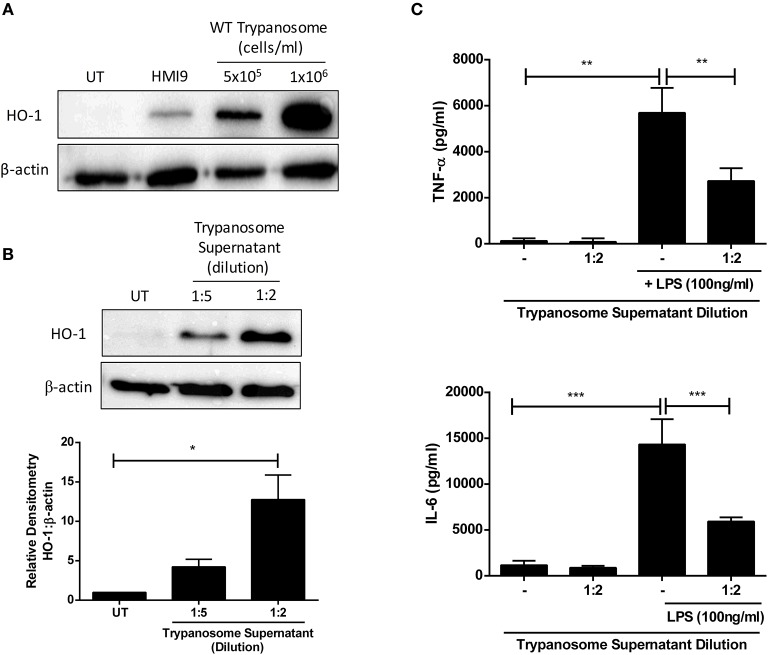
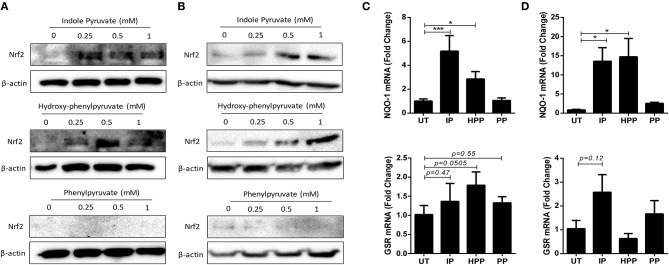
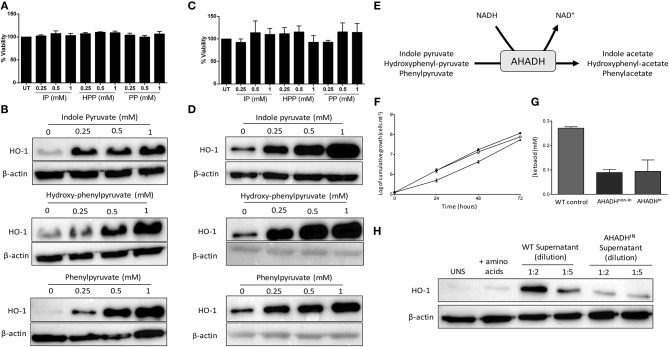
African trypanosomes, such as (), are protozoan parasites of the mammalian vasculature and central nervous system that are best known for causing fatal human sleeping sickness. As exclusively extracellular parasites, trypanosomes are subject to constant challenge from host immune defenses but they have developed very effective strategies to evade and modulate these responses to maintain an infection while simultaneously prolonging host survival. Here we investigate host parasite interactions, especially within the CNS context, which are not well-understood. We demonstrate that strongly upregulates the stress response protein, Heme Oxygenase 1 (HO-1), in primary murine glia and macrophages . Furthermore, using a novel AHADH cell line, we demonstrate that specific aromatic ketoacids secreted by bloodstream forms of are potent drivers of HO-1 expression and are capable of inhibiting pro-IL1β induction in both glia and macrophages. Additionally, we found that these ketoacids significantly reduced IL-6 and TNFα production by glia, but not macrophages. Finally, we present data to support Nrf2 activation as the mechanism of action by which these ketoacids upregulate HO-1 expression and mediate their anti-inflammatory activity. This study therefore reports a novel immune evasion mechanism, whereby secretes amino-acid derived metabolites for the purpose of suppressing both the host CNS and peripheral immune response, potentially via induction of the Nrf2/HO-1 pathway.
非洲锥虫,如(),是哺乳动物血管和中枢神经系统的原生动物寄生虫,它们最著名的是引起致命的人类昏睡病。作为完全的细胞外寄生虫,锥虫不断受到宿主免疫防御的挑战,但它们已经发展出非常有效的策略来逃避和调节这些反应,以维持感染,同时延长宿主的存活。在这里,我们研究宿主-寄生虫相互作用,特别是在中枢神经系统(CNS)的背景下,这些相互作用还没有被很好地理解。我们证明()在原代小鼠神经胶质细胞和巨噬细胞中强烈地上调应激反应蛋白血红素加氧酶 1(HO-1)。此外,我们使用一种新型的 AHADH 细胞系,证明了由血液期 ()分泌的特定芳香族酮酸是 HO-1 表达的有力驱动因素,并且能够抑制胶质细胞和巨噬细胞中 pro-IL1β的诱导。此外,我们发现这些酮酸可显著减少神经胶质细胞中 IL-6 和 TNFα 的产生,但不减少巨噬细胞。最后,我们提出的数据支持 Nrf2 激活是这些酮酸上调 HO-1 表达和介导其抗炎活性的作用机制。因此,本研究报告了一种新的免疫逃避机制,即()分泌氨基酸衍生的代谢产物,目的是抑制宿主中枢神经系统和外周免疫反应,可能通过诱导 Nrf2/HO-1 途径。