Castro-Alba Vanesa, Lazarte Claudia Eliana, Bergenståhl Björn, Granfeldt Yvonne
Department of Food Technology, Engineering and Nutrition Lund University Lund Sweden.
Food and Natural Products Center San Simón University Cochabamba Bolivia.
Food Sci Nutr. 2019 Aug 2;7(9):2854-2865. doi: 10.1002/fsn3.1127. eCollection 2019 Sep.
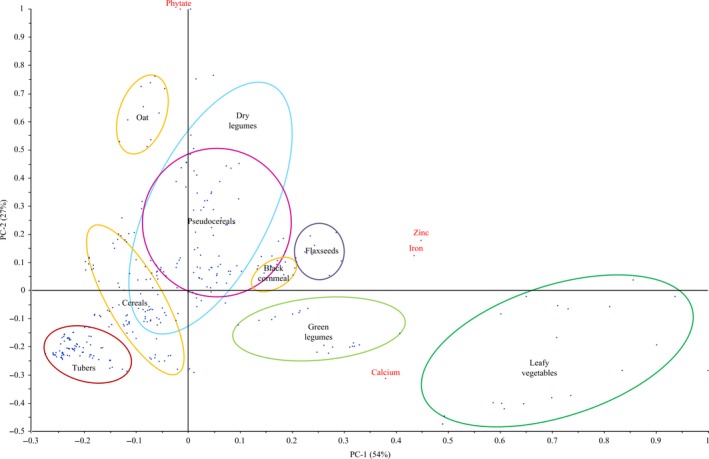
There is a scarcity of information on mineral and phytate content in plant-based foods in Bolivia. This study aimed to analyze iron, zinc, calcium, and phytate content and estimate the mineral bioavailability of foods consumed in Chapare, Bolivia. Minerals and phytate were analyzed, and bioavailability was estimated in 17 food samples. Leafy vegetables and green legumes had the highest mineral content, followed by pseudocereals. Estimated mineral bioavailability was low for cereals, dry legumes, pseudocereals, and flaxseeds foods mainly due to phytate content. But estimated zinc bioavailability for black cornmeal, yellow corn, and dry peas was moderate. Strong correlations ( < 0.01) were found between the three minerals, while phytate correlated negatively to iron, zinc, and calcium. To get an overview of the estimated mineral bioavailability of plant-based diets, we have included foods, from the same area, analyzed in a previous study where the evaluated diet covers 80% of RNI for iron and zinc, but <40% of calcium. In conclusion, leafy vegetables and green legumes had the highest contents of minerals and the lowest phytate content of the foods analyzed in the study. The usage of processing strategies and dietary diversification to reduce phytate content would significantly improve estimated mineral bioavailability in plant-based diets.
关于玻利维亚植物性食物中矿物质和植酸盐含量的信息匮乏。本研究旨在分析铁、锌、钙和植酸盐含量,并估算玻利维亚查帕雷地区所消费食物的矿物质生物利用率。对17份食物样本进行了矿物质和植酸盐分析,并估算了生物利用率。叶菜类蔬菜和绿色豆类的矿物质含量最高,其次是伪谷物。谷物、干豆类、伪谷物和亚麻籽食物的估算矿物质生物利用率较低,主要原因是植酸盐含量。但黑玉米粉、黄玉米和干豌豆的估算锌生物利用率中等。三种矿物质之间存在强相关性(<0.01),而植酸盐与铁、锌和钙呈负相关。为了全面了解植物性饮食的估算矿物质生物利用率,我们纳入了之前一项研究中在同一地区分析的食物,在该研究中,所评估的饮食涵盖了铁和锌推荐营养素摄入量(RNI)的80%,但钙的摄入量<40%。总之,叶菜类蔬菜和绿色豆类在所分析的食物中矿物质含量最高,植酸盐含量最低。采用加工策略和饮食多样化来降低植酸盐含量将显著提高植物性饮食中估算的矿物质生物利用率。