An Fuqiang, Zhao Hongliang, Zhou Weinan, Ma Yonghong, Li Ping
Beijing University of Science and Technology, No. 30 Collage Road, Haidian District, Beijing, China.
Shanxi Changzheng Power Technology Co., Ltd., Shanxi, China.
Sci Rep. 2019 Oct 1;9(1):14108. doi: 10.1038/s41598-019-49568-1.
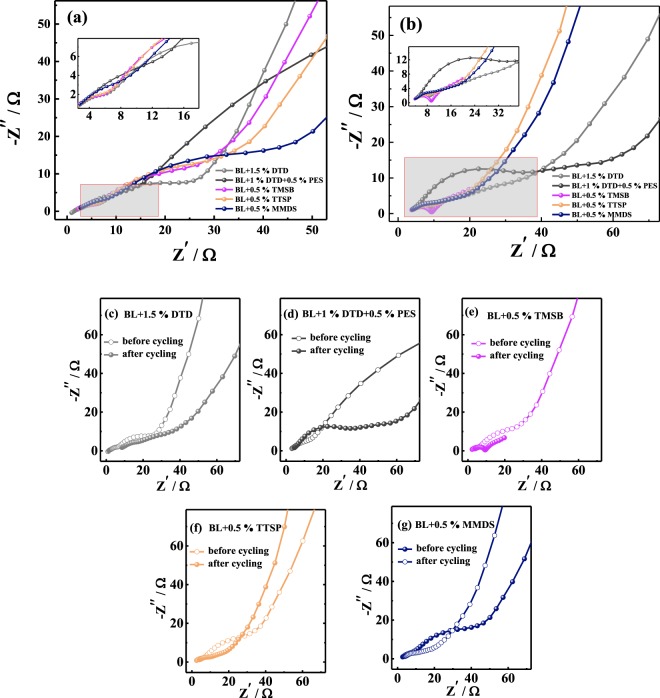
Recently, high-energy density cells containing nickel-rich cathodes and silicon-based anodes have become a practical solution for increasing the driving range of electric vehicles. However, their long-term durability and storage performance is comparatively poor because of the unstable cathode-electrolyte-interphase (CEI) of the high-reactivity cathode and the continuous solid-electrolyte-interphase (SEI) growth. In this work, we study several electrolyte systems consisting of various additives, such as S-containing (1,3,2-dioxathiolane 2,2-dioxide (DTD), DTD + prop-1-ene-1,3-sultone (PES), methylene methanedisulfonate (MMDS)) and Si-containing (tris(trimethylsilyl) phosphate (TTSP) and tris(trimethylsilyl) borate (TMSB)) compounds, in comparison to the baseline electrolyte (BL = 1.0 M LiPF + 3:5:2 w-w:w EC: EMC: DEC + 0.5 wt% lithium difluoro(oxalato)borate (LiDFOB) + 2 wt% lithium bis(fluorosulfonyl)imide (LiFSI) + 2 wt% fluoroethylene carbonate (FEC) + 1 wt% 1,3-propane sultone (PS)). Generally, electrolytes with Si-containing additives, particularly BL + 0.5% TTSP, show a lower impedance increase in the full cell, better beginning-of-life (BOL) performance, less reversible capacity loss through long-term cycles and better storage at elevated temperatures than do electrolytes with S-containing additives. On the contrary, electrolytes with S-containing additives exhibit the advantage of low SEI impedance but yield a worse performance in the full cell than do those with Si-containing additives. The difference between two types of additives is attributed to the distinct function of the electrodes, which is characterized by cyclic voltammetry (CV), electrochemical impedance spectroscopy (EIS) and X-ray photoelectron spectroscopy (XPS), which was performed on full cells and half cells with fresh and harvested electrodes.
最近,包含富镍阴极和硅基阳极的高能量密度电池已成为增加电动汽车行驶里程的切实可行解决方案。然而,由于高反应活性阴极的不稳定阴极-电解质界面(CEI)以及持续的固体电解质界面(SEI)生长,它们的长期耐久性和存储性能相对较差。在这项工作中,我们研究了几种由各种添加剂组成的电解质体系,例如含硫的(1,3,2-二氧杂硫杂环戊烷2,2-二氧化物(DTD)、DTD + 1-丙烯-1,3-磺内酯(PES)、亚甲基甲烷二磺酸盐(MMDS))和含硅的(磷酸三(三甲基硅基)酯(TTSP)和硼酸三(三甲基硅基)酯(TMSB))化合物,并与基线电解质(BL = 1.0 M LiPF + 3:5:2 w-w:w 碳酸乙烯酯:碳酸甲乙酯:碳酸二乙酯 + 0.5 wt% 二氟草酸硼酸锂(LiDFOB)+ 2 wt% 双(氟磺酰)亚胺锂(LiFSI)+ 2 wt% 氟代碳酸乙烯酯(FEC)+ 1 wt% 1,3-丙烷磺内酯(PS))进行比较。一般来说,含硅添加剂的电解质,特别是BL + 0.5% TTSP,在全电池中显示出较低的阻抗增加幅度、更好的初始性能、在长期循环中较少的可逆容量损失以及在高温下更好的存储性能,优于含硫添加剂的电解质。相反,含硫添加剂的电解质具有低SEI阻抗的优势,但在全电池中的性能比含硅添加剂差。两种添加剂之间的差异归因于电极的不同功能,这通过循环伏安法(CV)、电化学阻抗谱(EIS)和X射线光电子能谱(XPS)进行表征,这些测试在使用新鲜和使用过的电极的全电池和半电池上进行。