Hwang Jae Ha, Lee Dong Gyu, Kim Kwang Seog, Lee Sam Yong
Medicine (Baltimore). 2019 Oct;98(40):e17036. doi: 10.1097/MD.0000000000017036.
Peripheral osteoma, which arises from the periosteum, commonly develops in the head and neck region and is found frequently in the mandible, maxilla, and paranasal sinuses. However, osteoma of the face, especially from the nasal bone, is quite rare.
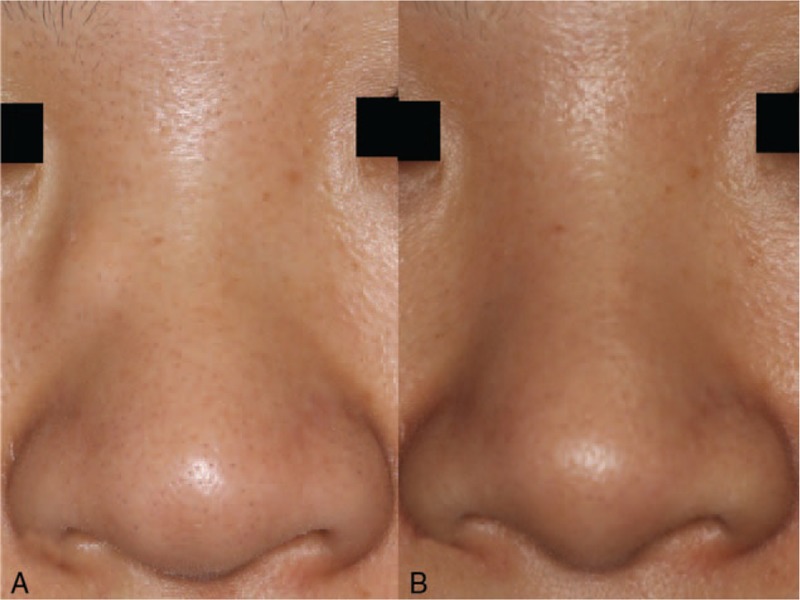
A 34-year-old female visited our outpatient department with a small mass on the nose. She had n laser treatment of nevus at the same spot 14 years before, and it had enlarged slowly since 10 years before.
Computed tomography scan revealed a 0.7 × 0.5 cm sized radio-opaque tumor of the nasal bone.
Under general anesthesia, surgical excision was performed through a transcolumellar and infracartilaginous incision. The excised tumor was a 0.7 × 0.5 cm sized hard mass.
Biopsy confirmed it as a peripheral osteoma. After tumor removal, structural stability of nasal framework including bone and cartilage was maintained, and symmetry of the nasal dorsum was acquired.
Chronic osteoma can compress the abutting structures. In the case of the nose, either structural instability or asymmetry can occur. By applying open rhinoplasty techniques, postoperative scars could be hidden and additional correction of the affected structure could be carried out if necessary. As a result, the surgeon can achieve the functional and esthetic outcomes simultaneously.
外周骨瘤起源于骨膜,常见于头颈部,多见于下颌骨、上颌骨和鼻窦。然而,面部骨瘤,尤其是鼻骨骨瘤相当罕见。
一名34岁女性因鼻部有一肿物前来我院门诊就诊。14年前她曾在同一部位接受过痣的激光治疗,自10年前起肿物缓慢增大。
计算机断层扫描显示鼻骨有一个0.7×0.5厘米大小的不透射线肿瘤。
在全身麻醉下,通过经鼻小柱和软骨下切口进行手术切除。切除的肿瘤为一个0.7×0.5厘米大小的硬块。
活检证实为外周骨瘤。肿瘤切除后,包括骨和软骨在内的鼻支架结构稳定性得以维持,鼻背对称性得以恢复。
慢性骨瘤可压迫相邻结构。在鼻部,可能会出现结构不稳定或不对称。通过应用开放式鼻整形技术,术后瘢痕可被隐藏,如有必要还可对受影响结构进行额外矫正。因此,外科医生可同时实现功能和美学效果。