School of Nursing, College of Nursing, Taipei Medical University, Taiwan.
Department of Nursing, Shuang Ho Hospital, Taipei Medical University, Taiwan.
Ind Health. 2020 Apr 2;58(2):161-169. doi: 10.2486/indhealth.2019-0066. Epub 2019 Oct 1.
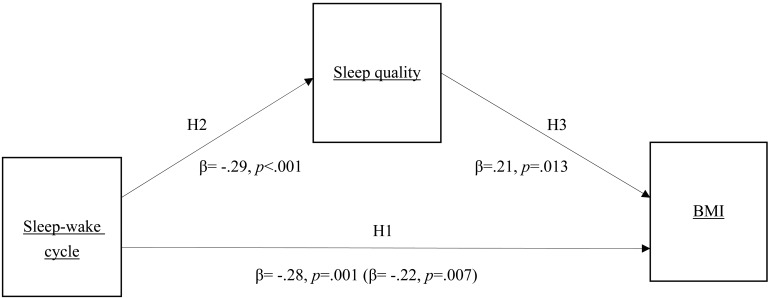
This study investigated the relationship between the sleep-wake cycle and body mass index (BMI) of female shift-working nurses and examine the mediating effect of sleep quality on this relationship. We recruited a total of 147 female nurses working monthly rotating shifts at a teaching hospital in Taiwan from the day (n=63), evening (n=50), and night (n=34) shifts. Our research instruments utilized a questionnaire to collect demographic and work-related information, the Pittsburgh Sleep Quality Index (PSQI), and actigraphs to record sleep patterns for seven consecutive days. The sleep-wake cycles were then estimated using the dichotomy index (I<O). The I<O values were negatively associated with both BMI (β=-0.28, p=0.001) and PSQI scores (β=-0.29, p<0.001), the bootstrapping results indicated that the estimate of the indirect effect was -0.28, and the 95% confidence interval ranged from -0.68 to -0.05. For female shift-working nurses, sleep quality mediates the influence of the sleep-wake cycle on BMI, indicating that the maintenance of a regular sleep-wake cycle and good sleep quality could be important for female shift-working nurses.
本研究旨在探讨女性轮班护士的睡眠-觉醒周期与体重指数(BMI)之间的关系,并检验睡眠质量在此关系中的中介作用。我们共招募了来自台湾一家教学医院的 147 名从事每月轮班工作的女性护士,包括白班(n=63)、晚班(n=50)和夜班(n=34)。我们的研究工具采用问卷收集人口统计学和与工作相关的信息、匹兹堡睡眠质量指数(PSQI)和活动记录仪记录连续七天的睡眠模式。然后使用二分指数(I<O)估计睡眠-觉醒周期。I<O 值与 BMI(β=-0.28,p=0.001)和 PSQI 评分(β=-0.29,p<0.001)呈负相关,Bootstrap 结果表明间接效应的估计值为-0.28,95%置信区间范围为-0.68 至-0.05。对于女性轮班护士,睡眠质量介导了睡眠-觉醒周期对 BMI 的影响,这表明保持规律的睡眠-觉醒周期和良好的睡眠质量对女性轮班护士很重要。