• 文献检索
  • 文档翻译
  • 深度研究
  • 学术资讯
  • Suppr Zotero 插件Zotero 插件
  • 邀请有礼
  • 套餐&价格
  • 历史记录
应用&插件
Suppr Zotero 插件Zotero 插件浏览器插件Mac 客户端Windows 客户端微信小程序
定价
高级版会员购买积分包购买API积分包
服务
文献检索文档翻译深度研究API 文档MCP 服务
关于我们
关于 Suppr公司介绍联系我们用户协议隐私条款
关注我们

Suppr 超能文献

核心技术专利:CN118964589B侵权必究
粤ICP备2023148730 号-1Suppr @ 2026

文献检索

告别复杂PubMed语法,用中文像聊天一样搜索,搜遍4000万医学文献。AI智能推荐,让科研检索更轻松。

立即免费搜索

文件翻译

保留排版,准确专业,支持PDF/Word/PPT等文件格式,支持 12+语言互译。

免费翻译文档

深度研究

AI帮你快速写综述,25分钟生成高质量综述,智能提取关键信息,辅助科研写作。

立即免费体验

欧盟食品供应链中各产品组食品浪费量的量化:物质流分析

Quantification of food waste per product group along the food supply chain in the European Union: a mass flow analysis.

作者信息

Caldeira Carla, De Laurentiis Valeria, Corrado Sara, van Holsteijn Freija, Sala Serenella

机构信息

European Commission-Joint Research Centre, Via Enrico Fermi 2749, I-21027 Ispra, VA, Italy.

VHK BV, Rotterdamseweg 386 B-18, 2629 HG, Delft, the Netherlands.

出版信息

Resour Conserv Recycl. 2019 Oct;149:479-488. doi: 10.1016/j.resconrec.2019.06.011.

DOI:10.1016/j.resconrec.2019.06.011
PMID:31582876
原文链接:https://pmc.ncbi.nlm.nih.gov/articles/PMC6703187/
Abstract

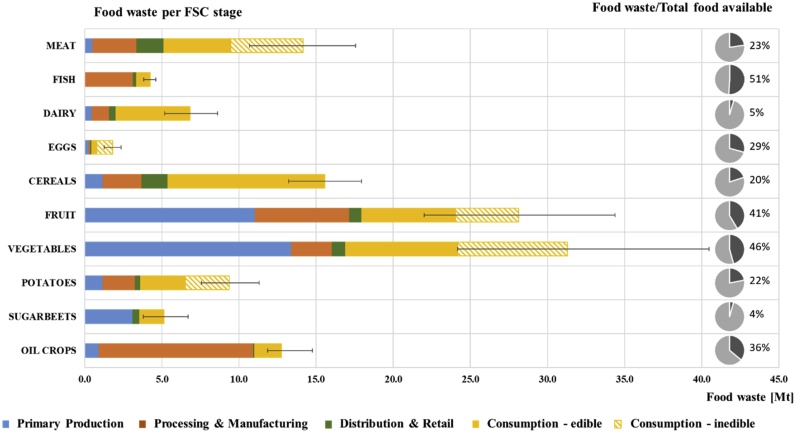
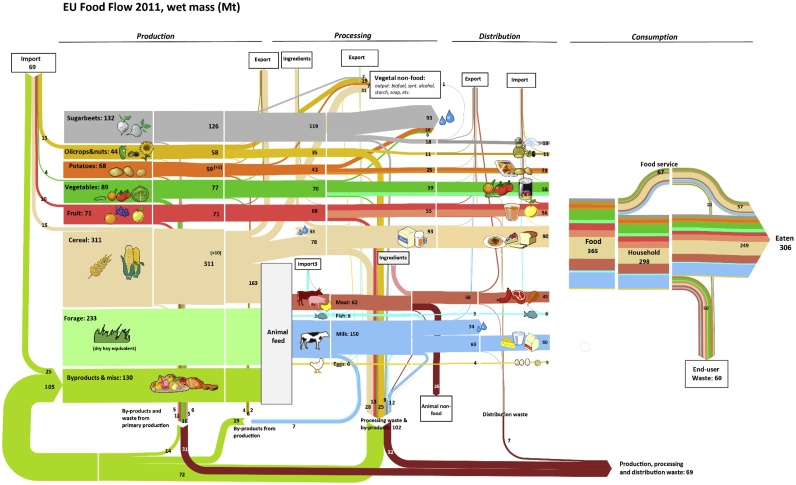
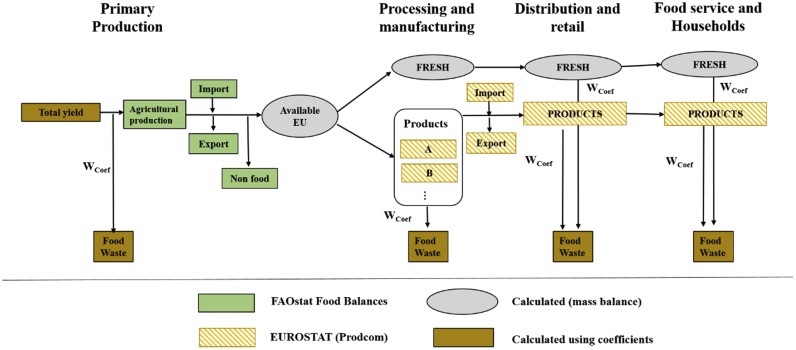
In 2015, the United Nations defined the Sustainable Development Goals (SDG), which include a target (12.3) on food waste. The target requires "by 2030, to halve per capita global food waste at the retail and consumer levels and to reduce food losses along production and supply chains, including post-harvest losses". The target has increased awareness about the food waste problem and boosted research in food waste quantification. Nevertheless, there is a lack of studies that adopt a systematic approach to account for food waste providing disaggregated values per food supply chain stage and per food groups. Such an approach could support policy makers in prioritizing interventions for food waste reduction. To fill this gap, this paper presents a high-level top-down approach to food waste accounting in the European Union. The study aims to support the understanding of the mass flows associated with food production, consumption, and waste, addressing different food groups along the food supply chain. The method for accountin is the mass flow analysis. According to the results, cereals, fruit, and vegetables as the food groups are responsible for the highest amount of food waste, and the consumption stage to be responsible for the largest share of food waste for most food groups. This work highlights the need for further primary research on food waste generation in the EU. Ultimately, this would allow to robustly estimate the food waste generated at EU level, and establishing a more accurate baseline to track the progress towards SDG target 12.3.

摘要

2015年,联合国确定了可持续发展目标(SDG),其中包括一项关于食物浪费的具体目标(12.3)。该目标要求“到2030年,将全球零售和消费层面人均食物浪费减半,并减少生产和供应链各环节的食物损失,包括收获后的损失”。这一目标提高了人们对食物浪费问题的认识,并推动了食物浪费量化方面的研究。然而,缺乏采用系统方法来统计食物浪费情况的研究,无法提供每个食物供应链阶段和每个食物类别的细分数据。这样的方法可以帮助政策制定者确定减少食物浪费干预措施的优先次序。为填补这一空白,本文提出了一种用于欧盟食物浪费核算的高层次自上而下的方法。该研究旨在帮助理解与食物生产、消费和浪费相关的物质流,涵盖食物供应链上的不同食物类别。核算方法是物质流分析。根据结果,谷物、水果和蔬菜这几类食物产生的食物浪费量最大,而且在大多数食物类别中,消费阶段产生的食物浪费占比最大。这项工作凸显了在欧盟对食物浪费产生情况进行进一步初步研究的必要性。最终,这将有助于可靠地估计欧盟层面产生的食物浪费量,并建立一个更准确的基线来跟踪实现可持续发展目标12.3的进展情况。
https://cdn.ncbi.nlm.nih.gov/pmc/blobs/852d/6703187/a24a39865aaf/gr3.jpg
https://cdn.ncbi.nlm.nih.gov/pmc/blobs/852d/6703187/2f668f1f604e/gr1.jpg
https://cdn.ncbi.nlm.nih.gov/pmc/blobs/852d/6703187/ca5276ad28e1/gr2.jpg
https://cdn.ncbi.nlm.nih.gov/pmc/blobs/852d/6703187/a24a39865aaf/gr3.jpg
https://cdn.ncbi.nlm.nih.gov/pmc/blobs/852d/6703187/2f668f1f604e/gr1.jpg
https://cdn.ncbi.nlm.nih.gov/pmc/blobs/852d/6703187/ca5276ad28e1/gr2.jpg
https://cdn.ncbi.nlm.nih.gov/pmc/blobs/852d/6703187/a24a39865aaf/gr3.jpg

相似文献

1
Quantification of food waste per product group along the food supply chain in the European Union: a mass flow analysis.欧盟食品供应链中各产品组食品浪费量的量化:物质流分析
Resour Conserv Recycl. 2019 Oct;149:479-488. doi: 10.1016/j.resconrec.2019.06.011.
2
Food waste accounting along global and European food supply chains: State of the art and outlook.全球和欧洲食品供应链中的食物浪费核算:现状与展望。
Waste Manag. 2018 Sep;79:120-131. doi: 10.1016/j.wasman.2018.07.032. Epub 2018 Jul 23.
3
Invited review: The consumer and dairy food waste: An individual plus policy, systems, and environmental perspective.邀请评论:消费者和乳制品食品浪费:个人加政策、系统和环境视角。
J Dairy Sci. 2022 May;105(5):3736-3745. doi: 10.3168/jds.2021-20994. Epub 2022 Mar 17.
4
Quantifying food waste in Hawaii's food supply chain.量化夏威夷食品供应链中的食物浪费。
Waste Manag Res. 2015 Dec;33(12):1076-83. doi: 10.1177/0734242X15607427. Epub 2015 Oct 7.
5
Quantification of food loss and waste and its percentage estimation along the food supply chain in Korea.韩国食品供应链中食物损失和浪费的量化及其百分比估计。
Waste Manag Res. 2023 Oct;41(10):1529-1538. doi: 10.1177/0734242X231178476. Epub 2023 Jun 20.
6
Reducing ethylene levels along the food supply chain: a key to reducing food waste?降低食品供应链中的乙烯水平:减少食物浪费的关键?
J Sci Food Agric. 2014 Sep;94(12):2357-61. doi: 10.1002/jsfa.6660. Epub 2014 Apr 30.
7
Waste not, want not: A bio-economic impact assessment of household food waste reductions in the EU.不浪费,不匮乏:欧盟家庭食物浪费减少的生物经济影响评估
Resour Conserv Recycl. 2019 Jul;146:514-522. doi: 10.1016/j.resconrec.2019.04.016.
8
The concept of food waste and food loss prevention and measuring tools.食物浪费与食物损失预防的概念及衡量工具。
Waste Manag Res. 2024 Aug;42(8):651-669. doi: 10.1177/0734242X241237187. Epub 2024 Mar 21.
9
Unveiling the potential for an efficient use of nitrogen along the food supply and consumption chain.揭示在食品供应和消费链中高效利用氮的潜力。
Glob Food Sec. 2020 Jun;25:100368. doi: 10.1016/j.gfs.2020.100368.
10
Estimating the magnitude of food waste generated in South Africa.估算南非产生的食物浪费量。
Waste Manag Res. 2013 Jan;31(1):80-6. doi: 10.1177/0734242X12457117. Epub 2012 Aug 9.

引用本文的文献

1
Circular valorization of green leafy side streams via pressurized liquid extraction techniques for recovery of bioactive compounds.通过加压液体萃取技术对绿叶副产物进行循环 valorization 以回收生物活性化合物。 (注:“valorization”这个词可能是特定专业领域的术语,这里直接保留英文,因为没有更准确的中文对应词,若有相关背景信息,可进一步优化翻译。)
Food Chem X. 2025 Aug 23;30:102944. doi: 10.1016/j.fochx.2025.102944. eCollection 2025 Aug.
2
Towards Healthy and Sustainable Diets: Understanding Food Consumption Trends in the EU.迈向健康与可持续饮食:了解欧盟的食物消费趋势
Foods. 2025 Aug 12;14(16):2798. doi: 10.3390/foods14162798.
3
Revisiting Additional Outcomes in Food Waste Studies: Evidence from Low-Income Households in Chile.

本文引用的文献

1
Food waste accounting methodologies: Challenges, opportunities, and further advancements.食物浪费核算方法:挑战、机遇与进一步进展
Glob Food Sec. 2019 Mar;20:93-100. doi: 10.1016/j.gfs.2019.01.002.
2
Food waste accounting along global and European food supply chains: State of the art and outlook.全球和欧洲食品供应链中的食物浪费核算:现状与展望。
Waste Manag. 2018 Sep;79:120-131. doi: 10.1016/j.wasman.2018.07.032. Epub 2018 Jul 23.
3
Quantifying household waste of fresh fruit and vegetables in the EU.量化欧盟新鲜果蔬的家庭浪费。
重新审视食物浪费研究中的其他结果:来自智利低收入家庭的证据。
Nutrients. 2025 Jul 18;17(14):2355. doi: 10.3390/nu17142355.
4
Obtention and Characterisation of Antioxidant-Rich Peptides from Defatted Grape Seed Meal Using Different Enzymes.使用不同酶从脱脂葡萄籽粕中获得富含抗氧化剂的肽并进行表征
Foods. 2025 Apr 3;14(7):1248. doi: 10.3390/foods14071248.
5
Analysis of Waste Trends in the European Union (2021-2023): Sectorial Contributions, Regional Differences, and Socio-Economic Factors.欧盟废弃物趋势分析(2021 - 2023年):部门贡献、区域差异及社会经济因素
Foods. 2025 Mar 27;14(7):1172. doi: 10.3390/foods14071172.
6
Tackling Food Waste: An Exploratory Case Study on Consumer Behavior in Romania.应对食物浪费:罗马尼亚消费者行为的探索性案例研究
Foods. 2024 Oct 18;13(20):3313. doi: 10.3390/foods13203313.
7
Vegetable Waste in the Retail Sector: Evaluation and Possibilities for Use in New Product Development.零售行业的蔬菜废弃物:评估及在新产品开发中的利用可能性
Foods. 2024 Sep 14;13(18):2916. doi: 10.3390/foods13182916.
8
From Attitude to Behavior: The Effect of Residents' Food Waste Attitudes on Their Food Waste Behaviors in Shanghai.从态度到行为:上海居民食物浪费态度对其食物浪费行为的影响
Foods. 2024 Jul 12;13(14):2201. doi: 10.3390/foods13142201.
9
The impact of dietary preference on household food waste: evidence from China.饮食偏好对家庭食物浪费的影响:来自中国的证据。
Front Nutr. 2024 Jul 9;11:1415734. doi: 10.3389/fnut.2024.1415734. eCollection 2024.
10
A Microbiological and Sensory Evaluation of Modified Atmosphere-Packed (MAP) Chicken at Use-By Date and Beyond.气调包装(MAP)鸡肉在保质期及过期后的微生物学和感官评价
Foods. 2024 Jul 5;13(13):2140. doi: 10.3390/foods13132140.
Waste Manag. 2018 Jul;77:238-251. doi: 10.1016/j.wasman.2018.04.001. Epub 2018 Apr 11.
4
Food waste quantification in primary production - The Nordic countries as a case study.初级生产中的食物浪费量化——以北欧国家为例。
Waste Manag. 2018 Jan;71:502-511. doi: 10.1016/j.wasman.2017.10.026.
5
Losses, inefficiencies and waste in the global food system.全球粮食系统中的损失、低效和浪费。
Agric Syst. 2017 May;153:190-200. doi: 10.1016/j.agsy.2017.01.014.
6
Missing Food, Missing Data? A Critical Review of Global Food Losses and Food Waste Data.缺失的食物,缺失的数据?对全球粮食损失和粮食浪费数据的批判性回顾。
Environ Sci Technol. 2017 Jun 20;51(12):6618-6633. doi: 10.1021/acs.est.7b00401. Epub 2017 May 26.
7
A half-century of production-phase greenhouse gas emissions from food loss & waste in the global food supply chain.全球食品供应链中食物损失和浪费的生产阶段温室气体排放长达半个世纪。
Sci Total Environ. 2016 Nov 15;571:721-9. doi: 10.1016/j.scitotenv.2016.07.041. Epub 2016 Jul 16.
8
Quantity and quality of food losses along the Swiss potato supply chain: Stepwise investigation and the influence of quality standards on losses.瑞士马铃薯供应链中的食物损耗数量和质量:逐步调查以及质量标准对损耗的影响。
Waste Manag. 2015 Dec;46:120-32. doi: 10.1016/j.wasman.2015.08.033. Epub 2015 Sep 2.
9
Food waste in the Swiss food service industry - Magnitude and potential for reduction.瑞士食品服务业中的食物浪费——规模及减少潜力
Waste Manag. 2015 Jan;35:218-26. doi: 10.1016/j.wasman.2014.09.015. Epub 2014 Oct 8.
10
The extent of food waste generation across EU-27: different calculation methods and the reliability of their results.欧盟27国食物浪费产生的程度:不同的计算方法及其结果的可靠性。
Waste Manag Res. 2014 Aug;32(8):683-94. doi: 10.1177/0734242X14545374.