Research Group of Gastroenterology and Nutrition, Department of Clinical Medicine, Faculty of Health Sciences, University of Tromsø-The Arctic University of Norway, Tromsø, Norway.
Gastroenterology Unit, Department of Medicine, University Hospital of North Norway, Tromsø, Norway.
Clin Transl Gastroenterol. 2019 Oct;10(10):e00082. doi: 10.14309/ctg.0000000000000082.
A healed intestinal mucosa is the aim of therapy in acute ulcerative colitis (UC). Disruption of mucosal wound healing may lead to severe complications including intestinal fibrosis. This study examined mucosal gene expression in the healing process of acute UC with a special focus on known mediators of fibrosis.
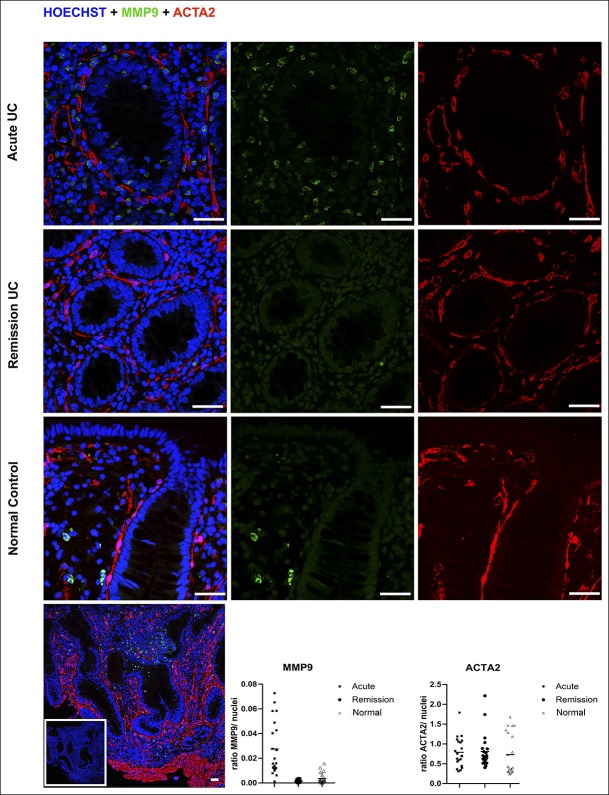
Endoscopic biopsies from patients with acute, moderate to severe UC were analyzed with a quantitative polymerase chain reaction array for 84 genes involved in fibrosis pathways. All patients were treated with infliximab (anti- tumor necrosis factor). Biopsies were taken before therapy and when disease remission was reached, defined as a Mayo score of ≤2, with an endoscopic subscore of 0 or 1. A healthy control group was included. Immunostaining of matrix metallopeptidase 9 and smooth muscle actin was performed.
Mucosal biopsies from acute UC (n = 28), remission UC (n = 28), and healthy controls (n = 13) were analyzed. Fibrosis and extracellular matrix-associated genes were upregulated in the endoscopically healed UC mucosa vs controls, with collagen type III alpha 1 chain, actin alpha 2, lysyl oxidase, TIMP metallopeptidase inhibitor 3, and caveolin 1 uniquely showing no overlap with acute disease. Pro- and antifibrotic mediators (interleukin [IL]13 receptor subunit alpha 2, IL1B, IL10, tumor necrosis factor, snail family transcriptional repressor 1, and C-C motif chemokine ligand 2) were upregulated in both acute and healed UC compared with controls. An attenuated pattern of the canonical transforming growth factor beta (TGFB) pathway was observed in acute UC and to a lesser extent in the healed mucosa, except for TGFB2, which was enhanced.
The endoscopically healed mucosa of UC showed a persisting dysregulation of fibrosis-associated mediators compared with controls, including extracellular matrix remodeling, profibrotic cytokines, and TGFB signaling pathways.
急性溃疡性结肠炎(UC)的治疗目标是修复肠黏膜。肠黏膜愈合受损可能导致严重并发症,包括肠纤维化。本研究通过定量聚合酶链反应阵列分析急性 UC 愈合过程中的黏膜基因表达,特别关注纤维化的已知介质。
对患有急性、中重度 UC 的患者进行内镜活检,采用定量聚合酶链反应阵列分析 84 种与纤维化途径相关的基因。所有患者均接受英夫利昔单抗(抗肿瘤坏死因子)治疗。在治疗前和达到疾病缓解时(定义为 Mayo 评分≤2,内镜下评分 0 或 1)采集活检。纳入健康对照组。进行基质金属蛋白酶 9 和平滑肌肌动蛋白的免疫染色。
分析了 28 例急性 UC、28 例缓解期 UC 和 13 例健康对照者的黏膜活检。与对照组相比,内镜下愈合的 UC 黏膜中纤维化和细胞外基质相关基因上调,其中胶原 III 链 alpha 1 、肌动蛋白 alpha 2 、赖氨酰氧化酶、TIMP 金属肽酶抑制剂 3 和小窝蛋白 1 与急性疾病无重叠。与对照组相比,促纤维化和抗纤维化介质(白细胞介素[IL]13 受体亚单位 alpha 2 、IL1B 、IL10 、肿瘤坏死因子、蜗牛家族转录抑制因子 1 和 C-C 基序趋化因子配体 2)在急性和愈合的 UC 中均上调。在急性 UC 中观察到经典转化生长因子β(TGFB)途径的减弱模式,在愈合的黏膜中程度较轻,但 TGFB2 增强。
与对照组相比,UC 的内镜下愈合黏膜显示纤维化相关介质持续失调,包括细胞外基质重塑、促纤维化细胞因子和 TGFB 信号通路。