London School of Hygiene & Tropical Medicine (Jarvis), London, UK; Centre for Urban Health Solution (Jarvis), St. Michael's Hospital, Toronto, Ont.; Department of Health Services Research and Policy (Murphy); Epidemiology and Population Health Faculty (Perel), London School of Hygiene & Tropical Medicine, London, UK; Department of Family and Community Medicine (Persaud), University of Toronto, Toronto, Ont.
CMAJ. 2019 Oct 7;191(40):E1093-E1099. doi: 10.1503/cmaj.190567.
Policy approaches have been considered to address inconsistent and inequitable prescription drug coverage in Canada, including a national essential medicines list. We sought to explore key factors influencing the acceptability and feasibility of an essential medicines list in Canada.
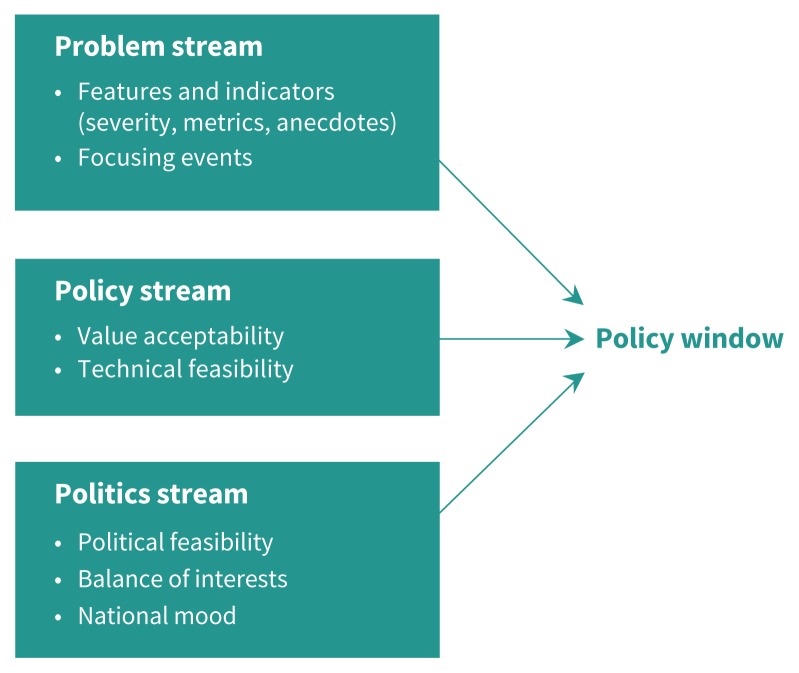
We conducted semi-structured interviews with decision-makers and other key stakeholders from government or pan-Canadian institutions, civil society and the private sector across Canada. We analyzed data using inductive thematic analysis and by applying Kingdon's Multiple Streams Framework to analyze the emergent themes deductively.
We conducted 21 interviews before thematic saturation was achieved. We categorized emergent themes to describe the problem, the essential medicines list policy (including content and process), and politics. There was consensus among participants that prescription drug coverage was an important problem to address. Participants differed in their views on how to define essential medicines and concerns about what would be excluded from an essential medicines list. There was consensus on important features for a process to develop an essential medicines list: an independent decision-making body, use of defined selection criteria based on quality evidence, and clear communication of the purpose of the essential medicines list. Federal government financing and the broader pharmacare model, engagement of various interest groups and changing political agendas emerged as core political factors to consider if developing a Canadian essential medicines list.
Although stakeholders' views on the content of a Canadian essential medicines list varied, there was consensus on the process to formulate and implement an essential medicines list or common national formulary, including choosing medicines based on best evidence. Greater understanding is now needed on how patients, clinicians and the public perceive the concept of an essential medicines list.
为了解决加拿大各地不一致和不平等的处方药覆盖问题,已经考虑了各种政策方法,包括国家基本药物清单。我们试图探讨影响加拿大基本药物清单可接受性和可行性的关键因素。
我们对来自加拿大政府或全加机构、民间社会和私营部门的决策者和其他利益攸关方进行了半结构化访谈。我们使用归纳主题分析方法对数据进行分析,并应用金登的多流框架对出现的主题进行演绎分析。
在达到主题饱和之前,我们进行了 21 次访谈。我们对出现的主题进行了分类,以描述问题、基本药物清单政策(包括内容和流程)和政治。参与者一致认为解决处方药覆盖问题非常重要。参与者对如何定义基本药物以及对基本药物清单中可能排除哪些药物存在不同看法。对于制定基本药物清单的过程,参与者达成了一些重要共识,包括:一个独立的决策机构、使用基于高质量证据的明确选择标准,以及明确说明基本药物清单的目的。联邦政府的融资和更广泛的药品保险模式、各种利益集团的参与以及不断变化的政治议程,是如果要制定加拿大基本药物清单,需要考虑的核心政治因素。
尽管利益攸关方对加拿大基本药物清单的内容有不同看法,但在制定和实施基本药物清单或共同的国家处方集的过程方面存在共识,包括根据最佳证据选择药物。现在需要进一步了解患者、临床医生和公众对基本药物清单概念的看法。