College of Basic Medical Sciences, Henan Key Laboratory of Medical Tissue Regeneration, Xinxiang Medical University, Xinxiang, China.
Department of Internal Medicine, Central Arkansas Veterans Healthcare System and University of Arkansas for Medical Sciences, Little Rock, AR, USA.
Cardiovasc Res. 2020 Aug 1;116(10):1721-1732. doi: 10.1093/cvr/cvz262.
Blood flow patterns play an important role in the localization of atherosclerosis in the sense that low-flow state is pro-atherogenic, and helical flow is protective against atherosclerosis. Proprotein convertase subtilisin/kexin type 9 (PCSK9) regulates cholesterol metabolism via low-density lipoprotein receptor (LDLr) degradation and is highly expressed in the atherosclerotic tissues. This study was designed to investigate the role of different blood flow patterns in the regulation of PCSK9 expression.
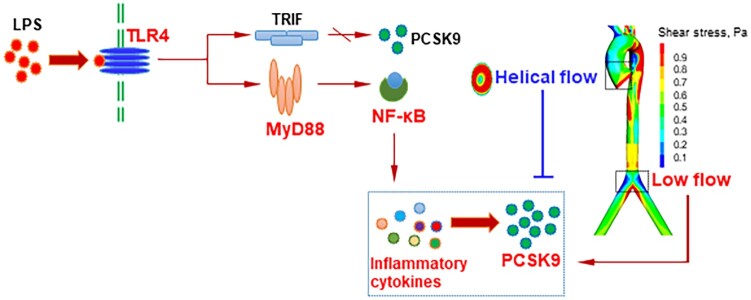
We designed an experimental model guider to generate stable helical flow. Our data showed that compared with normal flow, low-flow state induces whereas helical flow inhibits PCSK9 expression in the rabbit thoracic aorta in an inflammatory state. Our data also identified that TLR4-MyD88-NF-κB signalling plays an important role in PCSK9 expression. On the other hand, TRIF pathway had almost no effect. Further studies showed that the signals downstream of NF-κB, such as pro-inflammatory cytokines (IL-1β, IL-18, MCP-1, IL-6, TNF-α, IL-12, IFNγ, and GM-CSF) directly influence PCSK9 expression. Interestingly, high fat diet further enhanced PCSK9 expression in an inflammatory milieu.
These observations suggest a link between abnormal flow patterns and PCSK9 expression in inflammatory states, which may qualify helical flow and pro-inflammatory cytokines as potential targets to treat PCSK9-related cardiovascular diseases.
血流模式在动脉粥样硬化的定位中起着重要作用,因为低流速状态是促动脉粥样硬化的,而螺旋流对动脉粥样硬化有保护作用。前蛋白转化酶枯草溶菌素/ kexin 9 型(PCSK9)通过低密度脂蛋白受体(LDLr)降解调节胆固醇代谢,在动脉粥样硬化组织中高度表达。本研究旨在探讨不同血流模式在调节 PCSK9 表达中的作用。
我们设计了一个实验模型导向器来产生稳定的螺旋流。我们的数据表明,与正常血流相比,低流速状态在炎症状态下诱导而螺旋流抑制兔胸主动脉中的 PCSK9 表达。我们的数据还表明 TLR4-MyD88-NF-κB 信号通路在 PCSK9 表达中起重要作用。另一方面,TRIF 途径几乎没有影响。进一步的研究表明,NF-κB 下游的信号,如促炎细胞因子(IL-1β、IL-18、MCP-1、IL-6、TNF-α、IL-12、IFNγ和 GM-CSF)直接影响 PCSK9 的表达。有趣的是,高脂饮食在炎症环境中进一步增强了 PCSK9 的表达。
这些观察结果表明,在炎症状态下,异常的血流模式与 PCSK9 的表达之间存在联系,这可能使螺旋流和促炎细胞因子成为治疗 PCSK9 相关心血管疾病的潜在靶点。