Nölting Svenja, Ullrich Martin, Pietzsch Jens, Ziegler Christian G, Eisenhofer Graeme, Grossman Ashley, Pacak Karel
Department of Medicine IV, University Hospital, LMU Munich, Ziemssenstraße 1, 80336 München, Germany.
Department of Radiopharmaceutical and Chemical Biology, Institute of Radiopharmaceutical Cancer Research, Helmholtz-Zentrum Dresden-Rossendorf, Bautzner Landstrasse 400, 01328 Dresden, Germany.
Cancers (Basel). 2019 Oct 8;11(10):1505. doi: 10.3390/cancers11101505.
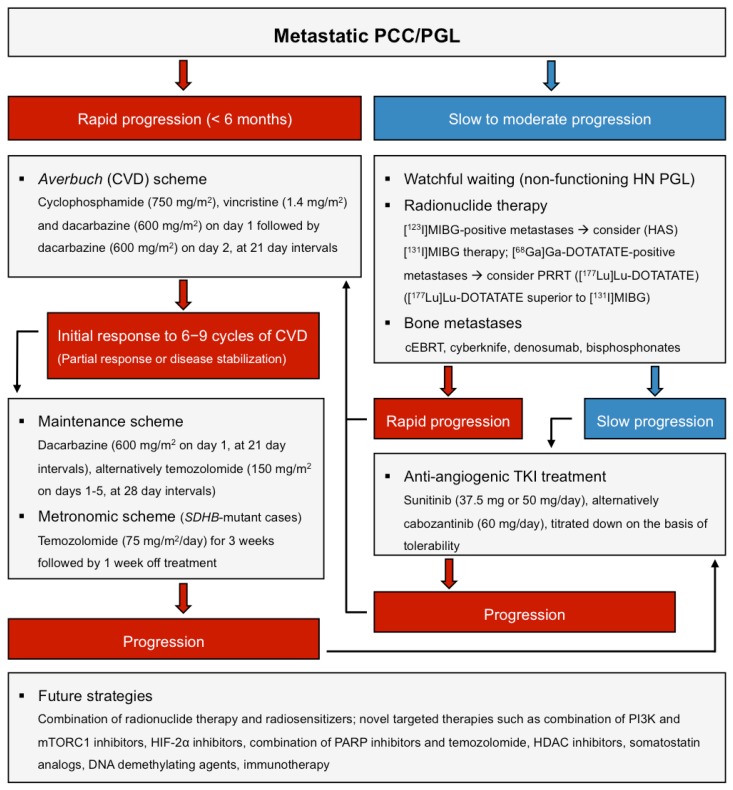
Pheochromocytomas and paragangliomas (PCC/PGLs) are rare, mostly catecholamine-producing neuroendocrine tumors of the adrenal gland (PCCs) or the extra-adrenal paraganglia (PGL). They can be separated into three different molecular clusters depending on their underlying gene mutations in any of the at least 20 known susceptibility genes: The pseudohypoxia-associated cluster 1, the kinase signaling-associated cluster 2, and the Wnt signaling-associated cluster 3. In addition to tumor size, location (adrenal vs. extra-adrenal), multiplicity, age of first diagnosis, and presence of metastatic disease (including tumor burden), other decisive factors for best clinical management of PCC/PGL include the underlying germline mutation. The above factors can impact the choice of different biomarkers and imaging modalities for PCC/PGL diagnosis, as well as screening for other neoplasms, staging, follow-up, and therapy options. This review provides a guide for practicing clinicians summarizing current management of PCC/PGL according to tumor size, location, age of first diagnosis, presence of metastases, and especially underlying mutations in the era of precision medicine.
嗜铬细胞瘤和副神经节瘤(PCC/PGLs)是罕见的、大多产生儿茶酚胺的神经内分泌肿瘤,位于肾上腺(PCCs)或肾上腺外副神经节(PGL)。根据至少20种已知易感基因中任何一种潜在的基因突变,它们可分为三个不同的分子簇:与假性缺氧相关的簇1、与激酶信号传导相关的簇2和与Wnt信号传导相关的簇3。除肿瘤大小、位置(肾上腺 vs. 肾上腺外)、多发性、首次诊断年龄以及转移疾病的存在(包括肿瘤负荷)外,PCC/PGL最佳临床管理的其他决定性因素包括潜在的种系突变。上述因素会影响PCC/PGL诊断中不同生物标志物和成像方式的选择,以及其他肿瘤的筛查、分期、随访和治疗方案。本综述为临床医生提供了一份指南,总结了在精准医学时代根据肿瘤大小、位置、首次诊断年龄、转移灶的存在,特别是潜在突变对PCC/PGL的当前管理。