Noguchi Taiji, Kondo Katsunori, Saito Masashige, Nakagawa-Senda Hiroko, Suzuki Sadao
Department of Public Health, Nagoya City University, Nagoya, Japan.
Center for Gerontology and Social Science, National Center for Geriatrics and Gerontology, Obu, Japan.
BMJ Open. 2019 Oct 8;9(10):e029279. doi: 10.1136/bmjopen-2019-029279.
The present study examined the association between community social capital and the onset of functional disability among older Japanese people by using validated indicators of social capital and a prospective multilevel design.
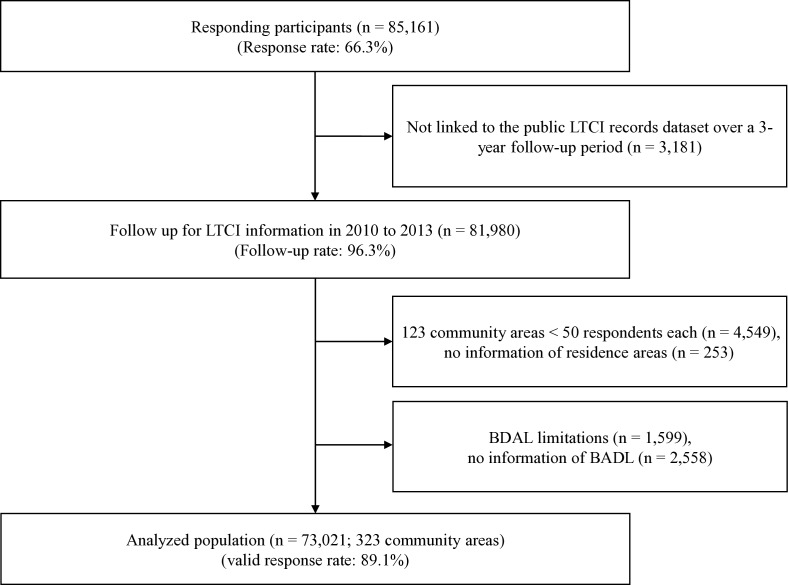
Prospective cohort study SETTING: We used data from the Japan Gerontological Evaluation Study, established from August 2010 to January 2012 in 323 districts.
The target population was restricted to non-institutionalised people aged 65 years or older who were independent in activities of daily living. Participants included 73 021 people (34 051 men and 38 970 women) who were followed up over a 3-year period.
The primary outcome measure was the onset of functional disability, defined as a new registration in public long-term care insurance system records with a care-needs level of two or above, analysed with multilevel Cox proportional hazards regression models by community social capital (civic participation, social cohesion and reciprocity).
The mean age of participants was 73.3 years (SD=6.0) for men and 73.8 years (SD=6.2) for women. During the study period, the onset of functional disability occurred in 1465 (4.3%) men and 1519 (3.9%) women. Of three community social capital variables, social cohesion significantly reduced the risk of onset of functional disability (HR 0.910; 95% CI 0.830 to 0.998) among men, after adjusting for individual social and behavioural variables. There was no significant effect among women.
Living in a community with rich social cohesion is associated with a lower incidence of onset of functional disability among older Japanese men.
本研究通过使用经过验证的社会资本指标和前瞻性多层次设计,探讨日本老年人社区社会资本与功能残疾发病之间的关联。
前瞻性队列研究
我们使用了日本老年学评估研究的数据,该研究于2010年8月至2012年1月在323个地区开展。
目标人群仅限于65岁及以上、日常生活活动能够自理的非机构化人群。参与者包括73021人(男性34051人,女性38970人),他们接受了为期3年的随访。
主要结局指标为功能残疾的发病,定义为公共长期护理保险系统记录中护理需求水平为二级或以上的新登记情况,通过社区社会资本(公民参与、社会凝聚力和互惠)的多层次Cox比例风险回归模型进行分析。
男性参与者的平均年龄为73.3岁(标准差=6.0),女性为73.8岁(标准差=6.2)。在研究期间,1465名(4.3%)男性和1519名(3.9%)女性出现了功能残疾。在调整了个体社会和行为变量后,在三个社区社会资本变量中,社会凝聚力显著降低了男性功能残疾发病的风险(风险比0.910;95%置信区间0.830至0.998)。女性中未发现显著影响。
生活在社会凝聚力丰富的社区与日本老年男性功能残疾发病的较低发生率相关。