Hajewski Christina J, Westermann Robert W, Holte Andrew, Shamrock Alan, Bollier Matthew, Wolf Brian R
University of Iowa Hospitals and Clinics, Iowa City, Iowa, USA.
Orthop J Sports Med. 2019 Sep 26;7(9):2325967119870753. doi: 10.1177/2325967119870753. eCollection 2019 Sep.
Excessive prescription of opioids has become a national problem. Providers must attempt to decrease the amount of opioids prescribed while still providing patients with adequate pain relief after surgery.
Implementing a standardized multimodal analgesic protocol will decrease the amount of opioids prescribed at the time of surgery as well as the total amount of opioids dispensed postoperatively.
Case series; Level of evidence, 4.
Patients who had undergone meniscectomy, rotator cuff repair (RCR), or anterior cruciate ligament (ACL) reconstruction at our institution were identified by Current Procedural Terminology code 12 months prior to and 6 months after the initiation of a standardized multimodal postoperative pain protocol. Records were reviewed to extract demographic data, amount of opioids prescribed at the time of surgery, amount and frequency of opioid refills, and call-ins regarding pain medication or its side effects. A Wilcoxon rank-sum test was used to evaluate differences in opioid prescriptions between pre- and postprotocol, and significance was set to < .05.
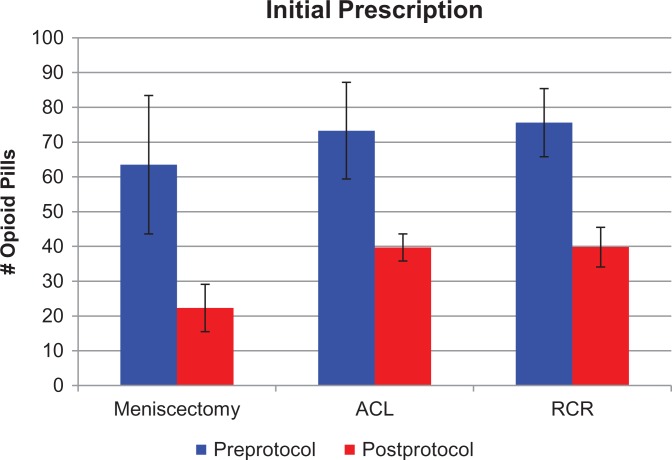
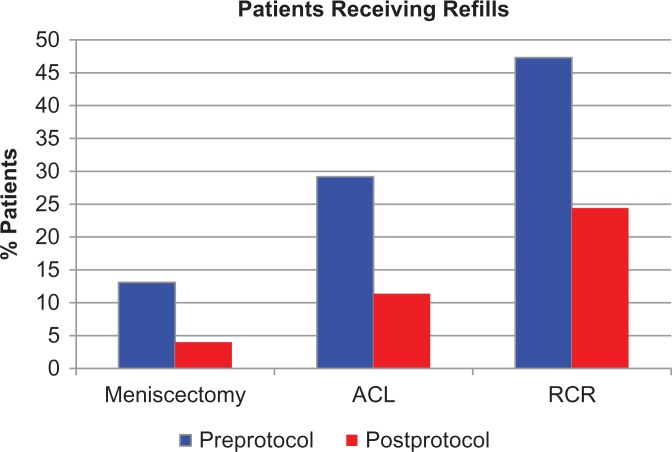
The mean amount of opioids prescribed at the time of surgery decreased from 63.5 to 22.3 pills ( < .0001) for meniscectomy, from 73.3 to 39.7 ( < .0001) for ACL reconstruction, and from 75.6 to 39.8 ( < .0001) for RCR. The percentage of patients receiving a refill of opioids during the postoperative period also decreased for all groups: from 13% to 4% ( = .0051) for meniscectomy, 29.2% to 11.4% ( = .0005) for ACL reconstruction, and 47.3% to 24.4% ( < .0001) for RCR. There was no significant difference in patient calls regarding pain medication or its side effects.
Institution of a standardized multimodal analgesia protocol significantly decreased the amount of opioids dispensed after common arthroscopic procedures. This reduction in the amount of opioids given on the day of surgery did not result in an increased demand for refills. Our study also demonstrated that 20 opioid pills were adequate for patients undergoing meniscectomy and 40 pills were adequate for ACL reconstruction and RCR in the majority of cases. This protocol serves as a way for providers to decrease the amount of opioids dispensed after surgery while providing patients with alternatives for pain relief.
阿片类药物的过度处方已成为一个全国性问题。医疗服务提供者必须在减少阿片类药物处方量的同时,仍要为术后患者提供足够的疼痛缓解。
实施标准化的多模式镇痛方案将减少手术时开具的阿片类药物量以及术后发放的阿片类药物总量。
病例系列;证据级别,4级。
通过当前操作术语代码,在标准化多模式术后疼痛方案启动前12个月和启动后6个月,确定在我们机构接受半月板切除术、肩袖修复术(RCR)或前交叉韧带(ACL)重建术的患者。审查记录以提取人口统计学数据、手术时开具的阿片类药物量、阿片类药物补充的量和频率,以及关于止痛药或其副作用的电话咨询。使用Wilcoxon秩和检验来评估方案前后阿片类药物处方的差异,显著性设定为<0.05。
半月板切除术患者手术时开具的阿片类药物平均量从63.5片降至22.3片(<0.0001),ACL重建术患者从73.3片降至39.7片(<0.0001),RCR患者从75.6片降至39.8片(<0.0001)。所有组术后接受阿片类药物补充的患者百分比也有所下降:半月板切除术患者从13%降至4%(P = 0.0051),ACL重建术患者从29.2%降至11.4%(P = 0.0005),RCR患者从47.3%降至24.4%(<0.0001)。在关于止痛药或其副作用的患者电话咨询方面没有显著差异。
实施标准化的多模式镇痛方案显著减少了常见关节镜手术后发放的阿片类药物量。手术当天给予的阿片类药物量的减少并未导致补充需求的增加。我们的研究还表明,在大多数情况下,20片阿片类药物对接受半月板切除术的患者足够,40片对ACL重建术和RCR患者足够。该方案为医疗服务提供者提供了一种在为患者提供疼痛缓解替代方法的同时减少术后阿片类药物发放量的途径。