Laboratorio de Fotobiología, Unidad Académica de Sistemas Arrecifales Puerto Morelos, Universidad Nacional Autónoma de México, Apto. Postal 13, 77500-QR, Cancún, Mexico.
School of Geographical and Earth Sciences, Gregory Building Rm419, University of Glasgow, Glasgow, G12 8QQ, UK.
Sci Rep. 2019 Oct 10;9(1):14657. doi: 10.1038/s41598-019-51248-z.
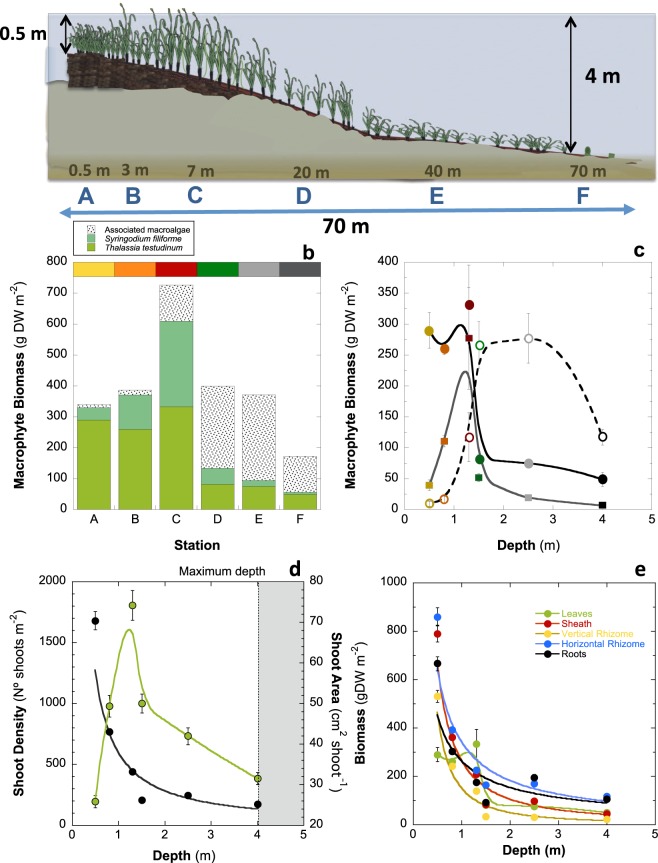
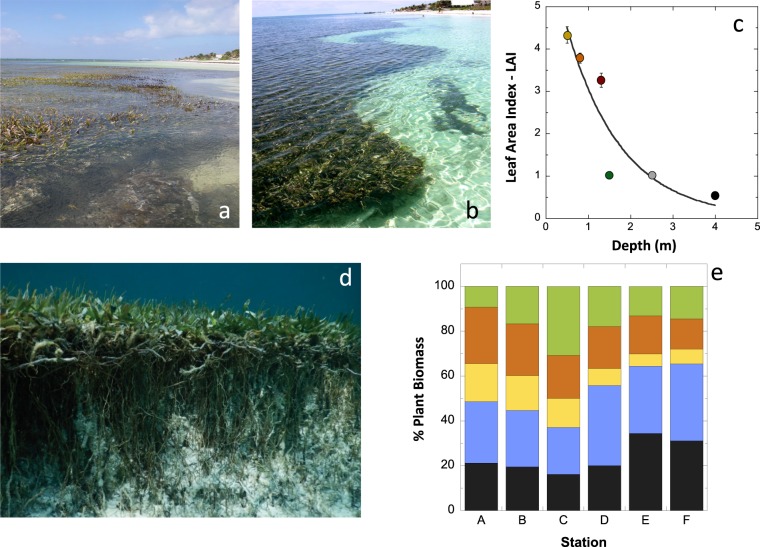
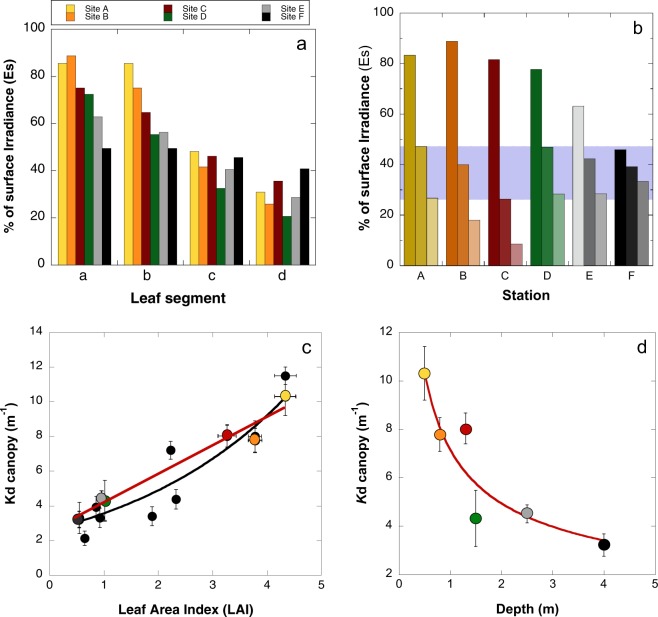
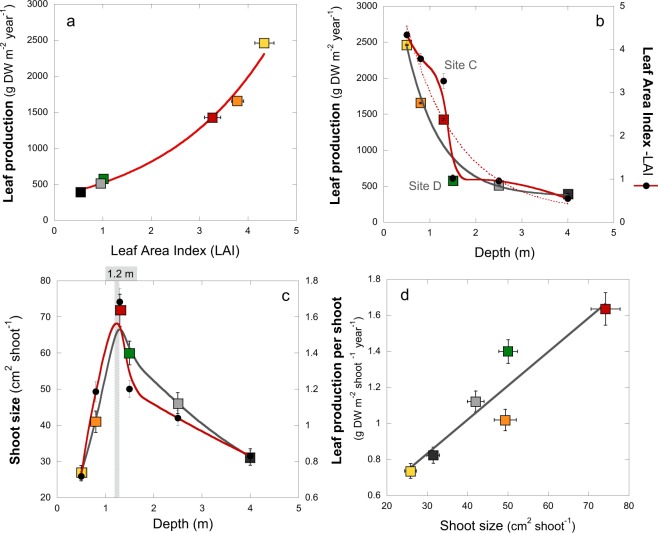
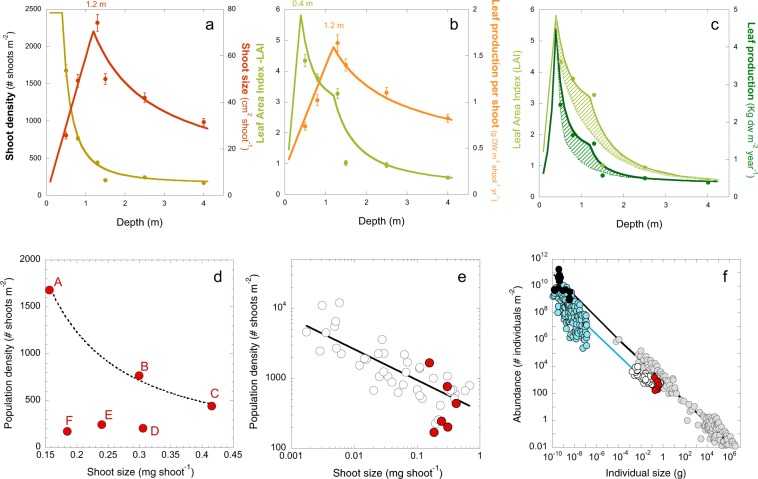
Analyses of the integrated seagrass response to depth support the previously documented low plasticity and consistent shade-adapted leaf physiology of a habitat-builder that dominates well-illuminated reef environments. Two structural responses, "canopy-opening" and "below-ground-mass-depletion", govern the photoacclimatory response and facilitate, respectively, light penetration within the canopy and functional adjustments in whole-plant carbon balances. Conversely, "canopy-closing" may also explain dense canopies formed close to the waterline, as they provide shade and photoprotection to a susceptible leaf physiology under high-light. Canopy light attenuation is primarily regulated by the leaf area index (LAI), which is governed by changes in shoot size and density. Shoot density diminishes non-linearly with depth, while shoot size increases to a maximum followed by a decline. The initial increase in shoot size, which resembles a self-thinning response, increases LAI and meadow production in shallow depths. These seagrass structural adjustments have relevant ecological implications. Canopy-thinning allows macrophyte diversity to increase with depth, while seagrass production and carbon storage diminish exponentially, and are maximal only in a shallow coastal fringe. The results support the universality of plant self-thinning, from phytoplankton to complex canopies, likely the consequence of simple physical laws related to light limitation and pigment self-shading within photosynthetic structures and communities.
对海草综合响应深度的分析支持了先前记录的低可塑性和一致的遮荫适应的栖息地建设者的叶片生理学,该栖息地建设者在光照良好的珊瑚礁环境中占主导地位。两种结构响应,“树冠开放”和“地下物质耗竭”,控制着光驯化反应,分别促进树冠内的光穿透和整个植物碳平衡的功能调整。相反,“树冠闭合”也可能解释了靠近水位线形成的茂密树冠,因为它们为敏感的叶片生理学在高光下提供遮荫和光保护。树冠光衰减主要受叶面积指数(LAI)的调节,LAI 由枝条大小和密度的变化决定。枝条密度随深度呈非线性减少,而枝条大小增加到最大值,然后下降。枝条大小的最初增加类似于自疏响应,增加了浅层的 LAI 和草地产量。这些海草结构调整具有相关的生态意义。树冠变薄允许大型植物多样性随深度增加,而海草的生产力和碳储存呈指数衰减,并且仅在浅海岸带达到最大值。结果支持了植物自疏的普遍性,从浮游植物到复杂的树冠,这可能是与光限制和光合结构和群落中色素自遮蔽相关的简单物理规律的结果。