KU Leuven Department of Rehabilitation Sciences, Leuven, Belgium.
Clinical Motion Analysis Laboratory, University Hospitals Leuven, Leuven, Belgium.
PLoS One. 2019 Oct 11;14(10):e0223363. doi: 10.1371/journal.pone.0223363. eCollection 2019.
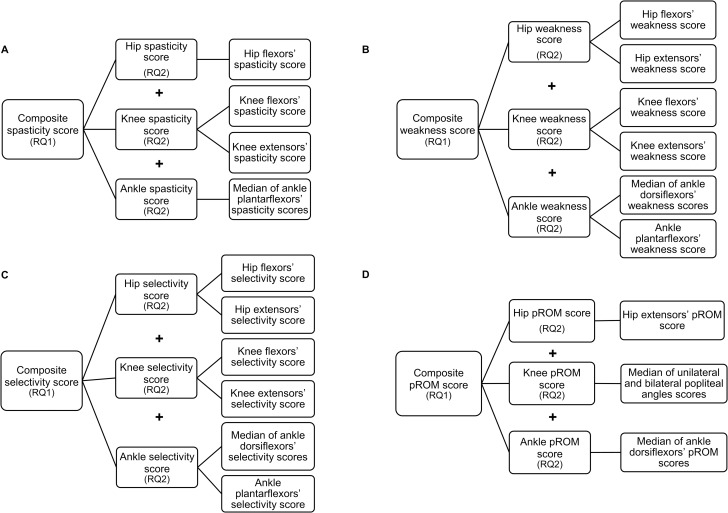
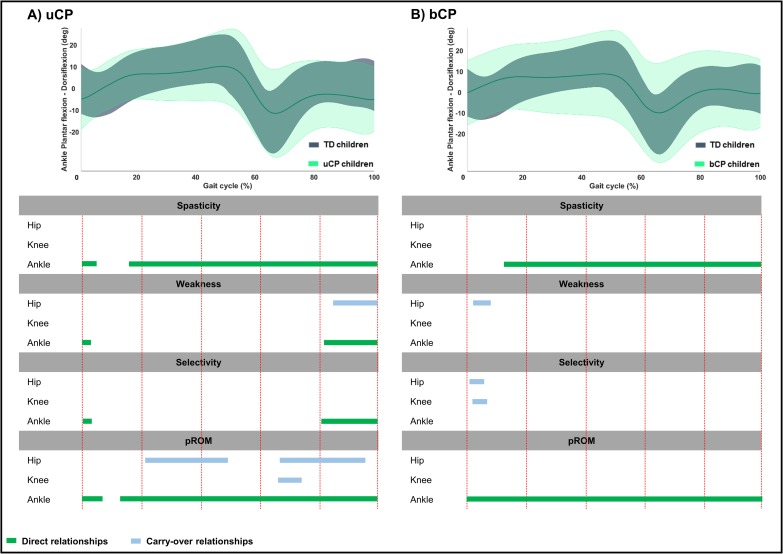
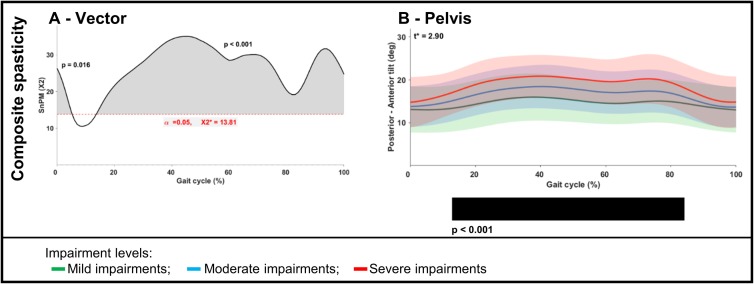
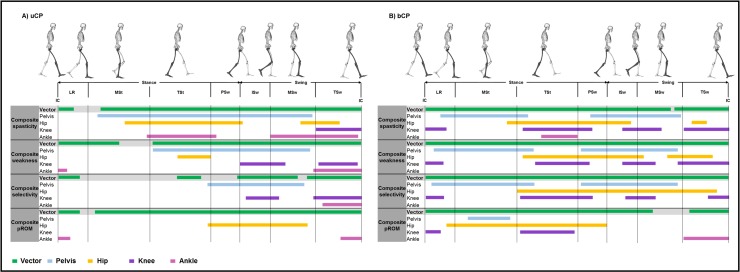
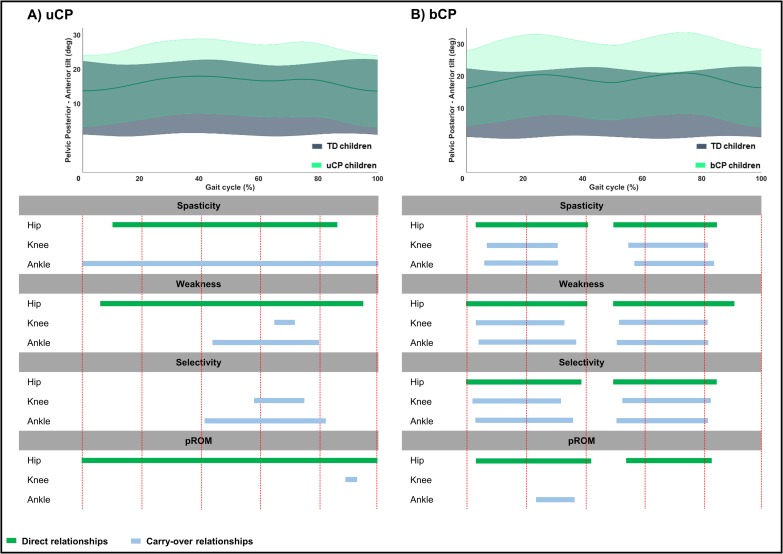
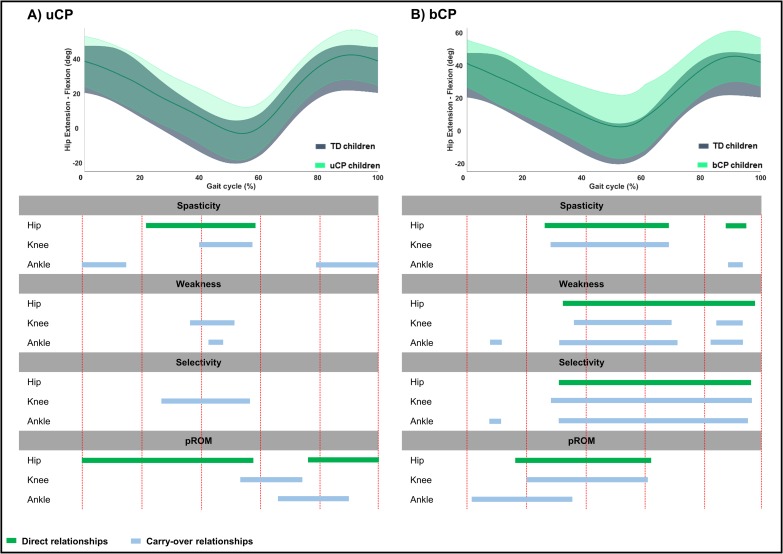
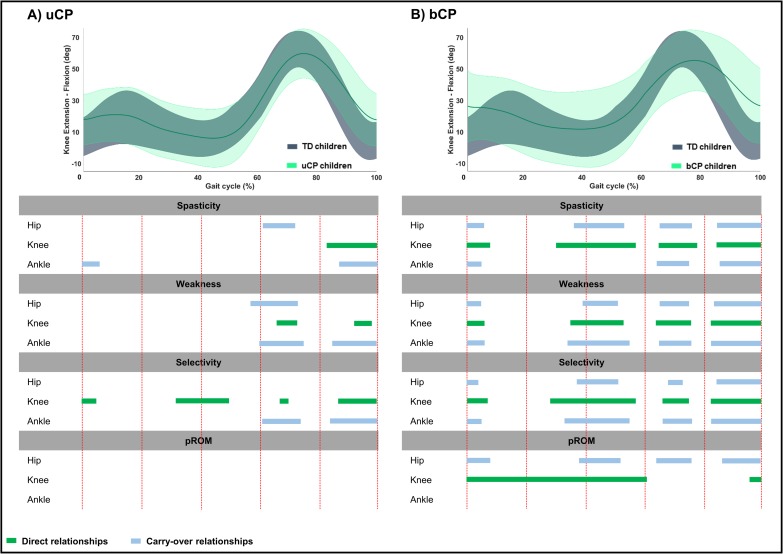
This study aimed to identify the relationships between clinical impairments and gait deviations in children with cerebral palsy (CP). A retrospective convenience sample of 367 children with CP was selected (3-18 years old) and divided in two groups based on clinical symptomatology [unilateral (uCP) / bilateral CP (bCP), (n = 167/200)]. All children underwent a three-dimensional gait analysis and a standardized clinical examination. Gait was inspected on a vector level (all sagittal motions combined), and an individual joint level (pelvis, hip, knee and ankle joint motions). Statistical non-parametric mapping was applied to identify specific parts of the gait cycle displaying relationships between the gait deviations of both groups and the impairment scores of spasticity, weakness, selectivity, and passive range of motion. Impairment scores were summarized in two ways: a) composite impairment scores (e.g. combined spasticity of all assessed muscles acting around the hip, knee and ankle joints) and b) joint specific impairment scores (e.g. spasticity of the muscles acting around the knee joint). Results showed that the vector and most of the individual motions were related to the composite scores. Direct and carry-over relationships were found between certain individual motions and joint impairment scores (around the same or neighboring joints, respectively). All correlations were more prominent for children with bCP compared to uCP, especially regarding the relationships of gait deviations with weakness and reduced selectivity. In conclusion, this study enabled the mapping of relationships between clinical impairments and gait deviations in children with CP, by identifying specific parts of the gait cycle that are related to each of these impairments. These results provide a comprehensive description of these relationships, while simultaneously highlighting the differences between the two CP groups. Integration of these findings could lead to a better understanding of the pathophysiology of gait deviations and, eventually, support individualized treatment planning.
本研究旨在确定脑瘫(CP)儿童的临床障碍与步态偏差之间的关系。我们选择了 367 名 CP 儿童(3-18 岁)作为回顾性便利样本,并根据临床症状将其分为两组[单侧 CP(uCP)/双侧 CP(bCP),(n = 167/200)]。所有儿童均接受了三维步态分析和标准化临床检查。步态在矢状面水平(所有矢状面运动的总和)和关节水平(骨盆、髋关节、膝关节和踝关节运动)进行检查。应用非参数统计映射来识别显示两组步态偏差与痉挛、无力、选择性和被动运动范围等损伤评分之间关系的特定步态周期部分。损伤评分以两种方式进行总结:a)综合损伤评分(例如,评估的围绕髋关节、膝关节和踝关节的所有肌肉的综合痉挛)和 b)关节特异性损伤评分(例如,膝关节周围肌肉的痉挛)。结果表明,矢状面和大多数个体运动与综合评分相关。在某些个体运动与关节损伤评分之间发现了直接和传递关系(分别是相同或相邻关节)。与 uCP 相比,bCP 儿童的所有相关性更为明显,尤其是与步态偏差与无力和选择性降低相关的相关性。总之,本研究通过确定与这些损伤相关的特定步态周期部分,实现了 CP 儿童临床障碍与步态偏差之间关系的映射。这些结果全面描述了这些关系,同时突出了两组 CP 之间的差异。整合这些发现可以帮助更好地理解步态偏差的病理生理学,并最终支持个体化治疗计划。