Department of Nursing, Faculty of Nursing and Midwifery, Bam University of Medical Sciences, Bam, Iran.
Department of Gynecologic Oncology, Tehran University of Medical Sciences, Tehran, Iran.
BMC Cancer. 2019 Oct 11;19(1):942. doi: 10.1186/s12885-019-6174-3.
Studies on relationship between tubal ligation and endometrial cancer have led to contradictory findings. In several studies, however, a reduced endometrial cancer risk was suggested following tubal ligation. Therefore, a systematic review and meta-analysis was conducted to examine the relationship between tubal ligation and endometrial cancer risk.
In this systematic review and meta-analysis, PubMed/Medline, Web of Science, Scopus, Embase, and Google Scholar were searched for relevant studies published up to May 30th, 2018. We compared endometrial cancer risk in women with and without tubal ligation in retrieved studies.
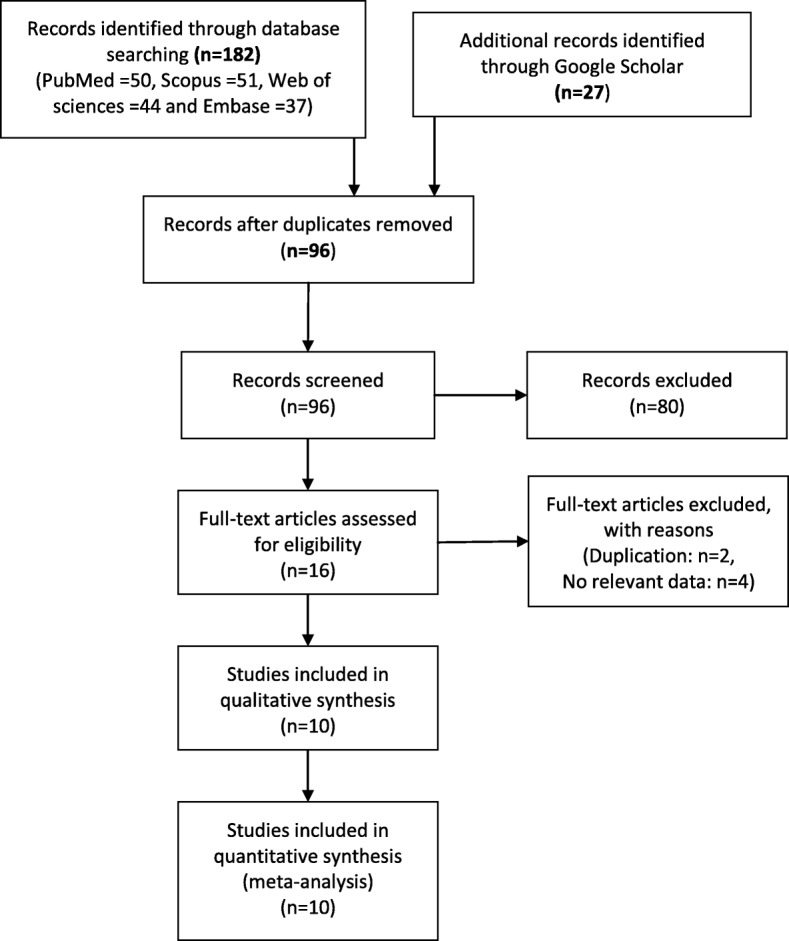
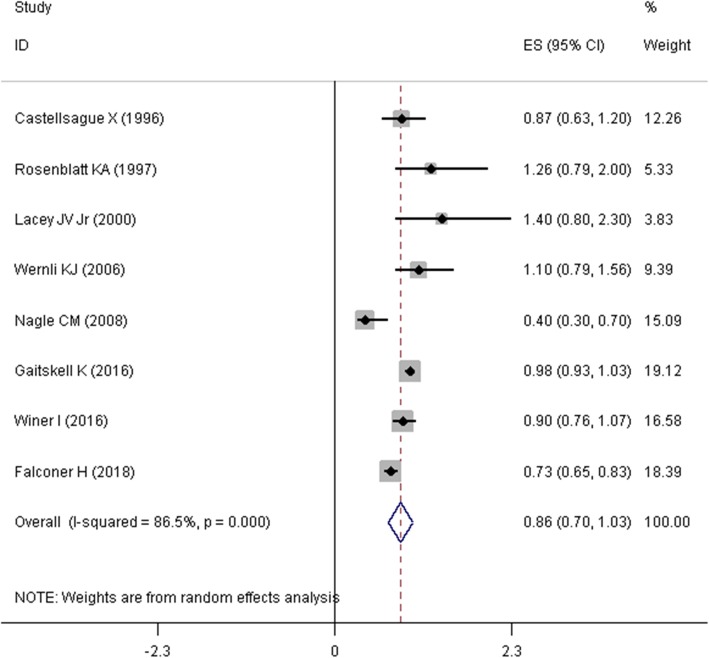
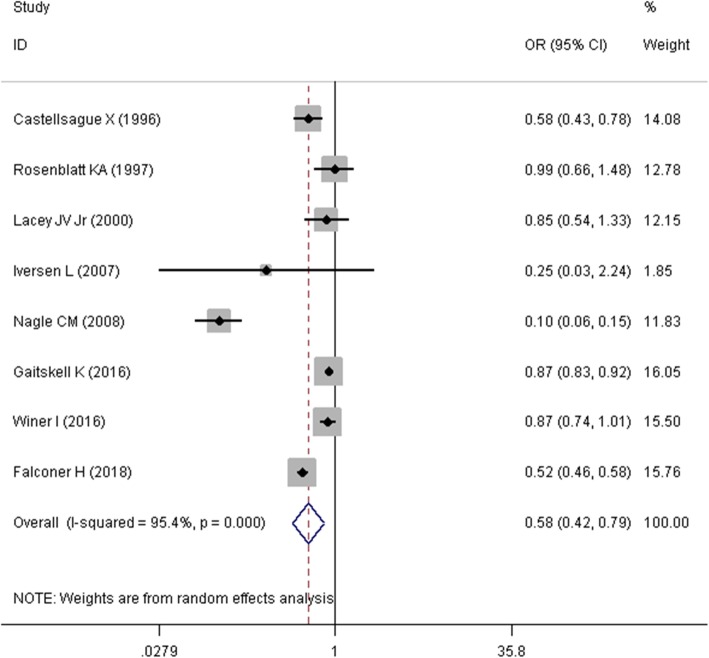
Two hundred nine studies were initially retrieved from the data bases. After exclusion of duplicates and studies which did not meet inclusion criteria, ten cohort and case-control studies, including 6,773,066 cases, were entered into the quantitative meta-analysis. There was 0.90% agreement between two researchers who searched and retrieved the studies. The summary OR (SOR) was reported using a random effect model. Begg's test suggested that there was no publication bias, but a considerable heterogeneity was observed (I = 95.4%, P = 0.001). We pooled the raw number of tables cells (i.e. a, b, c, and d) of eight studies. The SOR suggested that tubal ligation was significantly associated with a lower risk of endometrial cancer (SOR = 0.577, 95% CI = 0.420-0.792). Also, given the rare nature of endometrial cancer (< 5%), different effect sizes were considered as comparable measures of risk. Therefore we pooled ten studies and SOR of these studies revealed that tubal ligation was significantly associated with a lower risk of endometrial cancer (SOR = 0.696, 95% CI = 0.425-0.966). Besides that, we pooled eight studies in which adjusted effect sizes were reported and a subsequent analysis revealed that the summary estimate of adjusted odds ratio (SAOR) was significant (SAOR = 0.862, 95% CI = 0.698-1.026).
This study revealed a protective effect of tubal ligation on endometrial cancer risk (approximately 42% lower risk of cancer). It is recommended that studies should be designed to reveal mechanisms of this relationship.
关于输卵管结扎与子宫内膜癌之间关系的研究得出了相互矛盾的结论。然而,在一些研究中,输卵管结扎后子宫内膜癌的风险降低。因此,进行了系统评价和荟萃分析,以检查输卵管结扎与子宫内膜癌风险之间的关系。
在这项系统评价和荟萃分析中,检索了截至 2018 年 5 月 30 日发表的相关研究,包括 PubMed/Medline、Web of Science、Scopus、Embase 和 Google Scholar。我们比较了检索研究中输卵管结扎妇女和未结扎妇女的子宫内膜癌风险。
从数据库中最初检索到 209 项研究。排除重复项和不符合纳入标准的研究后,有 10 项队列研究和病例对照研究纳入了定量荟萃分析,共包括 6773066 例病例。两名研究人员在检索和筛选研究方面的一致性为 0.90%。使用随机效应模型报告汇总比值比(SOR)。Begg 检验表明不存在发表偏倚,但观察到相当大的异质性(I=95.4%,P=0.001)。我们合并了 8 项研究的原始表格单元格(即 a、b、c 和 d)数量。SOR 表明,输卵管结扎与子宫内膜癌风险降低显著相关(SOR=0.577,95%CI=0.420-0.792)。此外,鉴于子宫内膜癌的罕见性(<5%),不同的效应大小被认为是风险的可比衡量标准。因此,我们合并了 10 项研究,这些研究的 SOR 表明,输卵管结扎与子宫内膜癌风险降低显著相关(SOR=0.696,95%CI=0.425-0.966)。此外,我们合并了 8 项报告了调整后效应大小的研究,随后的分析表明,调整后优势比的汇总估计值(SAOR)具有统计学意义(SAOR=0.862,95%CI=0.698-1.026)。
本研究揭示了输卵管结扎对子宫内膜癌风险的保护作用(癌症风险降低约 42%)。建议设计研究以揭示这种关系的机制。