Newman Sharlene D, Cheng Hu, Schnakenberg Martin Ashley, Dydak Ulrike, Dharmadhikari Shalmali, Hetrick William, O'Donnell Brian
Department of Psychological and Brain Sciences, Indiana University, Bloomington, IN, United States.
Program in Neuroscience, Indiana University, Bloomington, IN, United States.
Front Hum Neurosci. 2019 Sep 19;13:318. doi: 10.3389/fnhum.2019.00318. eCollection 2019.
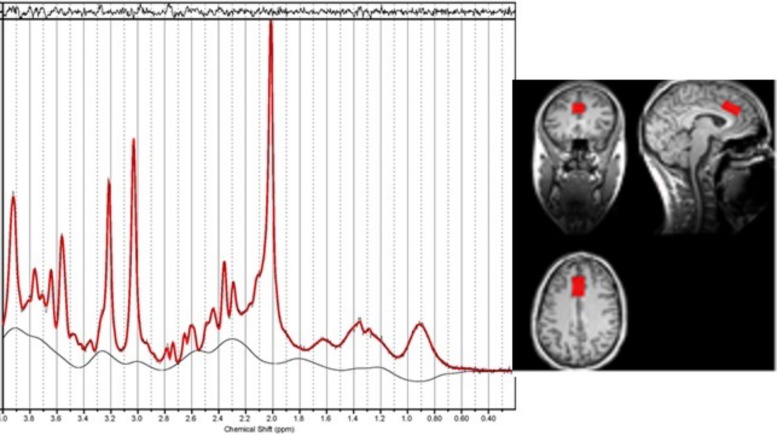
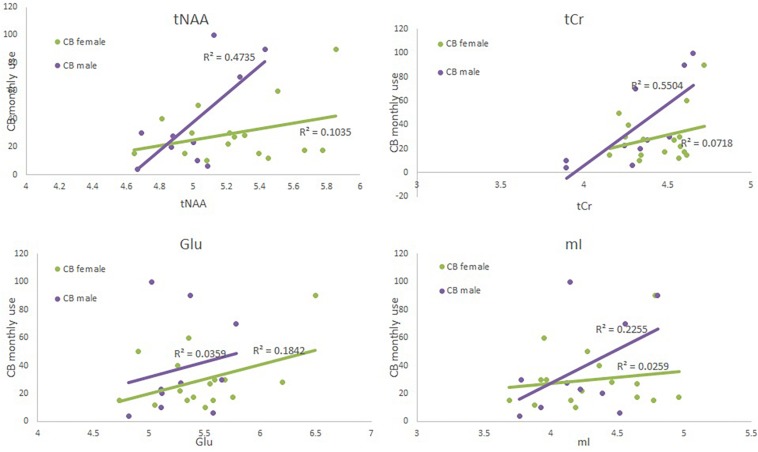
With the legalization of recreational cannabis (CB) the characterization of how it may impact brain chemistry is essential. Magnetic resonance spectroscopy (MRS) was used to examine neurometabolite concentrations in the dorsal anterior cingulate (dACC) in chronic CB users ( = 26; 10 females) and controls ( = 24; 10 females). The concentrations of glutamate (Glu), total creatine (tCr), choline (Cho), total -acetylaspartate (tNAA), and myo-inositol (mI) were estimated using LCModel. The ANCOVAs failed to show significant differences between controls and CB users. Regression analyses were then performed on the CB group to model each neurometabolite to determine its relationship to monthly CB use, sex, the interaction between CB use and sex. tCr was found to be predicted by both monthly CB use and sex. While the regression model was not significant the relationship between monthly CB use and Glu appears to be modulated by sex with the effect of monthly use (dose) being stronger in males. tNAA failed to show an effect of CB use but did reveal an effect of sex with females showing larger tNAA levels. Although the results presented are preliminary due to the small sample size they do guide future research. The results presented provide direction for further studies as they suggest that dose may significantly influence the observance of CB effects and that those effects may be modulated by sex. Studies with significantly larger sample sizes designed specifically to examine individuals with varying usage as well as sex effects are necessary.
随着娱乐用大麻(CB)的合法化,了解其对大脑化学的影响至关重要。本研究使用磁共振波谱(MRS)检测了慢性大麻使用者(n = 26;10名女性)和对照组(n = 24;10名女性)背侧前扣带回(dACC)中的神经代谢物浓度。使用LCModel估算谷氨酸(Glu)、总肌酸(tCr)、胆碱(Cho)、总N-乙酰天门冬氨酸(tNAA)和肌醇(mI)的浓度。协方差分析未显示对照组和大麻使用者之间存在显著差异。随后对大麻使用者组进行回归分析,以建立每种神经代谢物的模型,确定其与每月大麻使用量、性别以及大麻使用与性别的相互作用之间的关系。发现tCr可由每月大麻使用量和性别共同预测。虽然回归模型不显著,但每月大麻使用量与Glu之间的关系似乎受性别调节,每月使用量(剂量)对男性的影响更强。tNAA未显示大麻使用的影响,但确实揭示了性别的影响,女性的tNAA水平更高。尽管由于样本量小,目前的结果是初步的,但它们确实为未来的研究提供了指导。目前的结果为进一步研究提供了方向,因为它们表明剂量可能会显著影响大麻效应的观察,并且这些效应可能受性别调节。有必要进行样本量显著更大的研究,专门针对不同使用情况的个体以及性别效应进行研究。