
具有未知包接收率、噪声方差和模型参数的多传感器网络系统的自调谐分布式融合滤波器。
Self-Tuning Distributed Fusion Filter for Multi-Sensor Networked Systems with Unknown Packet Receiving Rates, Noise Variances, and Model Parameters.
机构信息
School of Electronics Engineering, Heilongjiang University, Harbin 150080, China.
出版信息
Sensors (Basel). 2019 Oct 13;19(20):4436. doi: 10.3390/s19204436.
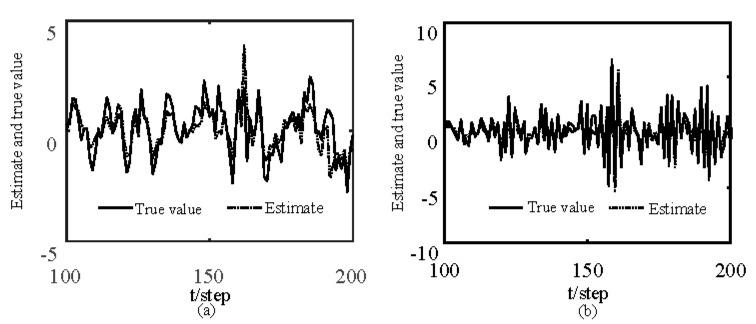
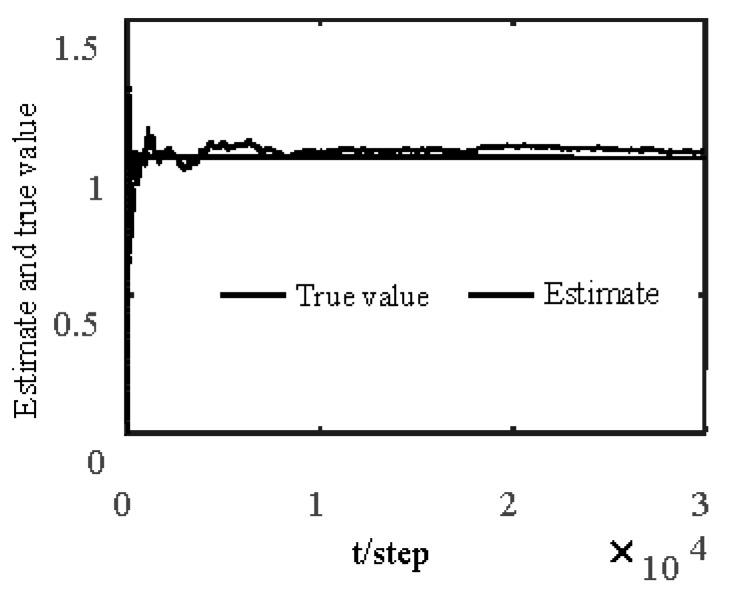
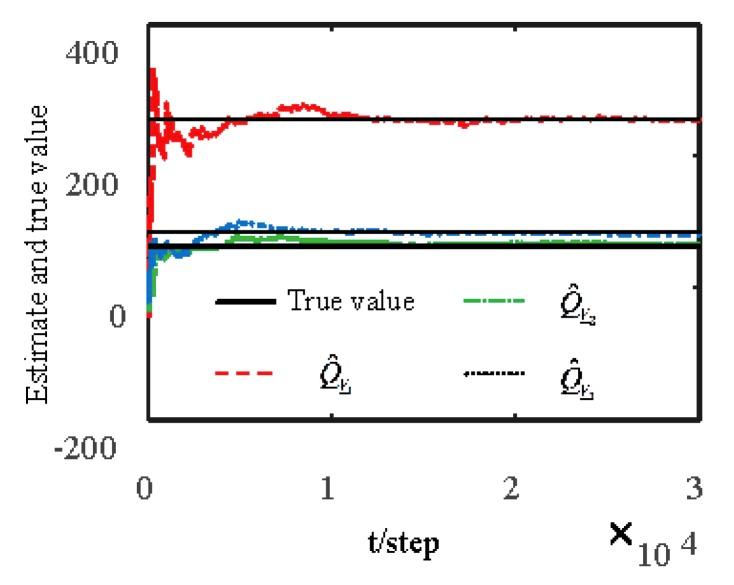
In this study, we researched the problem of self-tuning (ST) distributed fusion state estimation for multi-sensor networked stochastic linear discrete-time systems with unknown packet receiving rates, noise variances (NVs), and model parameters (MPs). Packet dropouts may occur when sensor data are sent to a local processor. A Bernoulli distributed stochastic variable is adopted to depict phenomena of packet dropouts. By model transformation, the identification problem of packet receiving rates is transformed into that of unknown MPs for a new augmented system. The recursive extended least squares (RELS) algorithm is used to simultaneously identify packet receiving rates and MPs in the original system. Then, a correlation function method is used to identify unknown NVs. Further, a ST distributed fusion state filter is achieved by applying identified packet receiving rates, NVs, and MPs to the corresponding optimal estimation algorithms. It is strictly proven that ST algorithms converge to optimal algorithms under the condition that the identifiers for parameters are consistent. Two examples verify the effectiveness of the proposed algorithms.
在这项研究中,我们研究了具有未知包接收率、噪声方差 (NV) 和模型参数 (MP) 的多传感器网络随机线性离散时间系统的自整定 (ST) 分布式融合状态估计问题。当传感器数据发送到本地处理器时,可能会发生数据包丢失。采用伯努利分布随机变量来描述数据包丢失现象。通过模型变换,将包接收率的辨识问题转化为新增系统中未知 MPs 的辨识问题。在原始系统中,采用递推扩展最小二乘法 (RELS) 算法同时辨识包接收率和 MPs。然后,采用相关函数法辨识未知 NVs。进一步地,将辨识得到的包接收率、NVs 和 MPs 应用于相应的最优估计算法,得到 ST 分布式融合状态滤波器。在参数辨识器一致的条件下,严格证明了 ST 算法收敛到最优算法。两个实例验证了所提出算法的有效性。




 Zotero 插件