Wójtowicz Anna, Zembala-Szczerba Małgorzata, Babczyk Dorota, Kołodziejczyk-Pietruszka Monika, Lewaczyńska Olga, Huras Hubert
Department of Obstetrics & Perinatology, Jagiellonian University Medical College, Ul. Kopernika 23, 31-501 Kraków, Poland.
Department of Neonatology, Jagiellonian University Medical College, Ul. Kopernika 23, 31-501 Kraków, Poland.
Int J Hypertens. 2019 Sep 17;2019:4108271. doi: 10.1155/2019/4108271. eCollection 2019.
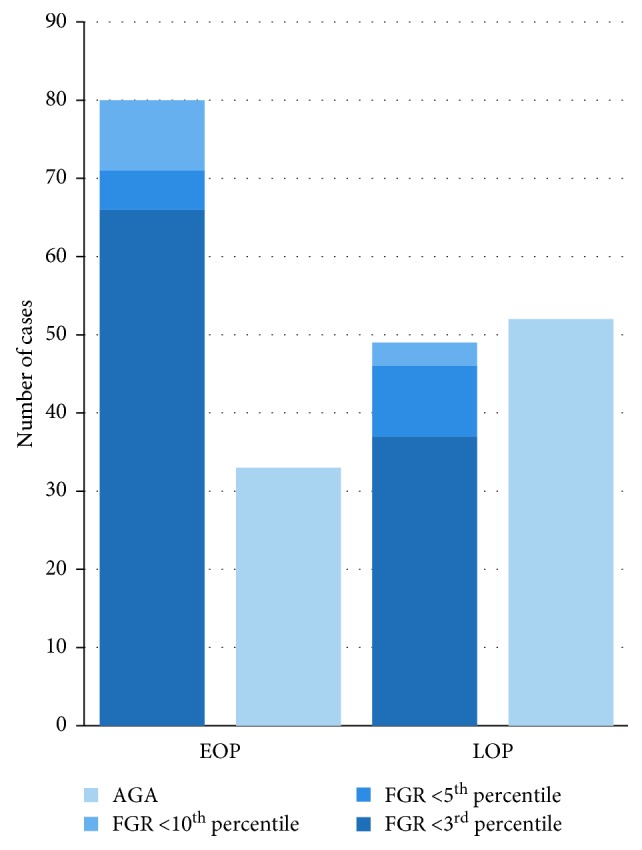
Recently, the diagnostic criteria of preeclampsia have been changed. No studies are available in the literature that analyzed in detail the differences between early-onset preeclampsia (EOP) and late-onset preeclampsia (LOP), taking into account the International Society for the Study of Hypertension in Pregnancy (ISSHP) criteria. Thus, we sought to retrospectively investigate in detail the differences in clinical and laboratory outcomes between EOP and LOP diagnosed according to the ISSHP criteria. A retrospective cohort study was conducted in 214 women with singleton pregnancies and preeclampsia admitted to the Department of Obstetrics and Perinatology of the University Hospital in Kraków, Poland, from 2013 to 2017 (113 (52.8%) women with EOP and 101 (47.2%) women with LOP). Electronic medical records were reviewed for demographics and medical history, laboratory tests, and delivery and neonatal data. Patients with preeclampsia accounted for 1.7% of the women who delivered during the study period. The EOP and LOP groups did not differ in the distribution of risk factors for preeclampsia. The most common risk factor was primiparity, which was observed in 72.0% of cases. Regarding the ISSHP diagnostic criteria, the two groups differed in the incidence of fetal growth restriction (=0.0009), hemolysis (=0.0416), and neurological complications (=00342), which were found more often in the EOP group. In addition, the EOP group had more frequent occurrence of severe cardiorespiratory ( < 0.0001) and hematological (=0.0127) complications, adverse fetoplacental conditions ( < 0.0001), and severe fetoplacental complications (=0.0003). Children born to women with EOP had lower Apgar scores ( < 0.001) and higher rates of intraventricular hemorrhage ( < 0.0001), respiratory disorders requiring mechanical ventilation ( < 0.0001), and early (=0.0004) and late sepsis (=0.002). EOP differed from LOP in terms of maternal and perinatal adverse outcomes. The observed higher rates of fetoplacental adverse conditions and severe complications indicate a significant contribution of impaired placentation to the etiopathogenesis of EOP.
最近,子痫前期的诊断标准发生了变化。在文献中没有研究详细分析早发型子痫前期(EOP)和晚发型子痫前期(LOP)之间的差异,同时考虑到国际妊娠高血压研究学会(ISSHP)的标准。因此,我们试图回顾性地详细研究根据ISSHP标准诊断的EOP和LOP在临床和实验室结果方面的差异。对2013年至2017年期间入住波兰克拉科夫大学医院妇产科和围产医学科的214名单胎妊娠子痫前期妇女进行了一项回顾性队列研究(113名(52.8%)EOP妇女和101名(47.2%)LOP妇女)。对电子病历进行了人口统计学和病史、实验室检查以及分娩和新生儿数据的审查。子痫前期患者占研究期间分娩妇女的1.7%。EOP组和LOP组在子痫前期危险因素的分布上没有差异。最常见的危险因素是初产,在72.0%的病例中观察到。关于ISSHP诊断标准,两组在胎儿生长受限(=0.0009)、溶血(=0.0416)和神经并发症(=0.0342)的发生率上存在差异,这些在EOP组中更常见。此外,EOP组严重心肺(<0.0001)和血液学(=0.0127)并发症、不良胎盘胎儿情况(<0.0001)和严重胎盘胎儿并发症(=0.0003)的发生频率更高。EOP妇女所生的儿童阿氏评分较低(<0.001),脑室内出血(<0.0001)、需要机械通气的呼吸障碍(<0.0001)以及早期(=0.0004)和晚期败血症(=0.002)的发生率较高。EOP在孕产妇和围产儿不良结局方面与LOP不同。观察到的较高胎盘胎儿不良情况和严重并发症发生率表明胎盘形成受损在EOP病因发病机制中起重要作用。