Klifto Kevin M, Gurno Caresse F, Grzelak Michael J, Seal Stella M, Asif Mohammed, Hultman C Scott, Caffrey Julie A
1Department of Plastic and Reconstructive Surgery, The Johns Hopkins University School of Medicine, Baltimore, MD USA.
Johns Hopkins Burn Center, 4940 Eastern Avenue, Baltimore, MD 21224 USA.
Burns Trauma. 2019 Oct 18;7:30. doi: 10.1186/s41038-019-0168-x. eCollection 2019.
Cutaneous manifestations of purpura fulminans (PF) present many challenges for clinicians and surgeons. In a state of septic shock complicated by limb ischemia, surgical interventions are necessary to control the pathological cascade and improve patient outcomes. The objective of this article was to report etiologies and surgical outcomes associated with cutaneous manifestations in adults.
This systematic review and meta-analysis compared 190 adult patients with etiologies, signs and symptoms, and surgical outcomes associated with cutaneous manifestations of PF. The PubMed, EMBASE, Cochrane Library, Web of Science, and Scopus databases were systematically and independently searched. Patient and clinical characteristics, surgical interventions, outcomes, and complications were recorded.
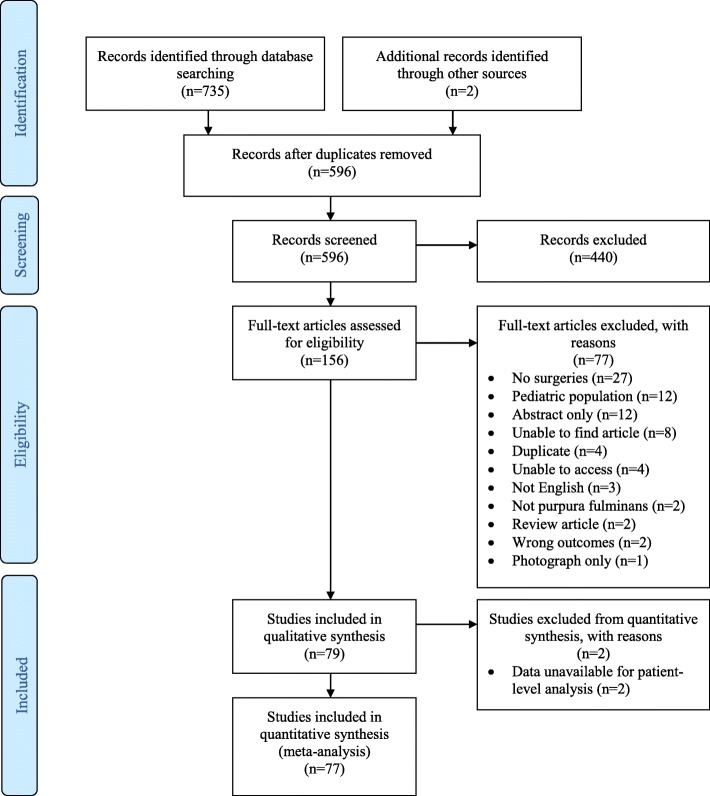
Seventy-nine studies were eligible for the systematic review, and 77 were eligible for meta-analysis using Preferred Reporting Items for Systematic Reviews and Meta-analysis (PRISMA) and Cochrane guidelines. A total of 71/190 (38%) cases reported surgical debridement. Fasciotomies were reported in 12/190 (6%) cases and 20 procedures. Amputations were reported in 154/190 (81%) cases. Reconstruction was reported in 45 cases. Skin grafts were applied in 31 cases. Flaps were used for reconstruction in 28 cases. Median (IQR) surgical procedures per patient were 4 (4, 5) procedures. Infectious organisms causing PF were 32% ( = 55) and 32% ( = 55). Coagulase-negative (95% confidence interval (CI)(8.2-177.9), = 0.032), (95%CI (7.2-133), = 0.029), (95% CI (13.3-75.9), = 0.006), and West Nile Virus (95%CI (8.2-177.9), = 0.032) were associated with significantly more extensive amputations compared to other organisms.
This systematic review and patient-level meta-analysis found the most common presentation of PF was septic shock from an infectious organism. and were equally the most common organisms associated with PF. The majority of cases were not treated in a burn center. The most common surgeries were amputations, with below-the-knee-amputations being the most common procedure. Skin grafting was the most commonly performed reconstructive procedure. The most common complications were secondary infections. Organisms with significantly more extensive amputations were coagulase-negative , , , and West Nile Virus. Interpretation of findings should be cautioned due to limited sample data.
暴发性紫癜(PF)的皮肤表现给临床医生和外科医生带来了诸多挑战。在伴有肢体缺血的感染性休克状态下,手术干预对于控制病理级联反应和改善患者预后是必要的。本文的目的是报告与成人皮肤表现相关的病因及手术结果。
本系统评价和荟萃分析比较了190例成年患者与PF皮肤表现相关的病因、体征和症状以及手术结果。对PubMed、EMBASE、Cochrane图书馆、科学网和Scopus数据库进行了系统且独立的检索。记录患者和临床特征、手术干预、结果及并发症。
79项研究符合系统评价的纳入标准,77项符合使用系统评价和荟萃分析的首选报告项目(PRISMA)及Cochrane指南进行荟萃分析的标准。总共71/190(38%)的病例报告了手术清创。12/190(6%)的病例及20例手术报告了筋膜切开术。154/190(81%)的病例报告了截肢手术。45例报告了重建手术。31例应用了皮肤移植。28例使用皮瓣进行重建。每位患者的中位(四分位间距)手术次数为4(4,5)次。导致PF的感染性生物分别占32%(n = 55)和32%(n = 55)。与其他生物相比,凝固酶阴性葡萄球菌(95%置信区间(CI)(8.2 - 177.9),P = 0.032)、金黄色葡萄球菌(95%CI(7.2 - 133),P = 0.029)、铜绿假单胞菌(95%CI(13.3 - 75.9),P = 0.006)和西尼罗河病毒(95%CI(8.2 - 177.9),P = 0.032)与更广泛的截肢显著相关。
本系统评价和患者水平的荟萃分析发现,PF最常见的表现是由感染性生物引起的感染性休克。金黄色葡萄球菌和铜绿假单胞菌同样是与PF相关的最常见生物。大多数病例未在烧伤中心接受治疗。最常见的手术是截肢,其中膝下截肢是最常见的术式。皮肤移植是最常进行的重建手术。最常见的并发症是继发感染。与更广泛截肢显著相关的生物是凝固酶阴性葡萄球菌、金黄色葡萄球菌、铜绿假单胞菌和西尼罗河病毒。由于样本数据有限,对研究结果的解读应谨慎。