Department of Nutrition, University of California, Davis, CA 95616 1, USA.
Obesity and Metabolism Research Unit, USDA/ARS/Western Human Nutrition Research Center 2, Davis, CA, 95616, USA.
Nutrients. 2019 Oct 24;11(11):2563. doi: 10.3390/nu11112563.
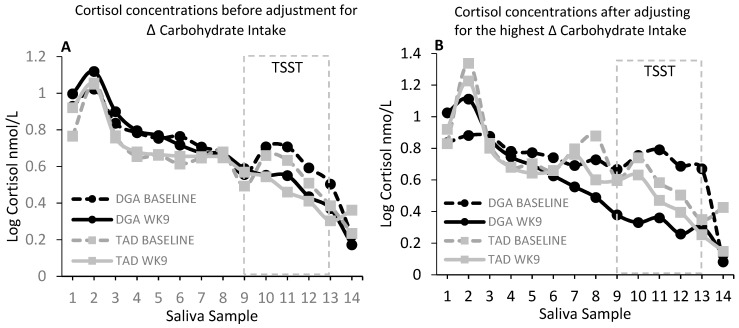
It is largely unknown whether and how whole food diets influence psychological stress and stress system responsiveness. To better understand the effects of whole diets on stress system responsiveness, we examined randomized control trial effects of a whole food diet based on the Dietary Guidelines for Americans (DGA) on cortisol responsiveness. A randomized, double-blind, controlled 8-week intervention was conducted in overweight and obese women to examine differentiated effects between two diet intervention groups: one based on the 2010 DGA and the other one based on a typical American diet (TAD). During a test week that occurred at baseline and again after 8 weeks of the intervention, we assessed salivary cortisol collected at 14 selected times across the day, including upon awakening, at bedtime, and during a test visit, and administered a standardized social stress task (Trier Social Stress Test, TSST). There were no statistical differences between the diet groups in salivary cortisol at baseline or after 8 weeks. However, when considering differences in dietary carbohydrate, but not fat or protein, from the pre-intervention (habitual) to the intervention period, there was a significant ( = 0.0001) interaction between diet group, intervention week, saliva sample, and level of intervention-based change in carbohydrate consumption. This interaction was reflected primarily by an 8-week reduction in salivary cortisol during a period just prior to (log Δ -0.35 ± 0.12 nmol/L) and 30 (log Δ -0.49 ± 0.12 nmol/L), 60 (log Δ -0.50 ± 0.13 nmol/L), 90 (log Δ -0.51 ± 0.13 nmol/L), and 120 (log Δ -0.4476 ± 0.1231 nmol/L) min after the TSST in the DGA group having the highest increase (90th percentile) in carbohydrate consumption. In support of this finding, we also found significant ( < 0.05) and inverse linear associations between dietary carbohydrate and log salivary cortisol, with the strongest negative association (β: -0.004 ± 0.0015, = 0.009) occurring at 30 min post-TSST, but only in the DGA group and at week 9 of the intervention. Together, increasing dietary carbohydrate as part of a DGA-based diet may reduce circulating cortisol and dampen psychological stress-related cortisol responsiveness.
目前尚不清楚全食物饮食是否以及如何影响心理压力和应激系统反应性。为了更好地了解全食物饮食对应激系统反应性的影响,我们研究了基于美国饮食指南(DGA)的全食物饮食对皮质醇反应性的随机对照试验效果。在超重和肥胖女性中进行了一项随机、双盲、对照的 8 周干预研究,以检验两种饮食干预组之间的差异效应:一种基于 2010 年 DGA,另一种基于典型的美国饮食(TAD)。在基线和干预 8 周后的测试周期间,我们评估了在一天中 14 个选定时间采集的唾液皮质醇,包括醒来时、睡前和测试访问时,并进行了标准化的社会应激测试(Trier 社会应激测试,TSST)。在基线或 8 周后,饮食组之间的唾液皮质醇没有统计学差异。然而,当考虑到干预前(习惯性)到干预期间饮食中碳水化合物的差异,而不是脂肪或蛋白质的差异时,饮食组、干预周、唾液样本和基于饮食的碳水化合物消耗变化水平之间存在显著的(=0.0001)交互作用。这种相互作用主要反映在 DGA 组中,在 TSST 前 30 分钟(logΔ-0.35±0.12 nmol/L)和 60 分钟(logΔ-0.49±0.12 nmol/L)、90 分钟(logΔ-0.50±0.13 nmol/L)和 120 分钟(logΔ-0.4476±0.1231 nmol/L)时,唾液皮质醇在 8 周内减少,而碳水化合物消耗增加最多(90 百分位数)。支持这一发现的是,我们还发现饮食碳水化合物与唾液皮质醇 log 值之间存在显著(<0.05)和线性反比关系,最强的负相关(β:-0.004±0.0015,=0.009)发生在 TSST 后 30 分钟,但仅在 DGA 组和干预的第 9 周。总之,作为基于 DGA 饮食的一部分增加饮食中的碳水化合物可能会降低循环皮质醇并抑制与心理压力相关的皮质醇反应性。