
注射毒品者复发性心内膜炎
Recurrent Endocarditis in Persons Who Inject Drugs.
作者信息
Rodger Laura, Shah Meera, Shojaei Esfandiar, Hosseini Seyed, Koivu Sharon, Silverman Michael
机构信息
Schulich School of Medicine, Western University London ON, Canada London ON, Canada.
Division of Infectious Diseases, Western University, London ON, Canada.
出版信息
Open Forum Infect Dis. 2019 Sep 9;6(10):ofz396. doi: 10.1093/ofid/ofz396. eCollection 2019 Oct.
BACKGROUND
Infective endocarditis (IE) is increasing among persons who inject drugs (PWID) and has high morbidity and mortality. Recurrent IE in PWID is not well described.
METHODS
This was a retrospective cohort study conducted between February 2007 and March 2016. It included adult inpatients (≥18) at any of 3 tertiary care centers in London, Ontario, with definite IE based on the Modified Duke's Criteria. The objectives were to characterize recurrent IE in PWID, identify risk factors for recurrent IE, identify the frequency of fungal endocarditis, and establish whether fungal infection was associated with higher mortality.
RESULTS
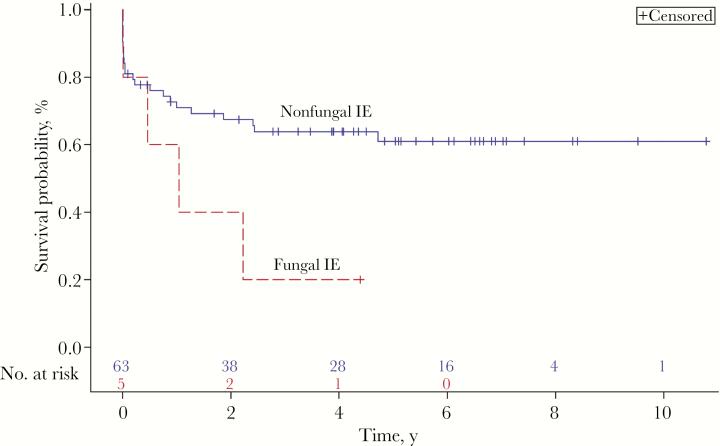
Three hundred ninety patients had endocarditis, with 212/390 in PWID. Sixty-eight of 212 (32%) PWID had a second episode, with 28/212 (12%) having additional recurrences. Second-episode IE was more common in PWID (11/178 [6.2%] vs 68/212 [32.1%]; < .001). Peripherally inserted central catheter (PICC) line abuse was associated with increased risk of recurrent endocarditis (odds ratio [OR], 1.97; 95% confidence interval [CI], 1.01-3.87; = .04). In PWID, fungal IE was more common in second episodes than first episodes (1/212 [0.5%] vs 5/68 [7.4%]; = .004). Additionally, fungal infections were associated with mortality in second-episode IE in PWID with an adjusted OR of 16.49 (95% CI, 1.12-243.17; = .041). Despite recurrent infection, likely due to continued drug use, there was a low rate of referral to addiction treatment (14/68 [20.6%]).
CONCLUSIONS
PWID have a high risk of recurrent endocarditis, particularly in patients who abuse PICC lines. Fungal endocarditis is more common in second-episode endocarditis and is associated with increased mortality. Consideration of empiric antifungal therapy in PWID with IE history and suspected IE should be considered.
背景
感染性心内膜炎(IE)在注射吸毒者(PWID)中的发病率呈上升趋势,且具有较高的发病率和死亡率。PWID复发性IE的情况尚未得到充分描述。
方法
这是一项在2007年2月至2016年3月期间进行的回顾性队列研究。研究对象包括安大略省伦敦市3家三级医疗中心中任何一家的成年住院患者(≥18岁),这些患者根据改良的杜克标准确诊为IE。目的是描述PWID复发性IE的特征,确定复发性IE的危险因素,确定真菌性心内膜炎的发生率,并确定真菌感染是否与较高的死亡率相关。
结果
390例患者患有心内膜炎,其中212例为PWID。212例PWID中有68例(32%)发生了第二次发作,212例中有28例(12%)有额外的复发。第二次发作的IE在PWID中更常见(11/178 [6.2%] 对68/212 [32.1%];P <.001)。外周中心静脉导管(PICC)滥用与复发性心内膜炎风险增加相关(比值比 [OR],1.97;95%置信区间 [CI],1.01 - 3.87;P =.04)。在PWID中,真菌性IE在第二次发作中比第一次发作更常见(1/212 [0.5%] 对5/68 [7.4%];P =.004)。此外,在PWID第二次发作的IE中,真菌感染与死亡率相关,校正后的OR为16.49(95% CI,1.12 - 243.17;P =.041)。尽管反复感染,可能是由于持续吸毒,但转介到成瘾治疗的比例较低(14/68 [20.6%])。
结论
PWID有较高的复发性心内膜炎风险,尤其是在滥用PICC的患者中。真菌性心内膜炎在第二次发作的心内膜炎中更常见,且与死亡率增加相关。对于有IE病史且疑似IE的PWID,应考虑经验性抗真菌治疗。
 Zotero 插件