Food & Health, Quadram Institute Bioscience, Norwich Research Park, Norwich, Norfolk NR4 7UA, UK.
Nutrients. 2019 Oct 28;11(11):2588. doi: 10.3390/nu11112588.
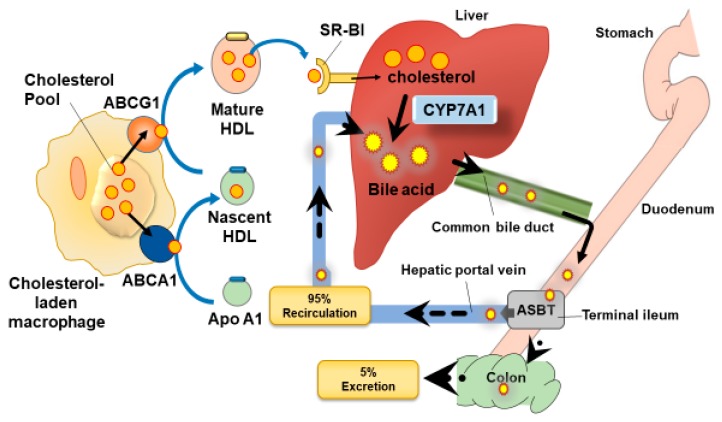
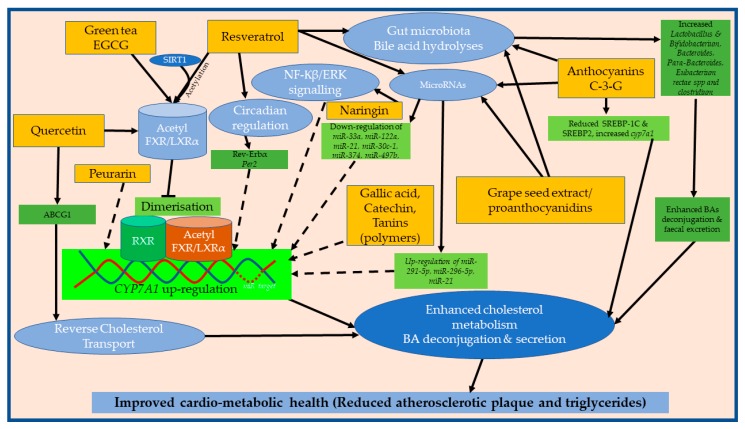
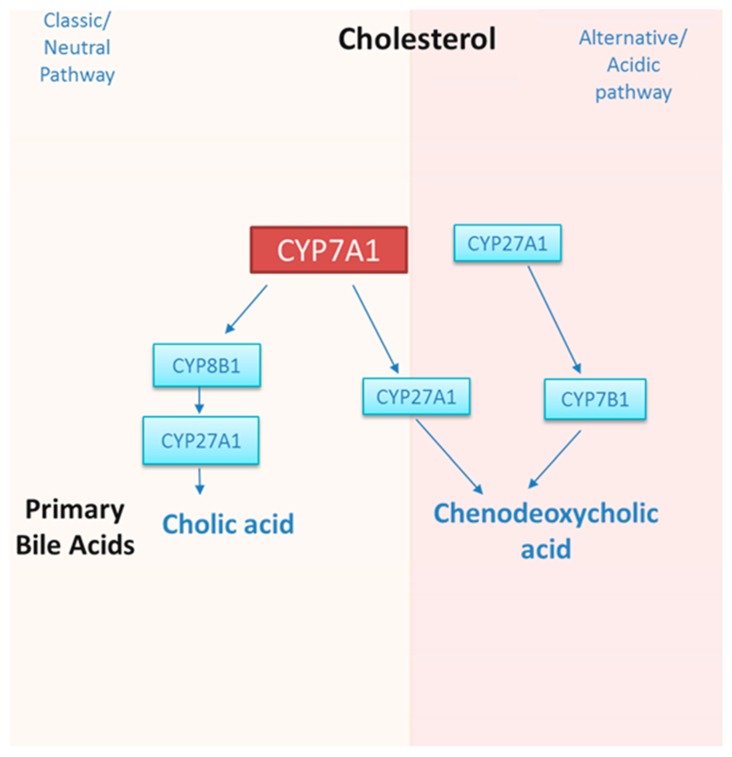
Atherosclerosis, the main contributor to coronary heart disease, is characterised by an accumulation of lipids such as cholesterol in the arterial wall. Reverse cholesterol transport (RCT) reduces cholesterol via its conversion into bile acids (BAs). During RCT in non-hepatic peripheral tissues, cholesterol is transferred to high-density lipoprotein (HDL) particles and returned to the liver for conversion into BAs predominantly via the rate-limiting enzyme, cholesterol 7 α-hydroxylase (CYP7A1). Numerous reports have described that polyphenol induced increases in BA excretion and corresponding reductions in total and LDL cholesterol in animal and in-vitro studies, but the process whereby this occurs has not been extensively reviewed. There are three main mechanisms by which BA excretion can be augmented: (1) increased expression of CYP7A1; (2) reduced expression of intestinal BA transporters; and (3) changes in the gut microbiota. Here we summarise the BA metabolic pathways focusing on CYP7A1, how its gene is regulated via transcription factors, diurnal rhythms, and microRNAs. Importantly, we will address the following questions: (1) Can polyphenols enhance BA secretion by modulating the CYP7A1 biosynthetic pathway? (2) Can polyphenols alter the BA pool via changes in the gut microbiota? (3) Which polyphenols are the most promising candidates for future research? We conclude that while in rodents some polyphenols induce CYP7A1 expression predominantly by the LXRα pathway, in human cells, this may occur through FXR, NF-KB, and ERK signalling. Additionally, gut microbiota is important for the de-conjugation and excretion of BAs. Puerarin, resveratrol, and quercetin are promising candidates for further research in this area.
动脉粥样硬化是冠心病的主要病因,其特征是胆固醇等脂质在动脉壁中积聚。胆固醇逆向转运(RCT)可将胆固醇转化为胆汁酸(BAs)来降低胆固醇水平。在非肝脏外周组织中的 RCT 过程中,胆固醇被转移到高密度脂蛋白(HDL)颗粒中,并返回肝脏主要通过限速酶胆固醇 7α-羟化酶(CYP7A1)转化为 BAs。大量报道描述了多酚诱导 BA 排泄增加,并相应降低动物和体外研究中的总胆固醇和 LDL 胆固醇,但这一过程尚未得到广泛研究。有三种主要机制可以增加 BA 排泄:(1)CYP7A1 表达增加;(2)肠道 BA 转运蛋白表达减少;(3)肠道微生物群的变化。在这里,我们总结了 BA 代谢途径,重点介绍了 CYP7A1,以及其基因如何通过转录因子、昼夜节律和 microRNAs 进行调节。重要的是,我们将解决以下问题:(1)多酚能否通过调节 CYP7A1 生物合成途径来增强 BA 分泌?(2)多酚能否通过改变肠道微生物群来改变 BA 池?(3)哪些多酚是未来研究最有前途的候选物?我们的结论是,虽然在啮齿动物中,一些多酚主要通过 LXRα 途径诱导 CYP7A1 表达,但在人类细胞中,这可能通过 FXR、NF-KB 和 ERK 信号发生。此外,肠道微生物群对 BA 的去结合和排泄很重要。葛根素、白藜芦醇和槲皮素是该领域进一步研究的有前途的候选物。