MacMillan Erin L, Schubert Julia J, Vavasour Irene M, Tam Roger, Rauscher Alexander, Taylor Carolyn, White Rick, Garren Hideki, Clayton David, Levesque Victoria, Li David Kb, Kolind Shannon H, Traboulsee Anthony L
Department of Radiology, University of British Columbia.
Department of Medicine, University of British Columbia.
Mult Scler J Exp Transl Clin. 2019 Oct 15;5(4):2055217319879952. doi: 10.1177/2055217319879952. eCollection 2019 Oct-Dec.
Magnetic resonance spectroscopy quantitatively monitors biomarkers of neuron-myelin coupling (N-acetylaspartate (NAA)), and inflammation (total creatine (tCr), total choline (tCho), myo-inositol (mI)) in the brain.
This study aims to investigate how ocrelizumab and interferon beta-1a differentially affects imaging biomarkers of neuronal-myelin coupling and inflammation in patients with relapsing multiple sclerosis (MS).
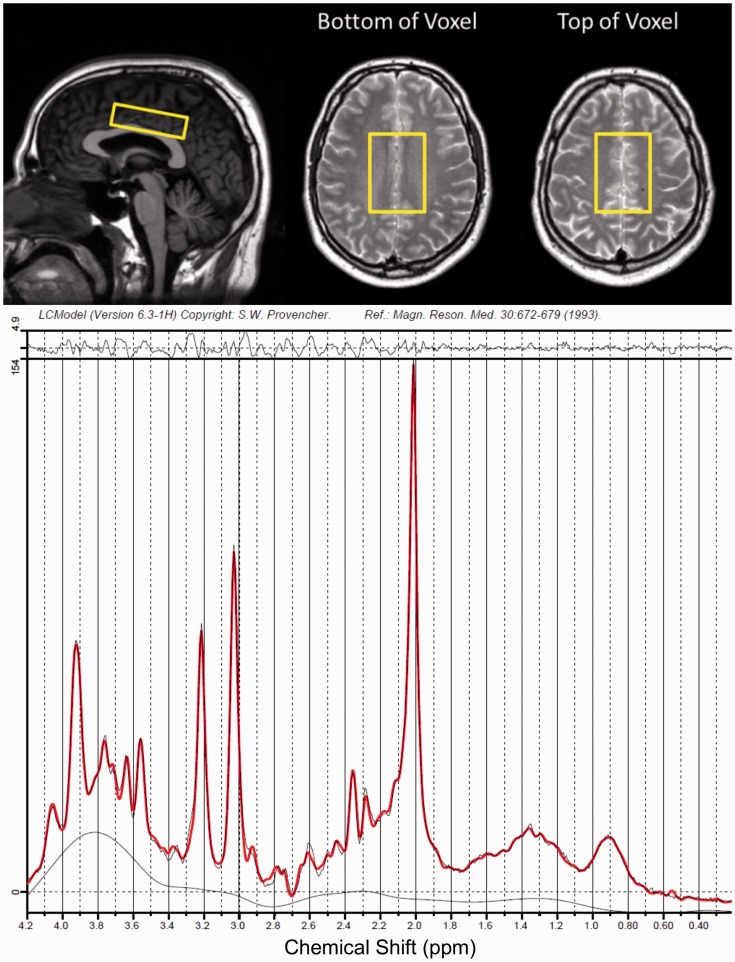
Forty patients with relapsing MS randomized to either treatment were scanned at 3T at baseline and weeks 24, 48, and 96 follow-up. Twenty-four healthy controls were scanned at weeks 0, 48, and 96. NAA, tCr, tCho, mI, and NAA/tCr were measured in a single large supra-ventricular voxel.
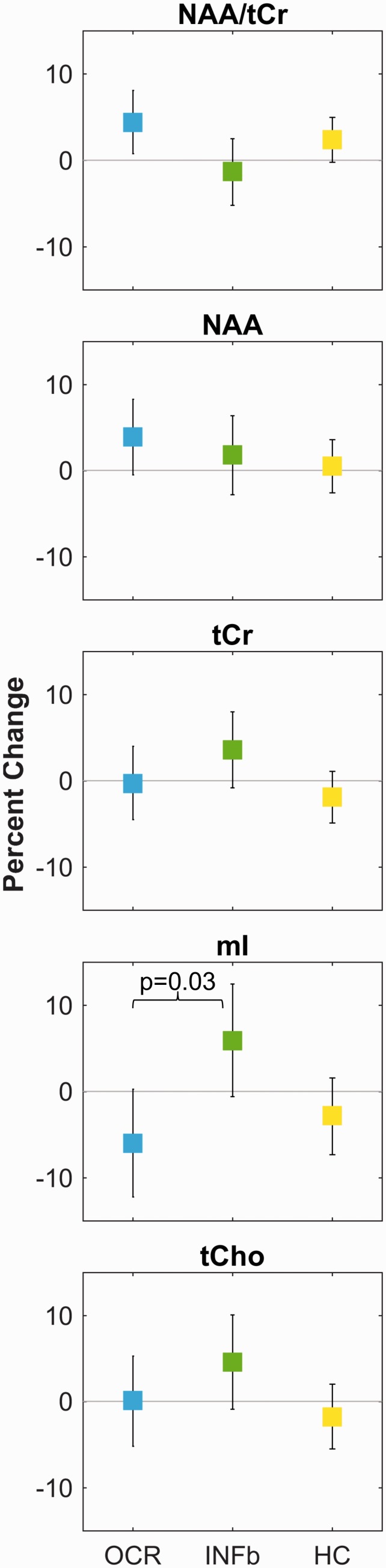
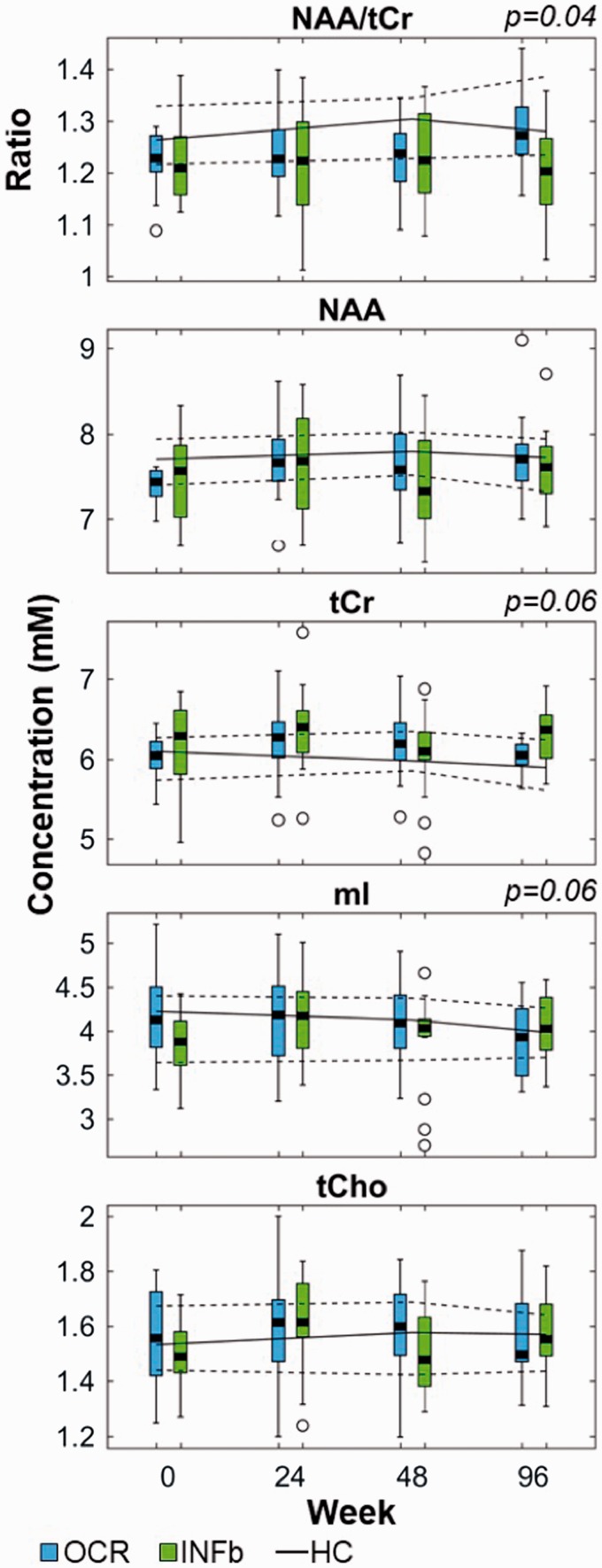
There was a time × treatment interaction in NAA/tCr ( = 0.04), primarily driven by opposing tCr trends between treatment groups after 48 weeks of treatment. Patients treated with ocrelizumab showed a possible decline in mI after week 48 week, and stable tCr and tCho levels. Conversely, the interferon beta-1a treated group showed possible increases in mI, tCr, and tCho over 96 weeks.
Results from this exploratory study suggest that over 2 years, ocrelizumab reduces gliosis compared with interferon beta-1a, demonstrated by declining ml, and stable tCr and tCho. Ocrelizumab may improve the physiologic milieu by decreasing neurotoxic factors that are generated by inflammatory processes.
磁共振波谱法定量监测大脑中神经元 - 髓鞘耦合的生物标志物(N - 乙酰天门冬氨酸(NAA))以及炎症的生物标志物(总肌酸(tCr)、总胆碱(tCho)、肌醇(mI))。
本研究旨在调查奥瑞珠单抗和干扰素β - 1a对复发型多发性硬化症(MS)患者神经元 - 髓鞘耦合及炎症的成像生物标志物的不同影响。
40例随机接受其中一种治疗的复发型MS患者在基线以及随访的第24周、48周和96周时接受3T扫描。24名健康对照者在第0周、48周和96周时接受扫描。在一个单一的大型脑室上体素中测量NAA、tCr、tCho、mI以及NAA/tCr。
NAA/tCr存在时间×治疗交互作用(P = 0.04),主要由治疗48周后治疗组间tCr的相反趋势驱动。接受奥瑞珠单抗治疗的患者在第48周后mI可能下降,tCr和tCho水平稳定。相反,干扰素β - 1a治疗组在96周内mI、tCr和tCho可能升高。
这项探索性研究的结果表明,在超过2年的时间里,与干扰素β - 1a相比,奥瑞珠单抗可减轻胶质增生,表现为mI下降以及tCr和tCho稳定。奥瑞珠单抗可能通过减少炎症过程产生的神经毒性因子来改善生理环境。