Medical Clinic IV, Department of Cardiology, Municipal Hospital Karlsruhe, Karlsruhe, Baden-Württemberg, Germany.
Heart Center, University of Cologne, Cologne, Germany.
Open Heart. 2019 Oct 3;6(2):e001082. doi: 10.1136/openhrt-2019-001082. eCollection 2019.
Predilation of the native valve has long been deemed necessary in transfemoral transcatheter aortic valve implantation (TF-TAVI), despite little trial evidence to support its clinical use. As most evidence is derived from retrospective analyses of observational studies, we conducted a two-armed, prospective multicentre registry.
Patients undergoing TF-TAVI with the Edwards SAPIEN 3 valve, with or without balloon aortic valvuloplasty (BAV), were included and their procedural characteristics, short-term safety and short-term efficacy outcomes compared. We hypothesised that BAV may be safely omitted in many patients and omission could be associated with procedural benefits.
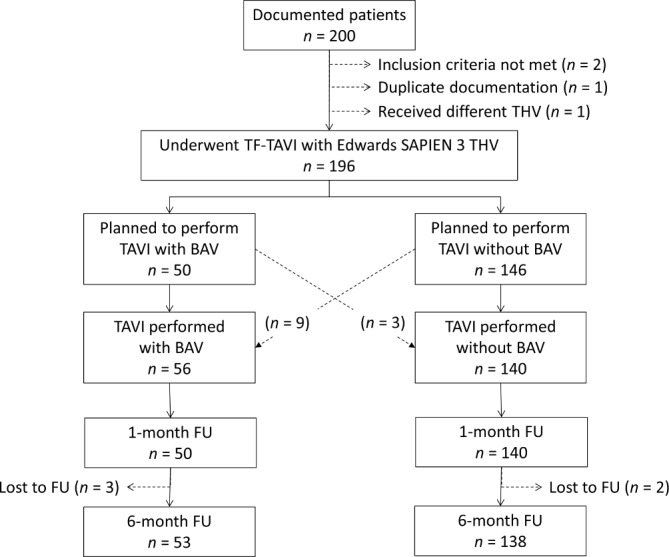
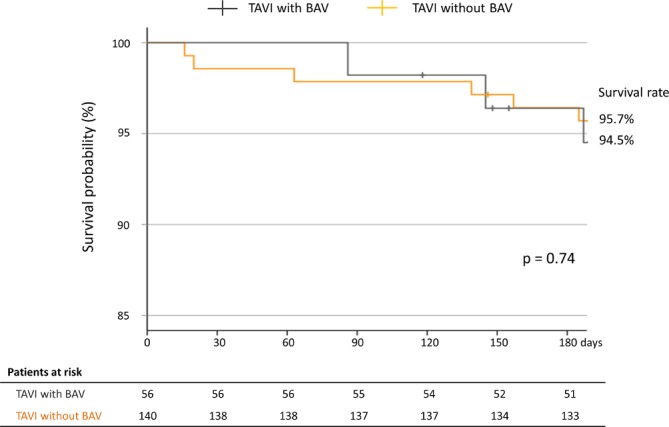
Overall, 196 consecutive patients underwent TF-TAVI, 56 with BAV and 140 without. The mean age was 81.2±6.2 years, and the mean logistic EuroSCORE I was 17.1±13.6. Device success according to Valve Academic Research Consortium-2 (VARC-2) was achieved in 96.4%. The median procedural duration was shorter without BAV (56 min vs 90 min; p=0.001), as was fluoroscopy time (10 min vs 13 min; p=0.001). The need for balloon postdilation was less frequent in patients without BAV (15.7% vs 30.4%, p=0.029). There was no difference in the proportion of patients meeting the VARC-2 defined composite safety endpoint at 30 days (9.3% without vs 8.9% with BAV; adjusted OR (adjOR) 2.55; 95% CI 0.56 to 18.84) and at 6 months (15.2% without vs 16.4% with BAV; adjOR 1.66; 95% CI 0.49 to 6.55).
In the majority of patients, BAV can be safely omitted from the TAVI procedure without adverse effects. The omission of BAV is associated with shorter procedural duration and could be advantageous for the majority of patients.
NCT02760771.
尽管很少有临床试验证据支持其临床应用,但经股动脉入路经导管主动脉瓣置换术(TF-TAVI)前对原生瓣膜进行预扩张一直被认为是必要的。由于大多数证据都来自于对观察性研究的回顾性分析,因此我们进行了一项双臂、前瞻性多中心注册研究。
本研究纳入了接受 Edwards SAPIEN 3 瓣膜 TF-TAVI 治疗的患者,包括进行和未进行球囊主动脉瓣成形术(BAV)的患者,并比较了他们的手术特点、短期安全性和短期疗效结果。我们假设在许多患者中可以安全地省略 BAV,并且省略 BAV 可能与手术获益相关。
共有 196 例连续患者接受了 TF-TAVI 治疗,其中 56 例患者进行了 BAV,140 例患者未进行 BAV。患者平均年龄为 81.2±6.2 岁,平均 LOGISTIC EuroSCORE I 为 17.1±13.6。根据 Valve Academic Research Consortium-2(VARC-2)标准,器械成功率达到 96.4%。不进行 BAV 的手术操作时间更短(56 分钟 vs 90 分钟;p=0.001),透视时间也更短(10 分钟 vs 13 分钟;p=0.001)。未进行 BAV 的患者球囊后扩张的需求也较少(15.7% vs 30.4%,p=0.029)。在 30 天(无 BAV 组 9.3%,有 BAV 组 8.9%;调整后 OR(adjOR)2.55;95%CI 0.56 至 18.84)和 6 个月(无 BAV 组 15.2%,有 BAV 组 16.4%;adjOR 1.66;95%CI 0.49 至 6.55)时,符合 VARC-2 定义的复合安全性终点的患者比例无差异。
在大多数患者中,不进行 TAVI 前的 BAV 预扩张是安全的,不会产生不良影响。省略 BAV 与手术操作时间缩短有关,对大多数患者是有利的。
NCT02760771。