Institut für Pathologie, Charité - Universitätsmedizin Berlin, Campus Charité Mitte, Charitéplatz 1, 10117, Berlin, Germany.
Institut für Biometrie und Klinische Epidemiologie, Charité - Universitätsmedizin Berlin, Charitéplatz 1, 10117, Berlin, Germany.
BMC Cancer. 2019 Nov 1;19(1):1033. doi: 10.1186/s12885-019-6261-5.
Budding is a complementary prognostic factor for colorectal cancer. In this study, we aimed to clarify the role of tumor budding in rectal cancer patients after preoperative chemoradiotherapy.
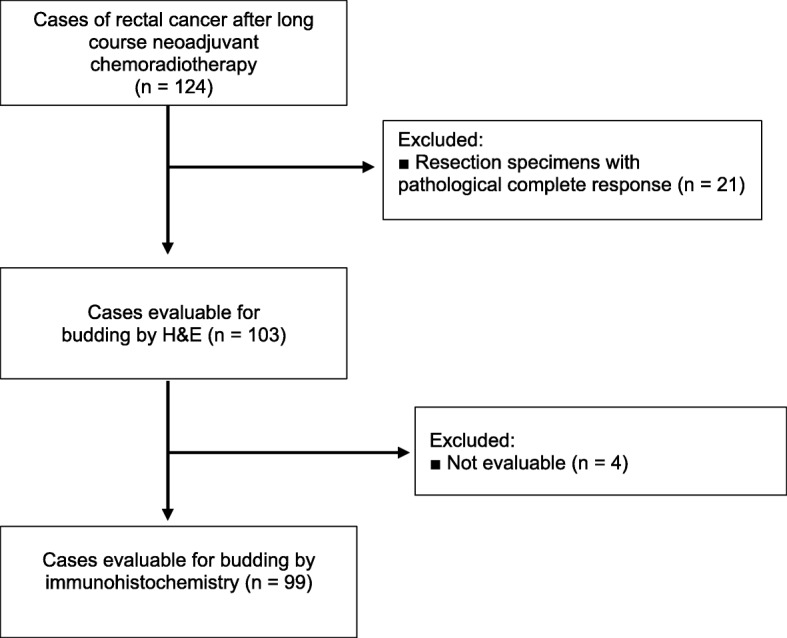
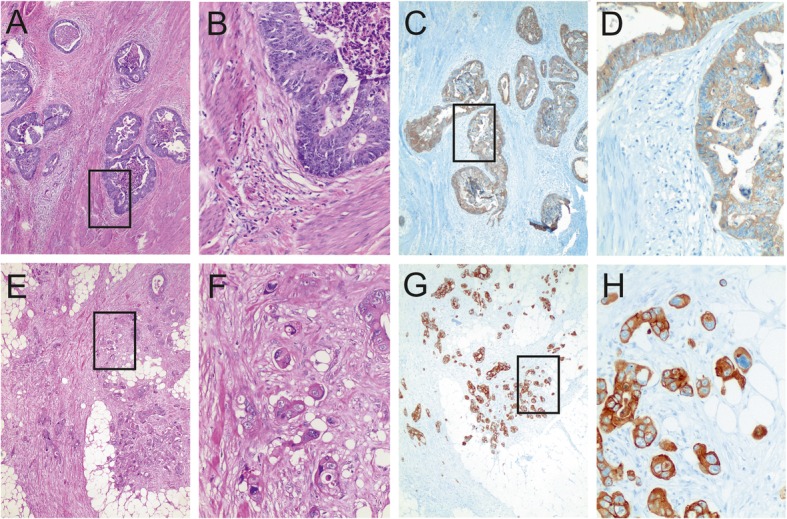
A total of 124 patients with rectal cancer treated with neoadjuvant chemoradiotherapy and consecutive surgery were included. Surgical specimens were evaluated for budding and routine clinicopathological features. Budding was evaluated on hematoxylin and eosin (H&E)-stained slides and by cytokeratin immunohistochemical (IHC) staining.
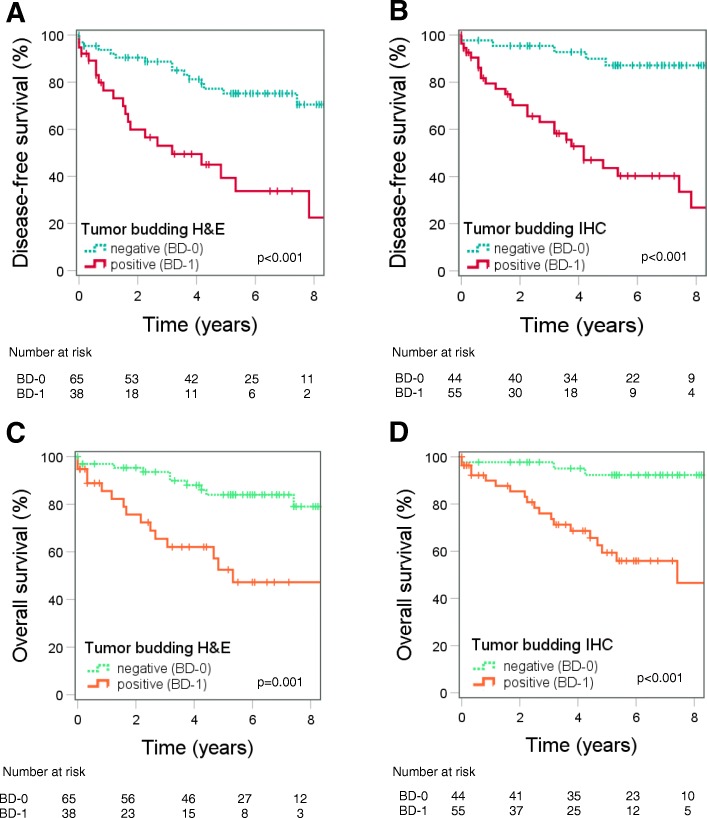
A budding rate of 36.9% (n = 38) by H&E and 55.6% (n = 55) by IHC was observed. Budding was significantly associated with a high ypT and ypN status, poor differentiation, and low degrees of tumor regression. Moreover, budding was strongly predictive of a worse patient outcome, as measured by tumor recurrence or death. In multivariate analyses, budding remained the only significant parameter for overall survival and was even superior to the ypT and ypN status (budding in H&E: hazard ratio (HR) 2.72, 95% confidence interval (95% CI) 1.15-6.44, p = 0.023; budding in IHC: HR 5.19, 95% CI 1.62-16.61, p = 0.006).
Budding is a strong prognostic predictor of survival in rectal cancer patients after neoadjuvant therapy. A standardized evaluation of tumor budding after neoadjuvant therapy may thus aid in risk stratification and guide the clinical management of patients with rectal cancer. Immunostaining can help to enhance the diagnostic accuracy and prognostic significance.
芽生是结直肠癌的一个补充预后因素。本研究旨在阐明术前放化疗后直肠癌患者肿瘤芽生的作用。
共纳入 124 例接受新辅助放化疗和连续手术治疗的直肠癌患者。对手术标本进行芽生和常规临床病理特征评估。芽生通过苏木精和伊红(H&E)染色切片和细胞角蛋白免疫组织化学(IHC)染色进行评估。
H&E 观察到芽生率为 36.9%(n=38),IHC 为 55.6%(n=55)。芽生与 ypT 和 ypN 状态高、分化差和肿瘤消退程度低显著相关。此外,芽生强烈预测患者的不良结局,表现为肿瘤复发或死亡。多变量分析显示,芽生仍然是总生存的唯一显著参数,甚至优于 ypT 和 ypN 状态(H&E 中的芽生:风险比(HR)2.72,95%置信区间(95%CI)1.15-6.44,p=0.023;IHC 中的芽生:HR 5.19,95%CI 1.62-16.61,p=0.006)。
芽生是新辅助治疗后直肠癌患者生存的强有力预后预测因子。因此,新辅助治疗后肿瘤芽生的标准化评估可能有助于风险分层,并指导直肠癌患者的临床管理。免疫染色有助于提高诊断准确性和预后意义。