Institute for Clinical Research, National Institutes of Health (NIH), Ministry of Health Malaysia, Block B4, No. 1, Jalan Setia Murni U13/52, 40170, Shah Alam, Selangor, Malaysia.
Clinical Research Centre, Sibu Hospital, Ministry of Health Malaysia, Sibu, Sarawak, Malaysia.
Hum Resour Health. 2019 Nov 4;17(1):82. doi: 10.1186/s12960-019-0410-4.
Job satisfaction of doctors is an important factor determining quality and performance of a health system. The aim of this study was to assess job satisfaction among doctors of the public and private primary care clinics in Malaysia and evaluate factors that could influence the job satisfaction rating.
This study was part of the Quality and Costs of Primary Care (QUALICOPC) Malaysia, a cross-sectional survey conducted between August 2015 and June 2016 in Malaysia. Data was collected from doctors recruited from public and private primary care clinics using a standardised questionnaire. Comparisons were made between doctors working in public and private clinics, and logistic regression analysis was used to determine factors influencing the likelihood of job satisfaction outcomes.
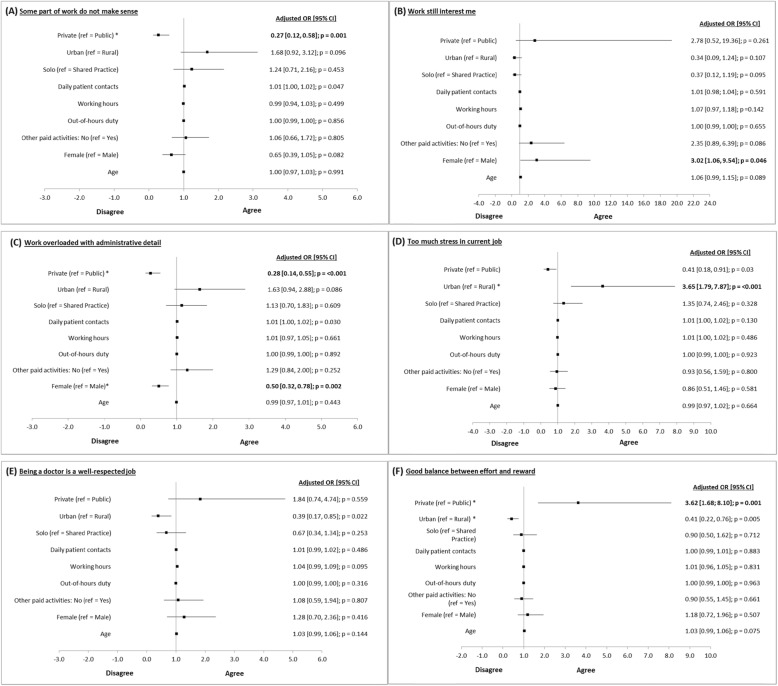
A total of 221 doctors from the public and 239 doctors from the private sector completed the questionnaire. Compared to private doctors, a higher proportion of public doctors felt they were being overloaded with the administrative task (59.7% vs 36.0%) and part of the work does not make sense (33.9% vs 18.4%). Only 62.9% of public doctors felt that there was a good balance between effort and reward while a significantly higher proportion (85.8%) of private doctors reported the same. Over 80% of doctors in both sectors indicated continued interest in their job and agreed that being a doctor is a well-respected job. Logistic regression analysis showed public-private sector and practice location (urban-rural) to be significantly associated with work satisfaction outcomes.
A higher proportion of public doctors experienced pressure from administrative tasks and felt that part of their work does not make sense than their colleague in the private sector. At the same time, the majority of private doctors reported positive outcome on effort-and-reward balance compared to only one third of public doctors. The finding suggests that decreasing administrative workload and enhancing work-based supports might be the most effective ways to improve job satisfaction of primary care doctors because these are some of the main aspects of the job that doctors, especially in public clinics, are most unhappy with.
医生的工作满意度是决定医疗体系质量和绩效的一个重要因素。本研究旨在评估马来西亚公立和私立初级保健诊所医生的工作满意度,并评估可能影响工作满意度评分的因素。
本研究是马来西亚初级保健质量和成本研究(QUALICOPC Malaysia)的一部分,该研究于 2015 年 8 月至 2016 年 6 月期间在马来西亚进行,采用横断面调查。从公立和私立初级保健诊所招募的医生使用标准化问卷收集数据。对在公立和私立诊所工作的医生进行了比较,并采用逻辑回归分析确定影响工作满意度结果的因素。
共有 221 名来自公立诊所和 239 名来自私立诊所的医生完成了问卷。与私人医生相比,更多的公立医生认为他们的行政工作负担过重(59.7%比 36.0%),部分工作没有意义(33.9%比 18.4%)。只有 62.9%的公立医生认为付出与回报之间有很好的平衡,而比例明显较高(85.8%)的私立医生也有同样的看法。超过 80%的医生在两个部门都表示对他们的工作继续感兴趣,并同意医生是一个受人尊敬的职业。逻辑回归分析显示,公私部门和执业地点(城乡)与工作满意度结果显著相关。
与私立部门的同事相比,更多的公立医生感到行政工作的压力,并且认为他们的部分工作没有意义。与此同时,与三分之一的公立医生相比,大多数私立医生报告在付出与回报平衡方面有积极的结果。这一发现表明,减少行政工作量和加强基于工作的支持可能是提高初级保健医生工作满意度的最有效方法,因为这些是医生,尤其是在公立诊所工作的医生最不满意的工作的主要方面。