Global Health Unit, Department of Paediatrics and Adolescent Medicine, Copenhagen University Hospital "Rigshospitalet", Copenhagen, Denmark.
Clinic of Social and Family Medicine, School of Medicine, University of Crete, Heraklion, Crete, Greece.
PLoS One. 2019 Nov 6;14(11):e0221389. doi: 10.1371/journal.pone.0221389. eCollection 2019.
Respiratory disease and, specifically, pneumonia, is the major cause of mortality and morbidity in young children. Diagnosis of both pneumonia and asthma in primary care rests principally on clinical signs, history taking, and bronchodilator responsiveness. This study aimed to describe clinical practices in diverse global primary care settings concerning differential diagnosis of respiratory disease in young children, especially between pneumonia and asthma.
Health professionals in Greece, Kyrgyzstan, Vietnam, and Uganda were observed during consultations with children aged 2-59 months, presenting with cough and/or difficult breathing. Data were analyzed descriptively and included consultation duration, practices, diagnoses and availability/use of medications and equipment. The study is part of the European Horizon 2020 FRESH AIR project.
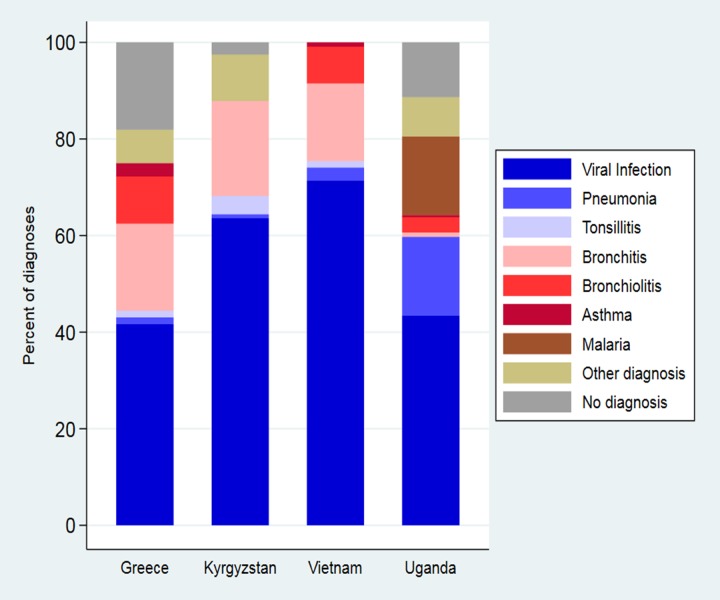
In total, 771 consultations by 127 health professionals at 74 facilities in the four countries were observed. Consultations were shorter in Vietnam and Uganda (3 to 4 minutes) compared to Greece and Kyrgyzstan (15 to 20 minutes). History taking was most comprehensive in Greece. Clinical examination was more comprehensive in Vietnam and Kyrgyzstan and less in Uganda. Viral upper respiratory tract infections were the most common diagnoses (41.7% to 67%). Pneumonia was diagnosed frequently in Uganda (16.3% of children), and rarely in other countries (0.8% to 2.9%). Asthma diagnosis was rare (0% to 2.8%). Antibiotics were prescribed frequently in all countries (32% to 69%). Short acting β-agonist trials were seldom available and used during consultations in Kyrgyzstan (0%) and Uganda (1.8%), and often in Greece (38.9%) and Vietnam (12.6%).
Duration and comprehensiveness of clinical consultations observed in this study seemed insufficient to guide respiratory diagnosis in young children. Appropriate treatment options may further not be available in certain studied settings. Actions aiming at educating and raising professional awareness, along with developing easy-to-use tools to support diagnosis and a general strengthening of health systems are important goals.
呼吸道疾病,特别是肺炎,是导致幼儿死亡和发病的主要原因。在初级保健中,肺炎和哮喘的诊断主要依赖于临床体征、病史采集和支气管扩张剂反应性。本研究旨在描述全球不同初级保健环境中,特别是在肺炎和哮喘之间,对幼儿呼吸道疾病进行鉴别诊断的临床实践。
在希腊、吉尔吉斯斯坦、越南和乌干达,对 2-59 月龄出现咳嗽和/或呼吸困难的儿童进行观察,记录健康专业人员的就诊情况。采用描述性方法对数据进行分析,包括就诊时间、诊疗操作、诊断以及药物和设备的可获得性/使用情况。本研究是欧洲地平线 2020 项目 FRESH AIR 的一部分。
共观察了来自四个国家 74 个医疗机构的 127 名健康专业人员的 771 次就诊。越南和乌干达的就诊时间较短(3-4 分钟),而希腊和吉尔吉斯斯坦的就诊时间较长(15-20 分钟)。希腊的病史采集最全面。越南和吉尔吉斯斯坦的临床检查更全面,而乌干达的检查相对较少。病毒性上呼吸道感染是最常见的诊断(41.7%-67%)。在乌干达,肺炎的诊断频率较高(16.3%的儿童),而在其他国家则较低(0.8%-2.9%)。哮喘的诊断很少见(0%-2.8%)。所有国家均频繁开具抗生素处方(32%-69%)。在吉尔吉斯斯坦(0%)和乌干达(1.8%),短效β-激动剂试验很少在就诊时提供和使用,而在希腊(38.9%)和越南(12.6%)则经常使用。
本研究观察到的临床就诊时间和全面性似乎不足以指导幼儿的呼吸道诊断。在某些研究环境中,可能无法获得适当的治疗选择。教育和提高专业意识的行动,以及开发易于使用的工具来支持诊断和加强卫生系统,是重要的目标。