Division of Genome Research, Center for Genome Science, Korea National Institute of Health, Cheongju, Chungbuk, Republic of Korea.
College of Pharmacy, Chungbuk National University, Cheongju, Chungbuk, Republic of Korea.
PLoS One. 2019 Nov 7;14(11):e0224274. doi: 10.1371/journal.pone.0224274. eCollection 2019.
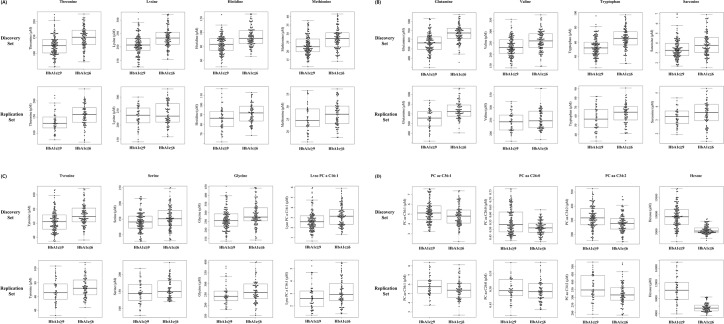
Glycated hemoglobin (HbA1c) is an indicator of the average blood glucose concentration. Failing to control HbA1c levels can accelerate the development of complications in patients with diabetes. Although metabolite profiles associated with HbA1c level in diabetes patients have been characterized using different platforms, more studies using high-throughput technology will be helpful to identify additional metabolites related to diabetes. Type 2 diabetes (T2D) patients were divided into two groups based on the HbA1c level: normal (HbA1c ≤6%) and high (HbA1c ≥9%) in both discovery and replication sets. A targeted metabolomics approach was used to quantify serum metabolites and multivariate logistic regression was used to identify significant differences between groups. The concentrations of 22 metabolites differed significantly between the two groups in the discovery set. In the replication set, the levels of 21 metabolites, including 16 metabolites identified in the discovery set, differed between groups. Among these, concentrations of eleven amino acids and one phosphatidylcholine (PC), lysoPC a C16:1, were higher and four metabolites, including three PCs (PC ae C36:1, PC aa C26:0, PC aa C34:2) and hexose, were lower in the group with normal HbA1c group than in the group with high HbA1c. Metabolites with high concentrations in the normal HbA1c group, such as glycine, valine, and PCs, may contribute to reducing HbA1c levels in patients with T2D. The metabolite signatures identified in this study provide insight into the mechanisms underlying changes in HbA1c levels in T2D.
糖化血红蛋白(HbA1c)是反映平均血糖浓度的指标。未能控制 HbA1c 水平会加速糖尿病患者并发症的发展。虽然已经使用不同的平台对与糖尿病患者 HbA1c 水平相关的代谢物谱进行了描述,但使用高通量技术进行更多的研究将有助于鉴定与糖尿病相关的其他代谢物。将 2 型糖尿病(T2D)患者根据 HbA1c 水平分为两组:在发现和复制集中,HbA1c 正常(HbA1c≤6%)和 HbA1c 高(HbA1c≥9%)。采用靶向代谢组学方法定量血清代谢物,采用多元逻辑回归鉴定组间差异。在发现集中,两组间 22 种代谢物的浓度差异显著。在复制集中,两组间的 21 种代谢物水平存在差异,其中包括在发现集中鉴定出的 16 种代谢物。在这些代谢物中,11 种氨基酸和一种溶血磷脂酰胆碱(LysoPC a C16:1)的浓度在 HbA1c 正常组中较高,而 4 种代谢物,包括 3 种溶血磷脂酰胆碱(PC ae C36:1、PC aa C26:0 和 PC aa C34:2)和己糖,在 HbA1c 高组中较低。在 HbA1c 正常组中浓度较高的代谢物,如甘氨酸、缬氨酸和溶血磷脂酰胆碱等,可能有助于降低 T2D 患者的 HbA1c 水平。本研究中鉴定的代谢物特征为 T2D 中 HbA1c 水平变化的机制提供了深入了解。