Kwon Somin, Iba Michiyo, Masliah Eliezer, Kim Changyoun
Molecular Neuropathology Section, Laboratory of Neurogenetics, National Institute on Aging, National Institutes of Health, Bethesda, MD 20892, USA.
Exp Neurobiol. 2019 Oct 31;28(5):547-553. doi: 10.5607/en.2019.28.5.547.
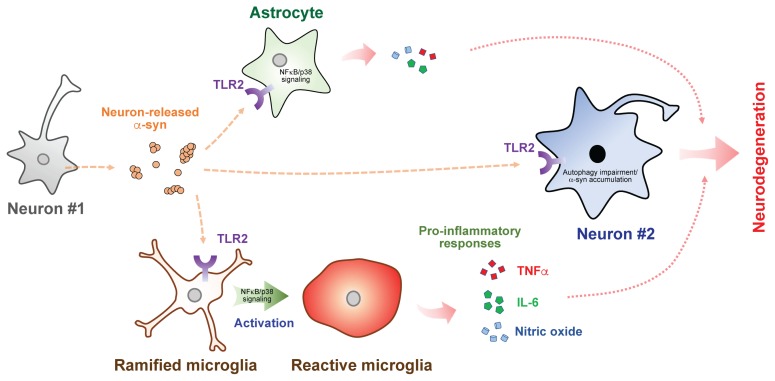
Synucleinopathies are neurodegenerative disorders characterized by the progressive accumulation of α-synuclein (α-syn) in neurons and glia and include Parkinson's disease (PD) and dementia with Lewy bodies (DLB). In this review, we consolidate our key findings and recent studies concerning the role of Toll-like receptor 2 (TLR2), a pattern recognition innate immune receptor, in the pathogenesis of synucleinopathies. First, we address the pathological interaction of α-syn with microglial TLR2 and its neurotoxic inflammatory effects. Then, we show that neuronal TLR2 activation not only induces abnormal α-syn accumulation by impairing autophagy, but also modulates α-syn transmission. Finally, we demonstrate that administration of a TLR2 functional inhibitor improves the neuropathology and behavioral deficits of a synucleinopathy mouse model. Altogether, we present TLR2 modulation as a promising immunotherapy for synucleinopathies.
突触核蛋白病是一类神经退行性疾病,其特征是α-突触核蛋白(α-syn)在神经元和神经胶质细胞中进行性积累,包括帕金森病(PD)和路易体痴呆(DLB)。在本综述中,我们汇总了关于Toll样受体2(TLR2)(一种模式识别先天免疫受体)在突触核蛋白病发病机制中的作用的关键发现和近期研究。首先,我们阐述α-syn与小胶质细胞TLR2的病理相互作用及其神经毒性炎症效应。然后,我们表明神经元TLR2激活不仅通过损害自噬诱导异常α-syn积累,还调节α-syn传递。最后,我们证明给予TLR2功能抑制剂可改善突触核蛋白病小鼠模型的神经病理学和行为缺陷。总之,我们提出TLR2调节作为突触核蛋白病一种有前景的免疫疗法。