Center for Clinical Trials and Evidence Synthesis, Department of Epidemiology, Johns Hopkins Bloomberg School of Public Health, 615 N. Wolfe Street, Room E6138, Baltimore, MD, 21205, USA.
Center for Evidence Synthesis in Health, Department of Health Services, Policy, and Practice (Primary), Brown University School of Public Health, Providence, RI, USA.
Syst Rev. 2019 Nov 7;8(1):264. doi: 10.1186/s13643-019-1188-0.
While identifying and cataloging unpublished studies from conference proceedings is generally recognized as a good practice during systematic reviews, controversy remains whether to include study results that are reported in conference abstracts. Existing guidelines provide conflicting recommendations.
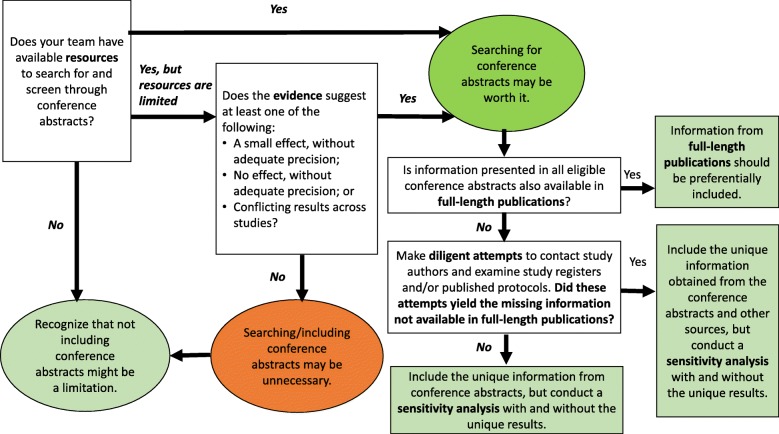
The main argument for including conference abstracts in systematic reviews is that abstracts with positive results are preferentially published, and published sooner, as full-length articles compared with other abstracts. Arguments against including conference abstracts are that (1) searching for abstracts is resource-intensive, (2) abstracts may not contain adequate information, and (3) the information in abstracts may not be dependable. However, studies comparing conference abstracts and fully published articles of the same study find only minor differences, usually with conference abstracts presenting preliminary results. Other studies that have examined differences in treatment estimates of meta-analyses with and without conference abstracts report changes in precision, but usually not in the treatment effect estimate. However, in some cases, including conference abstracts has made a difference in the estimate of the treatment effect, not just its precision. Instead of arbitrarily deciding to include or exclude conference abstracts in systematic reviews, we suggest that systematic reviewers should consider the availability of evidence informing the review. If available evidence is sparse or conflicting, it may be worthwhile to search for conference abstracts. Further, attempts to contact authors of abstracts or search for protocols or trial registers to supplement the information presented in conference abstracts is prudent. If unique information from conference abstracts is included in a meta-analysis, a sensitivity analysis with and without the unique results should be conducted.
Under given circumstances, it is worthwhile to search for and include results from conference abstracts in systematic reviews.
虽然在系统评价中识别和编目会议论文集中未发表的研究通常被认为是一种很好的做法,但对于是否包括会议摘要中报告的研究结果仍存在争议。现有的指南提供了相互矛盾的建议。
将会议摘要纳入系统评价的主要论点是,与其他摘要相比,具有阳性结果的摘要更优先发表,并且更早发表为全文文章。反对将会议摘要纳入系统评价的论点是:(1)搜索摘要需要大量资源;(2)摘要可能没有包含足够的信息;(3)摘要中的信息可能不可靠。然而,将会议摘要与相同研究的已发表全文文章进行比较的研究发现,两者之间只有微小的差异,通常会议摘要呈现初步结果。其他研究比较了包含和不包含会议摘要的荟萃分析的治疗估计值差异,报告了精度的变化,但通常不影响治疗效果估计值。然而,在某些情况下,将会议摘要纳入系统评价会影响治疗效果的估计值,而不仅仅是其精度。因此,我们建议系统评价者不应该任意决定在系统评价中纳入或排除会议摘要,而是应该考虑评估中可获得的证据。如果可用证据稀少或相互矛盾,那么搜索会议摘要可能是值得的。此外,尝试联系摘要作者或搜索方案或试验登记处以补充会议摘要中呈现的信息是明智的。如果从会议摘要中包含了独特的信息,则应进行包含和不包含独特结果的敏感性分析。
在特定情况下,搜索并将会议摘要的结果纳入系统评价是值得的。