Spaety Marie-Elodie, Gries Alexandre, Badie Amandine, Venkatasamy Aina, Romain Benoit, Orvain Christophe, Yanagihara Kazuyoshi, Okamoto Koji, Jung Alain C, Mellitzer Georg, Pfeffer Sébastien, Gaiddon Christian
Laboratory STREINTH (Stress Response and Innovative Therapies), Inserm IRFAC UMR_S1113, Université de Strasbourg, 3 av. Molière, 67200 Strasbourg, France.
Architecture and Reactivity of RNA, Institut de biologie moléculaire et cellulaire du CNRS, Université de Strasbourg, 15 rue René Descartes, 67084 Strasbourg, France.
Cancers (Basel). 2019 Nov 7;11(11):1747. doi: 10.3390/cancers11111747.
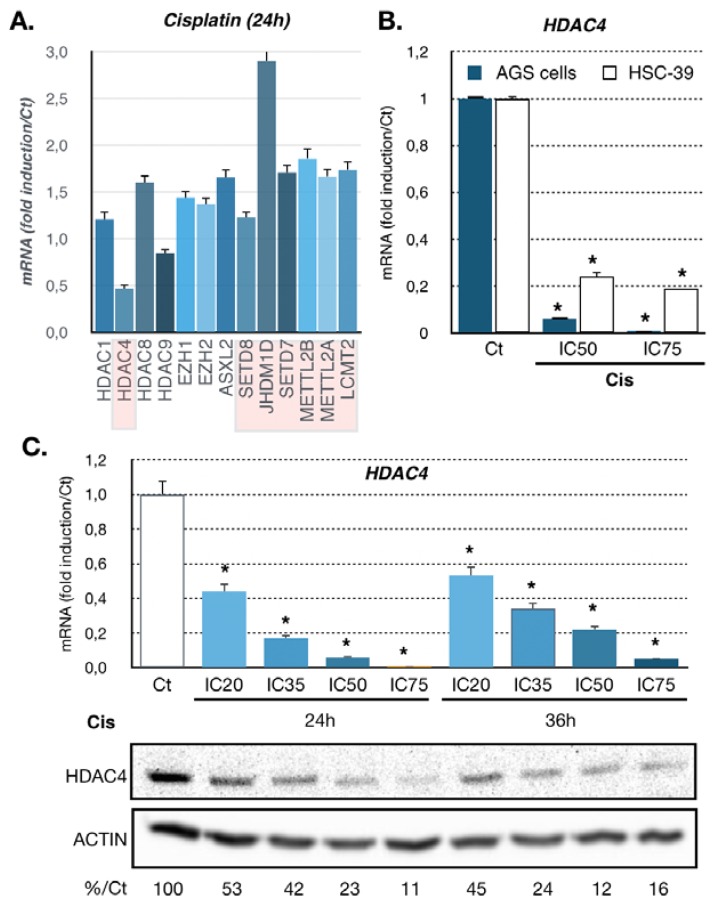
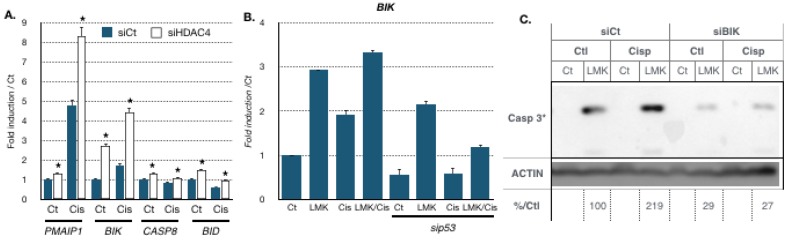
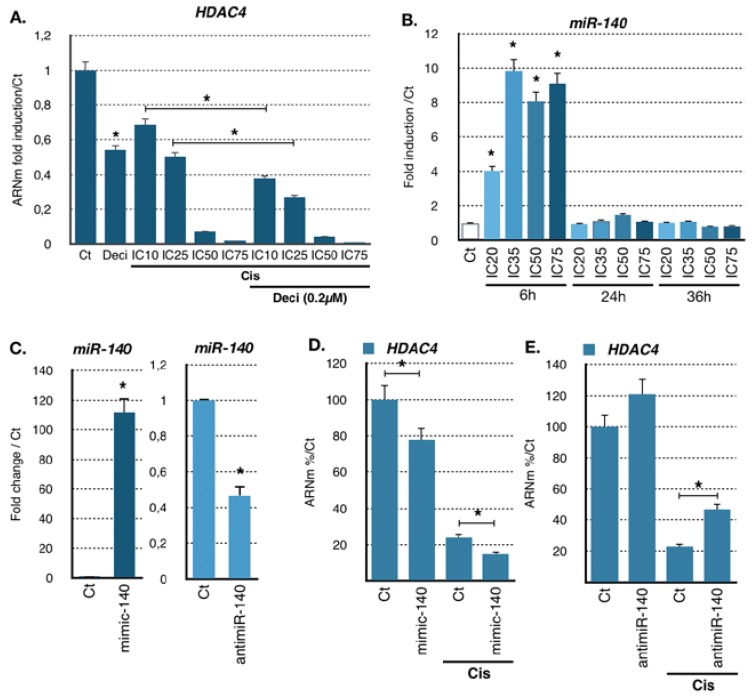
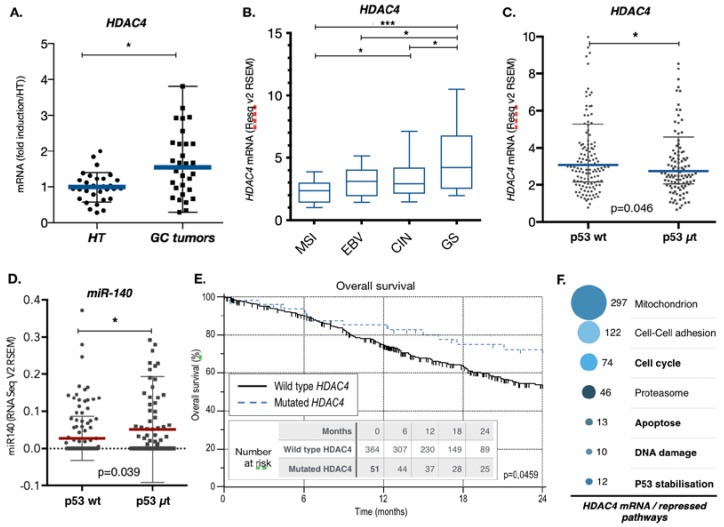
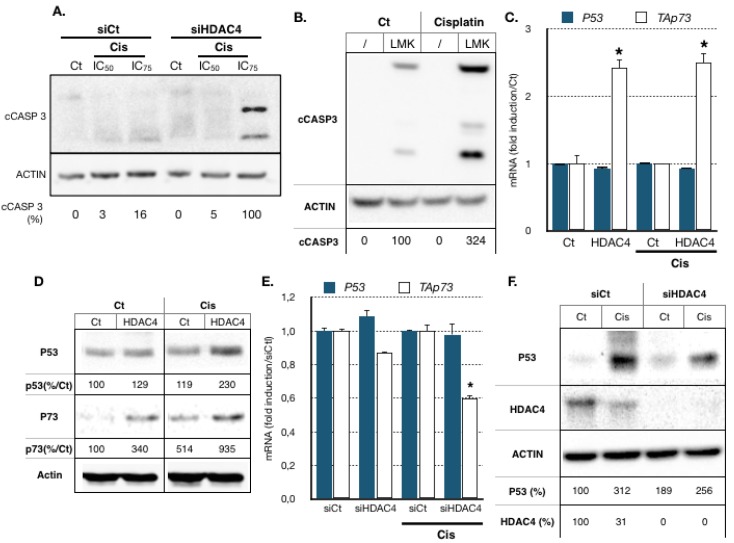
Gastric cancer (GC) remains a health issue due to the low efficiency of therapies, such as cisplatin. This unsatisfactory situation highlights the necessity of finding factors impacting GC sensibility to therapies. We analyzed the cisplatin pangenomic response in cancer cells and found HDAC4 as a major epigenetic regulator being inhibited. HDAC4 mRNA repression was partly mediated by the cisplatin-induced expression of miR-140. At a functional level, HDAC4 inhibition favored cisplatin cytotoxicity and reduced tumor growth. Inversely, overexpression of HDAC4 inhibits cisplatin cytotoxicity. Importantly, HDAC4 expression was found to be elevated in gastric tumors compared to healthy tissues, and in particular in specific molecular subgroups. Furthermore, mutations in HDAC4 correlate with good prognosis. Pathway analysis of genes whose expression in patients correlated strongly with HDAC4 highlighted DNA damage, p53 stabilization, and apoptosis as processes downregulated by HDAC4. This was further confirmed by silencing of HDAC4, which favored cisplatin-induced apoptosis characterized by cleavage of caspase 3 and induction of proapoptotic genes, such as , in part via a p53-dependent mechanism. Altogether, these results reveal HDAC4 as a resistance factor for cisplatin in GC cells that impacts on patients' survival.
由于顺铂等治疗方法效率低下,胃癌(GC)仍然是一个健康问题。这种不尽人意的情况凸显了寻找影响GC对治疗敏感性的因素的必要性。我们分析了癌细胞中顺铂的全基因组反应,发现HDAC4是一种被抑制的主要表观遗传调节因子。HDAC4 mRNA的抑制部分是由顺铂诱导的miR-140表达介导的。在功能水平上,HDAC4的抑制有利于顺铂的细胞毒性并减少肿瘤生长。相反,HDAC4的过表达抑制顺铂的细胞毒性。重要的是,与健康组织相比,在胃肿瘤中发现HDAC4表达升高,特别是在特定的分子亚组中。此外,HDAC4中的突变与良好的预后相关。对患者中与HDAC4表达密切相关的基因进行通路分析,结果表明DNA损伤、p53稳定和凋亡是HDAC4下调的过程。HDAC4的沉默进一步证实了这一点,HDAC4的沉默有利于顺铂诱导的凋亡,其特征是半胱天冬酶3的裂解和促凋亡基因的诱导,部分是通过p53依赖性机制。总之,这些结果揭示了HDAC4是GC细胞中顺铂的耐药因子,影响患者的生存。