Department of Respiratory and Critical Care Medicine, West China Hospital, Sichuan University, Chengdu, 610041, China.
Lung Cancer Research Group, Department of Molecular and Clinical Cancer Medicine, Institute of Translational Medicine, University of Liverpool, William Henry Duncan Building, 6 West Derby Street, Liverpool, L7 8TX, UK.
BMC Cancer. 2019 Nov 8;19(1):1068. doi: 10.1186/s12885-019-6317-6.
Accumulating evidence indicates inherited risk in the aetiology of lung cancer, although smoking exposure is the major attributing factor. Family history is a simple substitute for inherited susceptibility. Previous studies have shown some possible yet conflicting links between family history of cancer and EGFR mutation in lung cancer. As EGFR-mutated lung cancer favours female, never-smoker, adenocarcinoma and Asians, it may be argued that there may be some underlying genetic modifiers responsible for the pathogenesis of EGFR mutation.
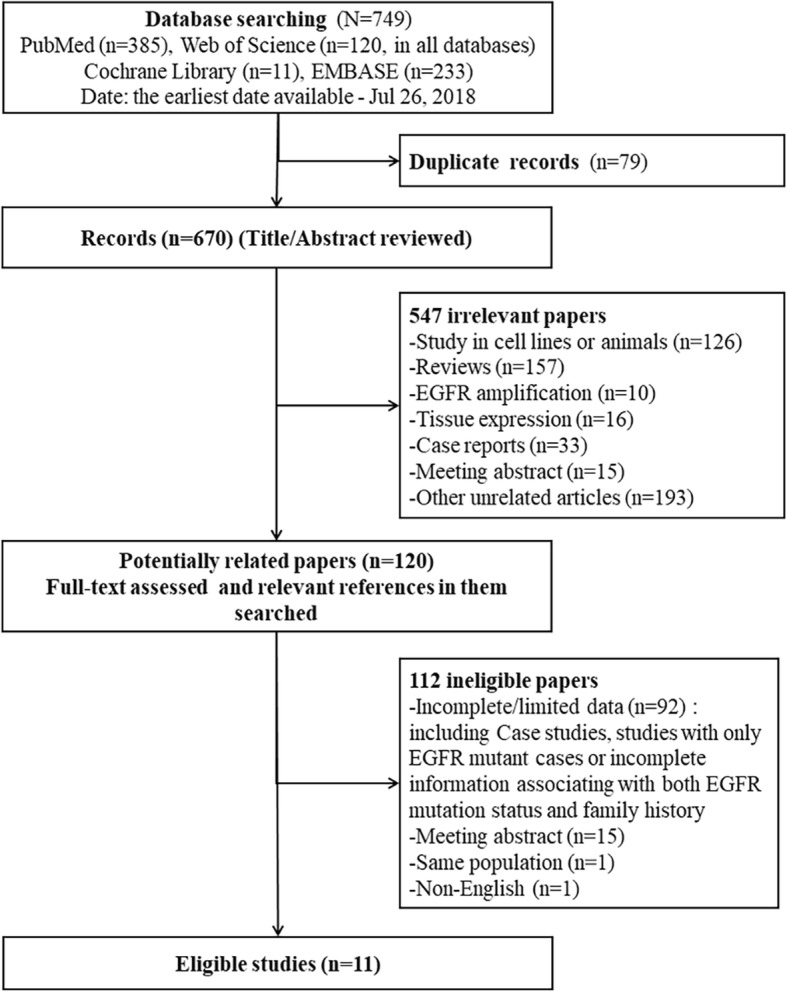
We searched four databases for all original articles on family history of malignancy and EGFR mutation status in lung cancer published up to July 2018. We performed a meta-analysis by using a random-effects model and odds ratio estimates. Heterogeneity and sensitivity were also investigated. Then we conducted a second literature research to curate case reports of familial lung cancers who studied both germline cancer predisposing genes and their somatic EGFR mutation status; and explored the possible links between cancer predisposing genes and EGFR mutation.
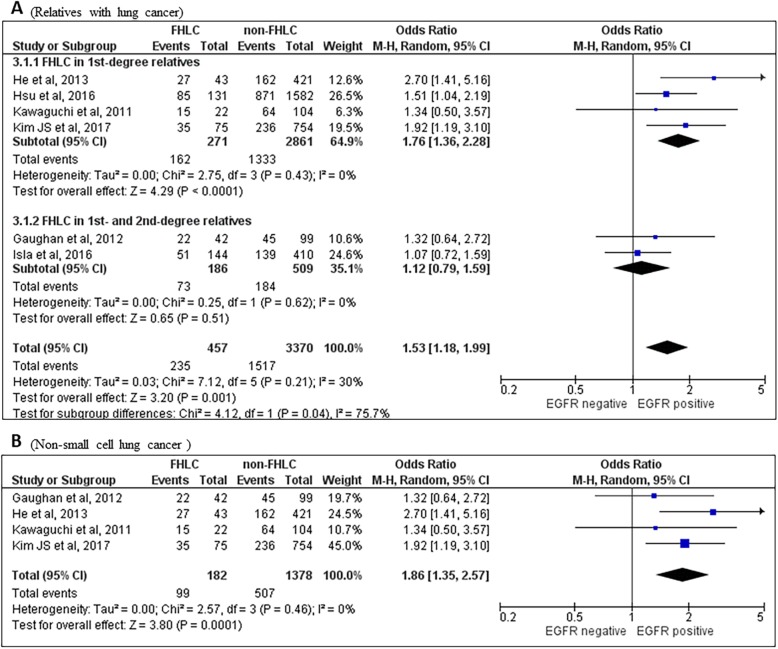
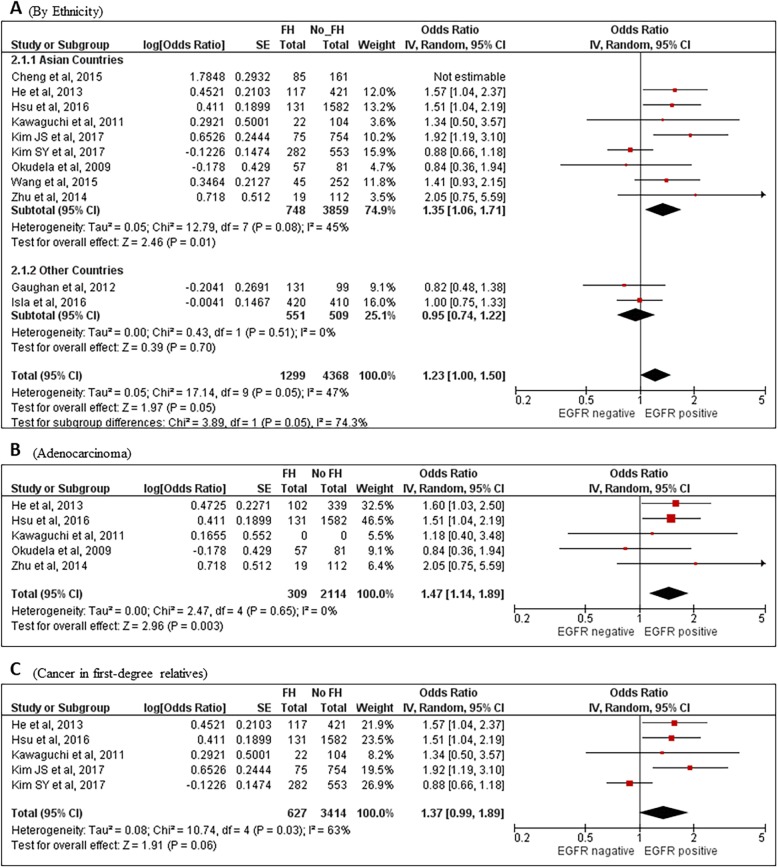
Eleven studies have been included in the meta-analysis. There is a significantly higher likelihood of EGFR mutation in lung cancer patients with family history of cancer than their counterparts without family history, preferentially in Asians (OR = 1.35[1.06-1.71], P = 0.01), those diagnosed with adenocarcinomas ((OR = 1.47[1.14-1.89], P = 0.003) and those with lung cancer-affected relatives (first and second-degree: OR = 1.53[1.18-1.99], P = 0.001; first-degree: OR = 1.76[1.36-2.28, P < 0.0001]). Familial lung cancers more likely have concurrent EGFR mutations along with mutations in their germline cancer predisposition genes including EGFR T790 M, BRCA2 and TP53. Certain mechanisms may contribute to the combination preferences between inherited mutations and somatic ones.
Potential genetic modifiers may contribute to somatic EGFR mutation in lung cancer, although current data is limited. Further studies on this topic are needed, which may help to unveil lung carcinogenesis pathways. However, caution is warranted in data interpretation due to limited cases available for the current study.
越来越多的证据表明肺癌的发病机制中存在遗传风险,尽管吸烟暴露是主要的致病因素。家族史是遗传易感性的简单替代指标。先前的研究表明,家族癌症史与肺癌中的 EGFR 突变之间存在一些可能但相互矛盾的联系。由于 EGFR 突变型肺癌偏爱女性、从不吸烟者、腺癌和亚洲人,因此可以认为,可能存在一些潜在的遗传修饰因子负责 EGFR 突变的发病机制。
我们检索了四个数据库,以获取截至 2018 年 7 月发表的关于恶性肿瘤家族史和肺癌中 EGFR 突变状态的所有原始文章。我们使用随机效应模型和优势比估计值进行了荟萃分析。还进行了异质性和敏感性研究。然后,我们进行了第二次文献研究,以整理研究种系癌症易感基因及其体细胞 EGFR 突变状态的家族性肺癌病例报告;并探讨了癌症易感基因与 EGFR 突变之间的可能联系。
共有 11 项研究纳入荟萃分析。与无家族史的患者相比,有家族癌症史的肺癌患者 EGFR 突变的可能性明显更高,尤其是在亚洲人(OR=1.35[1.06-1.71],P=0.01)、腺癌患者(OR=1.47[1.14-1.89],P=0.003)和有肺癌亲属的患者(一级和二级亲属:OR=1.53[1.18-1.99],P=0.001;一级亲属:OR=1.76[1.36-2.28,P<0.0001])。家族性肺癌更有可能同时存在 EGFR 突变以及其种系癌症易感性基因的突变,包括 EGFR T790M、BRCA2 和 TP53。某些机制可能有助于遗传突变和体细胞突变之间的组合偏好。
潜在的遗传修饰因子可能有助于肺癌中的体细胞 EGFR 突变,尽管目前的数据有限。需要进一步研究这一课题,这可能有助于揭示肺癌发生的途径。但是,由于目前的研究可用病例有限,因此在解释数据时需要谨慎。